Q.Diphenyls are potential threat to the environment. How are these produced from arylhalides?
🔒You're viewing a preview — the full solution, concept, methods & PYQ mapping are locked.
🔒 Start your 14-day free trial to unlock the full solution →Concept understanding — SN1 Reactivity
The Core Intuition: Who Wants to Leave, and Who Can Wait?
Imagine you're at a party where the host (the leaving group) is about to leave. The party (the reaction) happens in two stages. First, the host walks out the door — that's the slow, painful step. Then, a new guest (the nucleophile) rushes in to take the empty spot.
The SN1 reaction works exactly like this: the leaving group leaves first, forming a carbocation intermediate. The nucleophile attacks after the leaving group is gone. This means the rate of the reaction depends only on how easily the leaving group can leave — it does not depend on the nucleophile at all.
So the question becomes: What makes a carbocation form easily? The answer is stability. A carbocation that is more stable will form faster and last longer, making the SN1 reaction faster.
The Precise Statement of SN1 Reactivity Order
SN1 Reactivity Order (for alkyl halides):
Allylic≈Benzyl>3∘>2∘≫1∘≈Methyl
This is the order of how fast the SN1 reaction proceeds. Let's unpack why.
Why This Order? The Stability Ladder
A carbocation is a carbon with only six electrons in its valence shell — it's electron-deficient and positively charged. The more you can spread out (delocalize) that positive charge, the more stable the carbocation becomes.
1. Methyl and 1° Carbocations: The Unstable Ones
A methyl carbocation (CHX3X+) has no alkyl groups attached to the positive carbon. There is zero electron-donating effect to stabilize the charge. It is so unstable that it practically never forms in an SN1 reaction — the reaction simply doesn't happen.
A primary (1°) carbocation has one alkyl group attached. Alkyl groups are weakly electron-donating (through hyperconjugation and inductive effect), so it's slightly more stable than methyl — but still far too unstable to form under normal SN1 conditions.
Never say "SN1 happens on a primary carbon" in an exam. It is essentially impossible under standard conditions because the carbocation is too unstable.
2. Secondary (2°) Carbocations: The Borderline Case
A secondary carbocation has two alkyl groups donating electron density. It is moderately stable — stable enough to form, but only under certain conditions (like a good leaving group and a polar protic solvent). SN1 reactions on secondary carbons are possible, but they are slower than on tertiary carbons.
3. Tertiary (3°) Carbocations: The Sweet Spot
Three alkyl groups donate electron density to the positive carbon. This makes the carbocation very stable. Tertiary alkyl halides undergo SN1 reactions readily — they are the classic example.
4. Allylic and Benzylic: The Champions
These are special cases. In an allylic carbocation, the positive charge is adjacent to a carbon-carbon double bond. The π electrons of the double bond can delocalize the positive charge onto the second carbon:
CHX2=CH−CHX2X+↔+CHX2−CH=CHX2
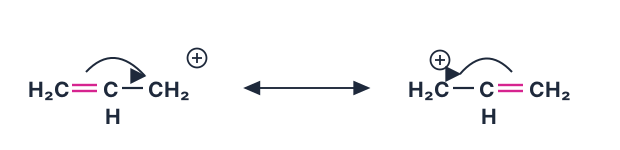
In a benzylic carbocation, the positive charge is adjacent to a benzene ring. The π system of the ring delocalizes the charge across multiple carbons:
CX6HX5−CHX2X+↔(several resonance structures)
Here are those resonance structures — the positive charge cycles from the CH₂ carbon onto the ortho and para positions of the ring:
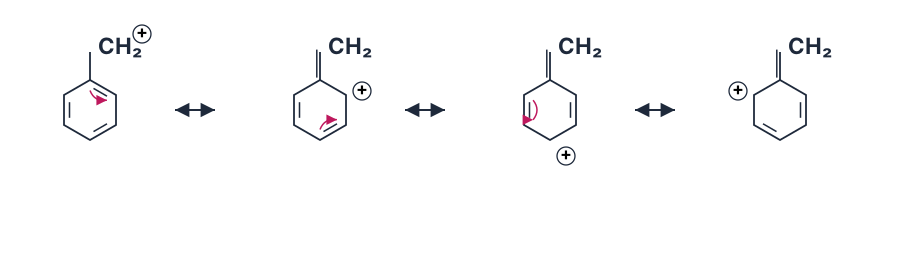
This resonance stabilization makes allylic and benzylic carbocations even more stable than tertiary ones. They form the fastest in SN1 reactions.
The Complete Picture in a Table
| Carbocation Type | Stability | SN1 Reactivity | Example |
|---|---|---|---|
| Methyl | Extremely unstable | Does not occur | CHX3Br |
Why this formula?
SN1 Reactivity: Why the Rate Law and Mechanism Hold
The Core Idea: A Two-Step, Carbocation-Mediated Process
SN1 stands for Substitution, Nucleophilic, Unimolecular. The "unimolecular" part is the key — the rate-determining step involves only one molecule (the substrate). This is fundamentally different from SN2, where both substrate and nucleophile collide.
The reaction proceeds in two distinct steps:
- Slow step: The leaving group departs, forming a carbocation intermediate.
- Fast step: The nucleophile attacks the carbocation.
Why the Rate Law is First-Order
Step 1: The Rate-Determining Step
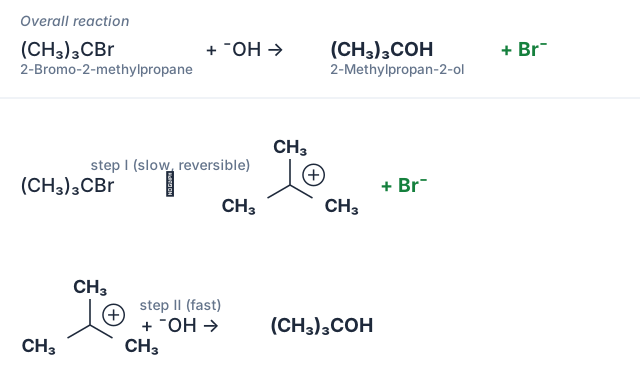
The slow step is the heterolytic cleavage of the C–LG bond:
R–LGslowR++LG−
Since this step involves only one molecule of substrate, the rate depends only on its concentration:
Rate=k1[R–LG]
Step 2: The Fast Step
The nucleophile then attacks the carbocation:
R++Nu−fastR–Nu
Because this step is fast, it does not affect the overall rate. The nucleophile concentration does not appear in the rate law.
The Resulting Rate Law
Rate=k[R–LG]
This is first-order in substrate and zero-order in nucleophile — a hallmark of SN1.
The classic example — hydrolysis of 2-bromo-2-methylpropane — shows both steps:
Why the Carbocation Stability Dictates Reactivity
The slow step involves breaking a bond without any help from the nucleophile. This creates a high-energy carbocation intermediate. The activation energy for this step depends entirely on how stable that carbocation is.
Carbocation Stability Order
Methyl<Primary<Secondary<Tertiary<Allylic/Benzylic
Why this order? Three factors stabilize carbocations:
- Hyperconjugation: Adjacent C–H or C–C bonds donate electron density into the empty p-orbital.
- Inductive effect: Alkyl groups are electron-donating, spreading the positive charge.
- Resonance: Allylic and benzylic carbocations delocalize the charge across multiple atoms.
For the benzylic case, that delocalisation looks like this:
The Reactivity Consequence
- Tertiary substrates form relatively stable carbocations → fast SN1.
- Primary substrates form highly unstable carbocations → SN1 is essentially impossible (the activation energy is too high).
- Methyl substrates never undergo SN1 — the carbocation is too unstable.
Why the Leaving Group Must Be Good
The slow step requires the leaving group to depart with its bonding electrons. A good leaving group:
- Is weakly basic (stable as an anion)
- Can stabilize negative charge (large, polarizable, or resonance-stabilized)
Examples: I−, Br−, Cl−, OTs−, H2O
Poor leaving groups: OH−, OR−, NH2− — these are strong bases and will not leave easily.
Why the Solvent Matters (Polar Protic Solvents)
SN1 reactions are faster in polar protic solvents (e.g., water, methanol, ethanol). Why? …
The key idea is the Fittig reaction — the aryl-aryl analogue of the Wurtz reaction, using sodium metal in dry ether.
Reasoning:
- Two molecules of an aryl halide (e.g. bromobenzene) are treated with sodium metal in dry ether.
- The two aryl groups couple directly through a new carbon-carbon bond between their ring carbons, releasing sodium halide.
- This gives a symmetrical diphenyl (biphenyl) -- the same coupling idea as the Wurtz reaction between two alkyl halides, applied here to aryl halides. …
Diphenyls are produced from aryl halides via the Fittig reaction — the aryl-aryl analogue of the Wurtz-Fittig reaction this chapter already covers: two molecules of an aryl halide couple in the presence of sodium metal and dry ether to form a biaryl (diphenyl), with sodium halide as the byproduct.
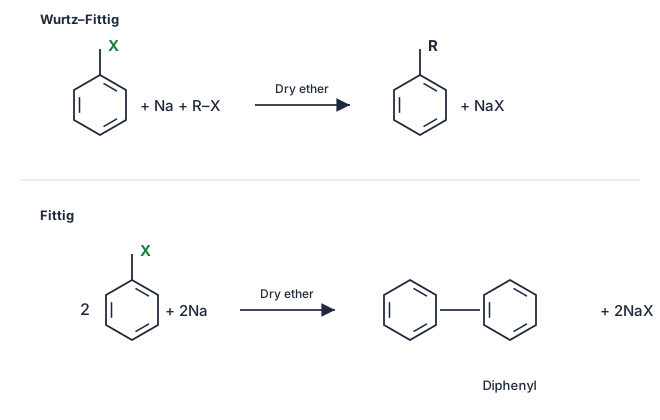
The reaction
2C6H5−X+2Nadry etherC6H5−C6H5+2NaX
This is the Fittig reaction: two molecules of the SAME aryl halide couple directly through a new carbon–carbon bond between their ring carbons, giving a symmetrical diphenyl (biphenyl), exactly the same coupling idea as the Wurtz reaction between two alkyl halides, just applied to aryl halides instead. (When one aryl halide and one alkyl halide are used together instead of two aryl halides, the same sodium/dry-ether coupling is called the Wurtz-Fittig reaction, giving an alkylbenzene rather than a diphenyl — the diagram above shows both side by side.)
Why this matters environmentally …
Concept: The Fittig Reaction (Aryl-Aryl Coupling)
Diphenyls (biaryls) are produced from aryl halides via the Fittig reaction — the aryl-only analogue of the Wurtz reaction, using sodium metal in dry ether. (When one aryl halide and one alkyl halide are coupled together instead, the same sodium/dry-ether reaction is called the Wurtz-Fittig reaction, giving an alkylbenzene rather than a diphenyl -- a different named reaction for a different combination of reactants.)
Method: Fittig Coupling
What it does:
Couples two molecules of the SAME aryl halide to form a symmetrical biaryl (diphenyl).
Reagents & conditions:
- Aryl halide (e.g. bromobenzene, chlorobenzene)
- Sodium metal, finely divided
- Dry ether as solvent
Overall reaction:
2C6H5−X+2Nadry etherC6H5−C6H5+2NaX
Step-by-step reasoning:
- Identify the reactants -- two molecules of the same aryl halide, no alkyl halide involved (that combination would instead be the Wurtz-Fittig reaction).
- Sodium metal in dry ether couples the two aryl groups directly, releasing sodium halide as the byproduct -- the same overall idea as the Wurtz reaction on alkyl halides, just applied to aryl halides.
- The product is a symmetrical diphenyl (biphenyl), since both starting aryl halides are identical.
Key exam points:
- Only symmetrical biaryls are formed this way (same aryl group on both sides). …
Common Mistakes: Production of Diphenyls from Aryl Halides
This question tests your understanding of the Fittig reaction — the aryl-aryl analogue of the Wurtz reaction. Here are the most frequent errors students make, and how to avoid each.
Mistake 1: Reaching for the Ullmann Reaction (Cu, high temperature) Instead
The error: Students write copper metal and a very high temperature (~200-250°C) as the reagent/conditions.
Why it's wrong: The Ullmann reaction is a real aryl-aryl coupling method in organic chemistry generally, but it is not the reaction this chapter's syllabus covers for this transformation. The syllabus's own named reaction for coupling two aryl halides is the Fittig reaction.
How to avoid: Remember the Fittig reaction specifically requires:
- Sodium metal (Na) as the coupling agent
- Dry ether as solvent
Correct reaction:
2Ar−X+2Nadry etherAr−Ar+2NaX
Mistake 2: Confusing Fittig with Wurtz-Fittig
The error: Students use the name "Wurtz-Fittig reaction" for this coupling.
Why it's wrong: Wurtz-Fittig specifically names the MIXED coupling of ONE aryl halide with ONE alkyl halide (giving an alkylbenzene). Coupling TWO aryl halides together, as this question asks, is the Fittig reaction -- a distinct, aryl-only named reaction.
How to avoid: Check what's being coupled:
- Aryl halide + aryl halide → Fittig reaction → diphenyl (biaryl)
- Aryl halide + alkyl halide → Wurtz-Fittig reaction → alkylbenzene
- Alkyl halide + alkyl halide → Wurtz reaction → alkane
Mistake 3: Writing the Wrong Product Name (Biphenyl vs. Diphenyl)
The error: Students worry that "diphenyl" and "biphenyl" name different things.
The reality: In common usage (including this chapter), diphenyl and biphenyl both refer to the same compound: two phenyl rings directly joined by a single C-C bond (C6H5−C6H5).
How to avoid: Draw the structure clearly -- two benzene rings connected by one single bond between ring carbons -- and use either name confidently.
Mistake 4: Assuming Any Aryl Halide Works Equally Well
The error: Students assume aryl chlorides, bromides, and iodides are all equally reactive.
Why it's wrong: As with the Wurtz reaction on alkyl halides, more reactive (weaker C-X bond) halides couple more readily.
How to avoid: If the question mentions "aryl halides" generically, bromides and iodides are the more typical choices for a clean reaction.
Mistake 5: Missing the Environmental Context …
- AP EAPCET 2025Set eng-2025-05-23-AN1 markMCQQ.The correct statement regarding X and Y formed in the following reaction is (CH3)3C−O−C2H5HIΔhalide(X)+alcohol(Y) (A) X undergoes substitution by SN2 mechanism (B) X undergoes substitution with water in two steps (C) Y gets converted to corresponding chloride with conc. HCl at room temperature (D) Reaction of Y with Cu/573K gives ketone
›Reveal solutionSolution
Acidic ether cleavage breaks the bond to the more stable carbocation: X=(CH3)3CI (tertiary, reacts SN1), Y=C2H5OH (primary). Answer: (B).
Concept and Intuition
When an unsymmetrical (mixed) ether is treated with excess HI (or HBr) and heat, the oxygen is first protonated, then the C–O bond that breaks is the one that generates the more stable carbocation (if the alkyl group can support one) — this is why a tert-alkyl aryl/alkyl ether cleaves at the tertiary carbon. Here (CH3)3C−O−C2H5 breaks at the tert-butyl–oxygen bond (giving the comparatively stable tertiary carbocation, trapped by iodide as (CH3)3CI), releasing the ethyl group attached to oxygen as ethanol. This makes X a tertiary alkyl halide (which reacts by SN1, a genuinely two-step mechanism: rate-determining ionisation to a carbocation, then fast capture by the nucleophile) and Y a simple primary alcohol (whose reactivity is governed by ordinary primary-alcohol chemistry).
Step-by-Step Solution
- Protonate ether oxygen; the C–O bond to the tertiary carbon breaks heterolytically (more stable cation) ⇒ tert-butyl cation + ethanol.
- Tert-butyl cation is captured by I− ⇒ X=(CH3)3C−I.
- The oxygen leaves attached to the ethyl group, protonated then deprotonated ⇒ Y=C2H5OH.
- Evaluate each statement:
- (A) X is tertiary, so it reacts by SN1, not SN2 — false.
- (B) X's substitution with water (hydrolysis) proceeds via the classic SN1 two-step route (ionisation, then attack by water) — true. …
- AP EAPCET 2022Set eng-2022-07-07-AN1 markMCQQ.The rate of reaction of t-butyl bromide and NaOH in water depends on the concentration of (A) Both t- butyl bromide & NaOH (B) NaOH (C) Independent of concentration (D) t-butyl bromide
›Reveal solutionSolution
Tertiary halides react by SN1; the slow step is ionization of the substrate alone, so rate =k[t-BuBr], independent of nucleophile concentration.
Concept and Intuition
Primary substrates typically undergo SN2 (bimolecular, rate depends on both substrate and nucleophile), while tertiary substrates (like t-butyl bromide) are too sterically hindered for backside attack and instead ionize first to form a stable tertiary carbocation (SN1). Because ionization (not the nucleophile's attack) is rate-determining, the rate law only involves the substrate.
Step-by-Step Solution
- Recognize t-butyl bromide as a tertiary alkyl halide: (CH3)3C−Br.
- Tertiary carbocations are stabilized by hyperconjugation/+I effect of three methyl groups, making ionization (SN1) favourable and fast enough to be viable as the mechanism, especially in a weakly nucleophilic, highly polar/protic solvent like water. …
- AP EAPCET 2021Set eng-2021-08-23-FN1 markMCQQ.Lucas test is used for the determination of ________ (A) Aldehydes (B) Phenols (C) Carboxylic acid (D) Alcohols
›Reveal solutionSolution
The Lucas reagent (HCl + ZnCl2) tests and classifies alcohols by how quickly they turn
cloudy (form the insoluble chloroalkane).
Concept and Intuition
The Lucas test exploits the SN1 vs SN2 reactivity difference among alcohols: a tertiary
carbocation forms readily, so tertiary alcohols react with Lucas reagent immediately
(instant turbidity); secondary alcohols form a less stable carbocation and react in a few
minutes; primary alcohols barely form a carbocation at all under these conditions and need
heating to react.
Step-by-Step Solution
- Lucas reagent = conc. HCl + anhydrous ZnCl2 (a Lewis acid catalyst that activates the −OH as a leaving group by coordinating to the oxygen).
- The alcohol undergoes substitution: R−OH+HClZnCl2R−Cl+H2O. The alkyl chloride product is insoluble in the aqueous reagent, so it appears as turbidity/an oily layer.
- Reaction rate (and hence how fast turbidity appears) follows carbocation stability: tertiary > secondary > primary, letting the test distinguish the three classes of alcohol. …
🎓Unlock everything free for 14 days
- ✓Full step-by-step solutions
- ✓Concept-first explanations
- ✓Methods, shortcuts & mistakes
- ✓PYQ mapping + timed mock tests
Full access for 14 days. No credit card required.