Q.Ethylidene chloride is a/an ______________.
🔒You're viewing a preview — the full solution, concept, methods & PYQ mapping are locked.
🔒 Start your 14-day free trial to unlock the full solution →Concept understanding — Carboxylic Acid Halogenation
Carboxylic Acid Halogenation: The Hell–Volhard–Zelinsky Reaction
Imagine you have a carboxylic acid — say, propanoic acid (CH3CH2COOH). You want to replace one of the hydrogen atoms on the carbon chain with a halogen (like bromine or chlorine). But here's the catch: the carboxylic acid group (−COOH) is already quite reactive. If you just add bromine directly, nothing useful happens — the α-carbon (the carbon right next to the −COOH group) is not reactive enough to attack bromine on its own.
The trick is to activate the α-carbon first. This is exactly what the Hell–Volhard–Zelinsky (HVZ) reaction does.
The Intuition
The −COOH group is electron-withdrawing. That makes the α-carbon slightly positive (electrophilic), but not enough to react with a halogen directly. To make it work, we convert the acid into an acyl halide (like RCOBr) using PBr3 or PCl3. The acyl halide is even more electron-withdrawing, which makes the α-hydrogen more acidic — it can be removed by a base (like a catalytic amount of PBr3 or Br2 itself) to form an enol or enolate intermediate. This enol then attacks a halogen molecule, giving an α-haloacyl halide. Finally, water hydrolyses it back to the α-halo carboxylic acid.
In short: activate → enolize → halogenate → hydrolyse.
The Precise Statement
RCH2COOH2. H2O1. Br2, PBr3RCHBrCOOH
The reaction is regioselective: halogenation occurs exclusively at the α-carbon (the carbon adjacent to the −COOH group). No other position on the chain is halogenated.
Step-by-Step Mechanism
- Formation of acyl bromide The carboxylic acid reacts with PBr3 (or PCl3) to form an acyl bromide:
RCH2COOH+PBr3→RCH2COBr+H3PO3
- Enolization A catalytic amount of PBr3 or Br2 acts as a Lewis acid, making the α-hydrogen more acidic. A base (often Br− from the reaction) abstracts this hydrogen, forming an enol:
RCH2COBr⇌RCH=C(OH)Br
- Halogenation The enol attacks a Br2 molecule, giving the α-bromoacyl bromide:
RCH=C(OH)Br+Br2→RCHBrCOBr+HBr
- Hydrolysis Water hydrolyses the acyl bromide back to the carboxylic acid:
RCHBrCOBr+H2O→RCHBrCOOH+HBr
The PBr3 is catalytic — it is regenerated in the hydrolysis step. Only a small amount is needed.
Why This Matters
The α-halo carboxylic acid is a versatile intermediate. You can:
- Substitute the halogen with OH to get α-hydroxy acids (like lactic acid).
- Substitute with NH3 to get α-amino acids (the building blocks of proteins). …
Why this formula?
Carboxylic Acid Halogenation — The Hell-Volhard-Zelinsky (HVZ) Reaction
Let's start with the core reaction and then unpack why it works the way it does.
The Reaction in a Nutshell
Carboxylic acids undergo α-halogenation (replacement of an α-hydrogen with a halogen) only under specific conditions:
R−CHX2−COOH+BrX2PBrX3 (cat⋅)R−CHBr−COOH+HBr
The key reagents: Br₂ (or Cl₂) + a catalytic amount of PBr₃ (or PCl₃). The product is an α-halo carboxylic acid.
Why Does This Happen? The Step-by-Step Reasoning
1. The Problem: Carboxylic Acids Are Not Enolizable Directly
- A carboxylic acid has a carbonyl group (C=O), but the α-hydrogen is not acidic enough to be removed by a base like OHX−.
- Why? The conjugate base (carboxylate ion, RCOOX−) is more stable than an enolate. So enolate formation is disfavoured.
Key insight: We need to activate the carbonyl first.
2. The Solution: Convert to an Acyl Halide (More Electrophilic)
- PBr₃ reacts with the carboxylic acid to form an acyl bromide:
3R−COOH+PBrX33R−COBr+HX3POX3
- The acyl bromide has a better leaving group (Br⁻ vs OH⁻) and a more electrophilic carbonyl carbon. This makes enolization easier.
3. Enolization of the Acyl Halide
- A small amount of HBr (from the reaction) or Br₂ itself can act as a Lewis acid to polarize the carbonyl.
- The α-hydrogen is now removable by a weak base (like Br⁻ or the enol itself), forming an enol:
R−CHX2−COBrR−CH=C(OH)Br
- This enol is nucleophilic at the α-carbon.
4. Halogenation of the Enol
- The enol attacks Br₂ (or Cl₂) at the α-position:
R−CH=C(OH)Br+BrX2R−CHBr−C(OH)BrX2R−CHBr−COBr+HBr
- The product is an α-bromo acyl bromide.
5. Regeneration of the Acid
- The α-bromo acyl bromide reacts with water (or with another molecule of carboxylic acid) to give the α-bromo carboxylic acid:
R−CHBr−COBr+HX2OR−CHBr−COOH+HBr
- The HBr produced can re-enter the cycle, making the process catalytic in PBr₃.
The Key Formula(e) — Why They Hold
Overall Stoichiometry
R−CHX2−COOH+BrX2PBrX3 (cat⋅)R−CHBr−COOH+HBr
Why this holds:
- One Br₂ molecule provides one Br atom for substitution and one for HBr.
- The catalyst (PBr₃) is not consumed — it is regenerated in the cycle. …
The key idea is classifying dihalides based on the position of the two halogen atoms. Ethylidene chloride has the formula CH3CHCl2.
Step 1: Write the structure. Ethylidene chloride is CH3−CHCl2. Both chlorine atoms are attached to the same carbon atom.
Step 2: Recall the definitions:
- gem-dihalide: both halogens on the same carbon.
- vic-dihalide: halogens on adjacent carbons. …
Ethylidene chloride is the common name for 1,1-dichloroethane, where both chlorine atoms are attached to the same carbon — making it a gem-dihalide. The correct option is (ii).
The first thing to understand is what the name "ethylidene chloride" actually tells you. In older nomenclature, "ethylidene" is the divalent group CH3CH< — ethane with two hydrogens removed from the same terminal carbon (contrast "ethyl", CH3CH2−, formed by removing just one). Both free valencies sit on that single carbon, so "ethylidene chloride" means both are occupied by chlorine atoms — two single C–Cl bonds on the same carbon.
So the structure is CH3CHCl2. That's 1,1-dichloroethane.
Now, the classification of dihalides depends on where the two halogen atoms are located:
- gem-Dihalides (geminal): both halogens on the same carbon atom. Example: CH3CHCl2.
- vic-Dihalides (vicinal): halogens on adjacent carbon atoms. Example: CH2ClCH2Cl (1,2-dichloroethane).
- Allylic halides: halogen attached to a carbon adjacent to a carbon-carbon double bond (allylic position). Example: CH2=CHCH2Cl.
- Vinylic halides: halogen attached directly to a carbon of a carbon-carbon double bond. Example: CH2=CHCl. …
Concept: Classification of Dihalides Based on Halogen Position
The classification depends on which carbon atoms the two halogen atoms are attached to.
Method: Position-of-Halogens Rule
Steps:
-
Draw the structure of ethylidene chloride.
Ethylidene chloride is CH3CHCl2 (common name).
IUPAC name: 1,1-dichloroethane.
-
Identify the carbon atoms bearing the halogen atoms.
- Both chlorine atoms are attached to the same carbon (the CH carbon).
-
Apply the definition:
- gem-dihalide (geminal): both halogens on the same carbon atom.
- vic-dihalide (vicinal): halogens on adjacent carbons. …
Here’s a breakdown of the common mistakes students make on this question, along with how to avoid each.
1. Confusing “Ethylidene” with “Ethylene”
- The Mistake: Students see “ethyl” and immediately think of a two-carbon chain with a double bond (like ethene). This leads them to incorrectly classify the compound as a vinylic halide (option (iv)).
- Why It’s Wrong: “Ethylidene” is the divalent group CH3CH< — a carbon carrying two free valencies (two H removed from the same carbon of ethane). In ethylidene chloride those two valencies hold two chlorine atoms through two single C–Cl bonds. The compound is CH3CHCl2, which has no double bond of any kind — neither C=C nor C=Cl.
- How to Avoid: Memorise the naming pattern:
- -yl = alkyl group (single bond).
- -ylidene = two hydrogens removed from the same carbon, leaving a divalent group (CH3CH<); its two valencies can form one double bond to a single atom or, as here, two single bonds to two separate atoms.
- -yne or -ene = carbon-carbon multiple bonds. Always draw the structure before classifying.
2. Mixing Up gem-dihalides and vic-dihalides
- The Mistake: Students think any dihalide on adjacent carbons is vic, and any on the same carbon is gem. But they forget to check the carbon skeleton.
- Why It’s Wrong: In ethylidene chloride (CH3CHCl2), both chlorine atoms are attached to the same carbon. That makes it a gem-dihalide (option (ii)), not a vic-dihalide (which requires Cl on two adjacent carbons, e.g., ClCH2CH2Cl).
- How to Avoid: Use the mnemonic:
- Gemini (twins) → same carbon.
- Vicinity (neighbours) → adjacent carbons. Draw the structure and number the carbons. If both halogens are on carbon #1, it’s gem.
3. Assuming “Chloride” Means a Single Chlorine Atom
- The Mistake: Students see “chloride” and think only one Cl is present, leading them to classify it as an allylic halide (option (iii)) or vinylic halide.
- Why It’s Wrong: There is no “di” anywhere in the common name — the two chlorines follow from the fact that ethylidene is a divalent group. “Ethylidene” (CH3CH<) carries two free valencies on the same carbon (exactly as Mistake 1 explains), and “chloride” tells you what occupies them — so there must be two Cl atoms, both on that carbon. The IUPAC name, 1,1-dichloroethane, makes the count explicit.
- How to Avoid: Always expand the name systematically:
- Ethylidene = CH3CH< (a divalent group — two free valencies on one carbon)
- Chloride = Cl occupying those two valencies → two Cl atoms. Write the molecular formula: C2H4Cl2. Then draw the structure — both Cl on the same carbon: CH3CHCl2.
4. Forgetting the Definition of Allylic and Vinylic Positions …
- AP EAPCET 2023Set eng-2023-05-19-FN1 markMCQQ.The 'X' in the following conversion is H3CCH2COOHXCH3CHBrCOOH (A)(i) Br2/P red,(ii) H2O (B)(i) Br2/CCl4,(ii) H2O (C) Br2 / OH− (D) PBr3
›Reveal solutionSolution
This tests recognition of the Hell–Volhard–Zelinsky reaction, which converts a carboxylic acid with α-hydrogens into its α-bromo (or α-chloro) derivative using Br2/red phosphorus followed by hydrolysis.
Concept and Intuition
Carboxylic acids do not directly react with Br2 at their α-carbon the way ketones/aldehydes do via their enol, because carboxylic acids exist overwhelmingly in the keto (acid) form and enolize very poorly. The Hell–Volhard–Zelinsky (HVZ) reaction solves this: red phosphorus reacts with Br2 to generate a small amount of PBr3, which converts the carboxylic acid into its far more easily enolizable acid bromide (RCOBr). This acid bromide's enol form reacts readily with Br2 to substitute a hydrogen at the α-carbon, giving the α-bromo acid bromide. Finally, this reactive intermediate is hydrolysed with water to yield the stable α-bromo carboxylic acid.
Step-by-Step Solution
- Identify the required transformation: CH3CH2COOH (propanoic acid) → CH3CHBrCOOH (2-bromopropanoic acid) — bromine is introduced specifically at the α-carbon (the carbon next to −COOH).
- Recognize this pattern as α-halogenation of a carboxylic acid, which is precisely what the HVZ reaction accomplishes.
- The HVZ reagents are (i) Br2 with catalytic red phosphorus, which in situ forms PBr3 and converts the acid to the acid bromide, enabling α-bromination via the enol form; then (ii) hydrolysis with H2O converts the resulting α-bromo acid bromide back to the free α-bromo carboxylic acid.
- This matches option (A) exactly: (i) Br2/P red, (ii) H2O. …
- AP EAPCET 2023Set eng-2023-05-19-FN1 markMCQQ.The preferred reagent for the following conversion is CH3CH2COOH→CH3CH2COCl (A) HCl (B) HOCl (C) SOCl2 (D) NaOCl
›Reveal solutionSolution
This tests the preferred laboratory reagent for converting a carboxylic acid to its acyl chloride; thionyl chloride (SOCl2) is preferred because its by-products are gases that leave the product clean.
Concept and Intuition
Several reagents can convert a carboxylic acid −COOH into an acyl chloride −COCl (e.g. PCl3, PCl5, SOCl2), but thionyl chloride is generally the preferred choice in practice. The reaction is:
RCOOH+SOCl2→RCOCl+SO2↑+HCl↑
Both by-products, sulphur dioxide and hydrogen chloride, are gases that simply escape the reaction mixture, so the desired acyl chloride is obtained in a purer form without needing extensive work-up to remove solid phosphorus-containing by-products (as would be needed with PCl3/PCl5, which leave behind phosphorous acid or phosphorus oxychloride residues).
Step-by-Step Solution
- Identify the required transformation: CH3CH2COOH (propanoic acid) → CH3CH2COCl (propanoyl chloride), i.e., replacing −OH with −Cl at the carbonyl carbon.
- Recognize this as acyl chloride formation from a carboxylic acid.
- Among the given options, only SOCl2 (option C) is a reagent used for this transformation; HCl, HOCl, and NaOCl (options A, B, D) are not reagents that convert carboxylic acids to acid chlorides. …
- AP EAPCET 2022Set eng-2022-07-05-AN1 markMCQQ.Identify the major product from the following reaction sequence (2-cyclohexylethanol, a cyclohexane ring bearing a CH2CH2OH group) (i) CrO3, H2SO4 (ii) Cl2/Red P (ii) H2O ? (A) C6H11CH2COOH (a cyclohexane ring bearing a CH2COOH group, no chlorine) (B) C6H5CH2COOH (a benzene ring bearing a CH2COOH group) (C) a cyclohexane ring bearing a Cl substituent at the 4-position and a CH2COOH group at the 1-position (D) a cyclohexane ring bearing a CHClCOOH group (chlorine on the carbon alpha to the COOH), i.e. C6H11CHClCOOH
›Reveal solutionSolution
Oxidation of the primary alcohol to a carboxylic acid, followed by Hell-Volhard-Zelinsky alpha-chlorination, gives an alpha-chloro carboxylic acid as the final product.
Concept and Intuition
This sequence chains together two classic named reactions: (1) CrO3/H2SO4 (Jones-type oxidation) fully oxidizes a primary alcohol through the aldehyde stage to a carboxylic acid; (2) the Hell-Volhard-Zelinsky (HVZ) reaction uses Cl2 (or Br2) with red phosphorus to selectively halogenate a carboxylic acid specifically at its alpha carbon (via an enol-like acyl halide intermediate), which is a hallmark reaction for functionalizing the position next to −COOH.
Step-by-Step Solution
- Start: 2-cyclohexylethanol, C6H11−CH2−CH2−OH (a cyclohexane ring bearing a −CH2CH2OH side chain).
- Step (i), CrO3/H2SO4: oxidizes the terminal −CH2OH all the way to −COOH (strong oxidant, primary alcohol → carboxylic acid), giving cyclohexylacetic acid, C6H11−CH2−COOH.
- Step (ii), Cl2/red P (HVZ reaction): red phosphorus first converts a small amount of the acid to the acyl chloride, which enolizes and is chlorinated specifically at the alpha carbon (the carbon adjacent to the carbonyl), giving C6H11−CHCl−COOH (after the acyl chloride hydrolyzes back to the acid). …
- AP EAPCET 2021Set eng-2021-08-19-FN1 markMCQQ.In the following reaction sequence, identify product 'Q' and reagent 'R': [FIGURE] (Me-CH2-C≡C-CH2-Br is treated with(i) Mg/Ether(ii) CO2(iii) H3O+ to give product Q; Q is then treated with reagent R to give Me-C≡C-CH2-C(=O)Cl) (A) [FIGURE] (Me-CH2-C≡C-CH2-COOH) and SOCl2 (B) [FIGURE] (Me-CH=CH-CH2-CH2-COOH, trans double bond) and SO2Cl2 (C) [FIGURE] (Me-CH=CH-CH2-COOH, cis double bond) and SOCl2 (D) [FIGURE] (Me-CH2-C≡C-CH2-COOH) and CH3SO2Cl2
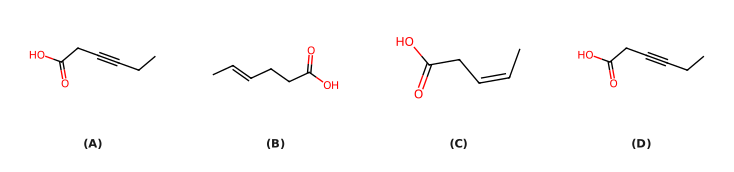
›Reveal solutionSolution
Grignard formation + CO2 + H3O+ is a standard carboxylation that never touches the triple
bond; converting the resulting acid to an acid chloride is the textbook job of SOCl2.
Concept and Intuition
Forming a Grignard reagent from an alkyl (here propargylic) halide is a simple oxidative-insertion
of Mg into the C–Br bond — it does not isomerise or rearrange the carbon skeleton or move the
triple bond under these conditions (no acid/base or transition-metal catalyst is present to trigger
an allenic/propargylic shift). Bubbling CO2 through a Grignard reagent, then quenching with
aqueous acid, is the standard way to extend a carbon chain by one carbon and install a −COOH
group at the position that held the −MgBr.
Once a carboxylic acid needs to become an acid chloride, the reagent of choice (retaining the
carbon skeleton, releasing only gaseous by-products SO2 and HCl so the product is easy to
purify) is thionyl chloride, SOCl2.
Step-by-Step Solution
- Me−CH2−C≡C−CH2−BrMg/EtherMe−CH2−C≡C−CH2−MgBr — simple insertion, skeleton and triple-bond position unchanged.
- (ii) CO2 the Grignard carbon attacks CO2 to give a magnesium carboxylate: Me−CH2−C≡C−CH2−COOMgBr.
- (iii) H3O+ protonation gives the free acid, Q =Me−CH2−C≡C−CH2−COOH (a hex-3-ynoic acid).
- Converting Q's −COOH to −COCl with retention of the carbon skeleton requires R=SOCl2: R−COOH+SOCl2→R−COCl+SO2↑+HCl↑. …
🎓Unlock everything free for 14 days
- ✓Full step-by-step solutions
- ✓Concept-first explanations
- ✓Methods, shortcuts & mistakes
- ✓PYQ mapping + timed mock tests
Full access for 14 days. No credit card required.