Q.Chlorobenzene is formed by reaction of chlorine with benzene in the presence of AlCl3. Which of the following species attacks the benzene ring in this reaction?
🔒You're viewing a preview — the full solution, concept, methods & PYQ mapping are locked.
🔒 Start your 14-day free trial to unlock the full solution →Concept understanding — Carboxylic Acid Halogenation
Carboxylic Acid Halogenation: The Hell–Volhard–Zelinsky Reaction
Imagine you have a carboxylic acid — say, propanoic acid (CH3CH2COOH). You want to replace one of the hydrogen atoms on the carbon chain with a halogen (like bromine or chlorine). But here's the catch: the carboxylic acid group (−COOH) is already quite reactive. If you just add bromine directly, nothing useful happens — the α-carbon (the carbon right next to the −COOH group) is not reactive enough to attack bromine on its own.
The trick is to activate the α-carbon first. This is exactly what the Hell–Volhard–Zelinsky (HVZ) reaction does.
The Intuition
The −COOH group is electron-withdrawing. That makes the α-carbon slightly positive (electrophilic), but not enough to react with a halogen directly. To make it work, we convert the acid into an acyl halide (like RCOBr) using PBr3 or PCl3. The acyl halide is even more electron-withdrawing, which makes the α-hydrogen more acidic — it can be removed by a base (like a catalytic amount of PBr3 or Br2 itself) to form an enol or enolate intermediate. This enol then attacks a halogen molecule, giving an α-haloacyl halide. Finally, water hydrolyses it back to the α-halo carboxylic acid.
In short: activate → enolize → halogenate → hydrolyse.
The Precise Statement
RCH2COOH2. H2O1. Br2, PBr3RCHBrCOOH
The reaction is regioselective: halogenation occurs exclusively at the α-carbon (the carbon adjacent to the −COOH group). No other position on the chain is halogenated.
Step-by-Step Mechanism
- Formation of acyl bromide The carboxylic acid reacts with PBr3 (or PCl3) to form an acyl bromide:
RCH2COOH+PBr3→RCH2COBr+H3PO3
- Enolization A catalytic amount of PBr3 or Br2 acts as a Lewis acid, making the α-hydrogen more acidic. A base (often Br− from the reaction) abstracts this hydrogen, forming an enol:
RCH2COBr⇌RCH=C(OH)Br
- Halogenation The enol attacks a Br2 molecule, giving the α-bromoacyl bromide:
RCH=C(OH)Br+Br2→RCHBrCOBr+HBr
- Hydrolysis Water hydrolyses the acyl bromide back to the carboxylic acid:
RCHBrCOBr+H2O→RCHBrCOOH+HBr
The PBr3 is catalytic — it is regenerated in the hydrolysis step. Only a small amount is needed.
Why This Matters
The α-halo carboxylic acid is a versatile intermediate. You can:
- Substitute the halogen with OH to get α-hydroxy acids (like lactic acid).
- Substitute with NH3 to get α-amino acids (the building blocks of proteins). …
Why this formula?
Carboxylic Acid Halogenation — The Hell-Volhard-Zelinsky (HVZ) Reaction
Let's start with the core reaction and then unpack why it works the way it does.
The Reaction in a Nutshell
Carboxylic acids undergo α-halogenation (replacement of an α-hydrogen with a halogen) only under specific conditions:
R−CHX2−COOH+BrX2PBrX3 (cat⋅)R−CHBr−COOH+HBr
The key reagents: Br₂ (or Cl₂) + a catalytic amount of PBr₃ (or PCl₃). The product is an α-halo carboxylic acid.
Why Does This Happen? The Step-by-Step Reasoning
1. The Problem: Carboxylic Acids Are Not Enolizable Directly
- A carboxylic acid has a carbonyl group (C=O), but the α-hydrogen is not acidic enough to be removed by a base like OHX−.
- Why? The conjugate base (carboxylate ion, RCOOX−) is more stable than an enolate. So enolate formation is disfavoured.
Key insight: We need to activate the carbonyl first.
2. The Solution: Convert to an Acyl Halide (More Electrophilic)
- PBr₃ reacts with the carboxylic acid to form an acyl bromide:
3R−COOH+PBrX33R−COBr+HX3POX3
- The acyl bromide has a better leaving group (Br⁻ vs OH⁻) and a more electrophilic carbonyl carbon. This makes enolization easier.
3. Enolization of the Acyl Halide
- A small amount of HBr (from the reaction) or Br₂ itself can act as a Lewis acid to polarize the carbonyl.
- The α-hydrogen is now removable by a weak base (like Br⁻ or the enol itself), forming an enol:
R−CHX2−COBrR−CH=C(OH)Br
- This enol is nucleophilic at the α-carbon.
4. Halogenation of the Enol
- The enol attacks Br₂ (or Cl₂) at the α-position:
R−CH=C(OH)Br+BrX2R−CHBr−C(OH)BrX2R−CHBr−COBr+HBr
- The product is an α-bromo acyl bromide.
5. Regeneration of the Acid
- The α-bromo acyl bromide reacts with water (or with another molecule of carboxylic acid) to give the α-bromo carboxylic acid:
R−CHBr−COBr+HX2OR−CHBr−COOH+HBr
- The HBr produced can re-enter the cycle, making the process catalytic in PBr₃.
The Key Formula(e) — Why They Hold
Overall Stoichiometry
R−CHX2−COOH+BrX2PBrX3 (cat⋅)R−CHBr−COOH+HBr
Why this holds:
- One Br₂ molecule provides one Br atom for substitution and one for HBr.
- The catalyst (PBr₃) is not consumed — it is regenerated in the cycle. …
The key idea is electrophilic aromatic substitution — a strong Lewis acid (AlCl3) generates a highly reactive electrophile from chlorine.
- AlCl3 accepts a lone pair from Cl2, polarising the bond and forming a complex: Cl2+AlCl3→Clδ+−Clδ−−AlCl3. …
In the Friedel–Crafts chlorination of benzene, the attacking electrophile is the chlorine cation Cl+, generated by the Lewis acid AlCl3 polarising the Cl2 bond. The correct option is (ii).
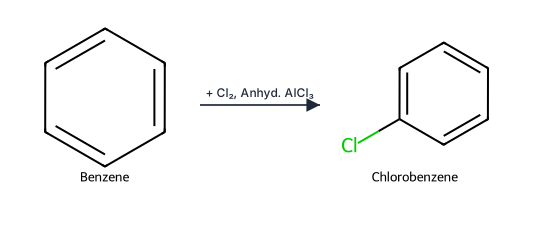
This is a classic electrophilic aromatic substitution (EAS) reaction — the Friedel–Crafts halogenation. Benzene’s π-electron cloud is rich and nucleophilic, but it does not react directly with neutral chlorine gas at room temperature. You need a powerful electrophile to pull electrons away from the ring and form the sigma complex. That’s where the Lewis acid comes in.
The role of AlCl3 is to accept a lone pair from one chlorine atom of Cl2, creating a highly polarised complex. This weakens the Cl–Cl bond so much that it effectively breaks heterolytically, generating a Cl+ ion (or a strongly δ+ chlorine in the complex) that can attack the ring.
Let’s walk through the mechanism step by step.
- Generation of the electrophile AlCl3 is electron-deficient (it has only six electrons in its valence shell). It coordinates to a chlorine atom of Cl2, forming a complex:
Cl2+AlCl3→Clδ+⋯Clδ−⋯AlCl3
The Al–Cl bond in the complex pulls electron density away from the Cl2 molecule. This makes one chlorine strongly electrophilic — essentially a Cl+ equivalent.
- Attack on the benzene ring The π-electrons of benzene attack this electrophilic chlorine, forming a delocalised carbocation intermediate (the arenium ion or sigma complex):
C6H6+Cl+→C6H6Cl+
This step is slow and rate-determining. …
Concept: Electrophilic Aromatic Substitution (EAS) — Role of the Catalyst
Method: Identify the Active Electrophile
In the chlorination of benzene using Cl2 and AlCl3, the catalyst generates a strong electrophile that attacks the electron-rich benzene ring.
Steps:
-
Recognize the reaction type
This is an electrophilic aromatic substitution. Benzene is electron-rich, so it needs a positive or electron-deficient species to attack it.
-
Role of AlCl3
AlCl3 is a Lewis acid. It accepts a lone pair from chlorine in Cl2, polarising the Cl−Cl bond.
-
Formation of the attacking species
The polarisation leads to heterolytic cleavage:
Cl2+AlCl3→Cl++[AlCl4]− …
Common Mistakes & How to Avoid Them
Mistake 1: Choosing Cl− (option (i))
Why students pick it: They see chlorine is involved and assume the negative ion (chloride) is the attacking species, confusing nucleophilic with electrophilic substitution.
Why it’s wrong: Benzene is electron-rich (due to its delocalised π-system). It repels negative species. Chlorobenzene formation is an electrophilic aromatic substitution — the attacking species must be electron-deficient (an electrophile). Cl− is a nucleophile, not an electrophile.
How to avoid: Always check the charge of the attacking species. If benzene is the substrate, the attacking species must be positive or at least neutral but electron-deficient. Memorise: Benzene loves positive things.
Mistake 2: Choosing AlCl3 (option (iii))
Why students pick it: They see AlCl3 is added as a catalyst and assume it directly attacks benzene.
Why it’s wrong: AlCl3 is a Lewis acid — it accepts electrons. Its role is to activate chlorine by forming a complex, not to attack benzene directly. The actual attacking species is generated from this interaction.
How to avoid: Distinguish between catalyst and attacking species. The catalyst helps create the electrophile but does not itself attack the ring. Ask: What does the catalyst do to the reagent? Here, AlCl3 polarises Cl2 to generate Cl+.
Mistake 3: Choosing [AlCl4]− (option (iv))
Why students pick it: They see a negative charge and think it might stabilise something, or confuse it with the attacking species.
Why it’s wrong: [AlCl4]− is a byproduct formed after AlCl3 accepts a chloride ion. It is negatively charged and stable — it does not attack the electron-rich benzene ring.
How to avoid: Track the reaction mechanism step-by-step:
- AlCl3+Cl2→Cl++[AlCl4]−
- Cl+ attacks benzene.
- [AlCl4]− is just a spectator/counterion.
Mistake 4: Not recognising Cl+ as the correct electrophile (option (ii)) …
- AP EAPCET 2023Set eng-2023-05-19-FN1 markMCQQ.The 'X' in the following conversion is H3CCH2COOHXCH3CHBrCOOH (A)(i) Br2/P red,(ii) H2O (B)(i) Br2/CCl4,(ii) H2O (C) Br2 / OH− (D) PBr3
›Reveal solutionSolution
This tests recognition of the Hell–Volhard–Zelinsky reaction, which converts a carboxylic acid with α-hydrogens into its α-bromo (or α-chloro) derivative using Br2/red phosphorus followed by hydrolysis.
Concept and Intuition
Carboxylic acids do not directly react with Br2 at their α-carbon the way ketones/aldehydes do via their enol, because carboxylic acids exist overwhelmingly in the keto (acid) form and enolize very poorly. The Hell–Volhard–Zelinsky (HVZ) reaction solves this: red phosphorus reacts with Br2 to generate a small amount of PBr3, which converts the carboxylic acid into its far more easily enolizable acid bromide (RCOBr). This acid bromide's enol form reacts readily with Br2 to substitute a hydrogen at the α-carbon, giving the α-bromo acid bromide. Finally, this reactive intermediate is hydrolysed with water to yield the stable α-bromo carboxylic acid.
Step-by-Step Solution
- Identify the required transformation: CH3CH2COOH (propanoic acid) → CH3CHBrCOOH (2-bromopropanoic acid) — bromine is introduced specifically at the α-carbon (the carbon next to −COOH).
- Recognize this pattern as α-halogenation of a carboxylic acid, which is precisely what the HVZ reaction accomplishes.
- The HVZ reagents are (i) Br2 with catalytic red phosphorus, which in situ forms PBr3 and converts the acid to the acid bromide, enabling α-bromination via the enol form; then (ii) hydrolysis with H2O converts the resulting α-bromo acid bromide back to the free α-bromo carboxylic acid.
- This matches option (A) exactly: (i) Br2/P red, (ii) H2O. …
- AP EAPCET 2023Set eng-2023-05-19-FN1 markMCQQ.The preferred reagent for the following conversion is CH3CH2COOH→CH3CH2COCl (A) HCl (B) HOCl (C) SOCl2 (D) NaOCl
›Reveal solutionSolution
This tests the preferred laboratory reagent for converting a carboxylic acid to its acyl chloride; thionyl chloride (SOCl2) is preferred because its by-products are gases that leave the product clean.
Concept and Intuition
Several reagents can convert a carboxylic acid −COOH into an acyl chloride −COCl (e.g. PCl3, PCl5, SOCl2), but thionyl chloride is generally the preferred choice in practice. The reaction is:
RCOOH+SOCl2→RCOCl+SO2↑+HCl↑
Both by-products, sulphur dioxide and hydrogen chloride, are gases that simply escape the reaction mixture, so the desired acyl chloride is obtained in a purer form without needing extensive work-up to remove solid phosphorus-containing by-products (as would be needed with PCl3/PCl5, which leave behind phosphorous acid or phosphorus oxychloride residues).
Step-by-Step Solution
- Identify the required transformation: CH3CH2COOH (propanoic acid) → CH3CH2COCl (propanoyl chloride), i.e., replacing −OH with −Cl at the carbonyl carbon.
- Recognize this as acyl chloride formation from a carboxylic acid.
- Among the given options, only SOCl2 (option C) is a reagent used for this transformation; HCl, HOCl, and NaOCl (options A, B, D) are not reagents that convert carboxylic acids to acid chlorides. …
- AP EAPCET 2022Set eng-2022-07-05-AN1 markMCQQ.Identify the major product from the following reaction sequence (2-cyclohexylethanol, a cyclohexane ring bearing a CH2CH2OH group) (i) CrO3, H2SO4 (ii) Cl2/Red P (ii) H2O ? (A) C6H11CH2COOH (a cyclohexane ring bearing a CH2COOH group, no chlorine) (B) C6H5CH2COOH (a benzene ring bearing a CH2COOH group) (C) a cyclohexane ring bearing a Cl substituent at the 4-position and a CH2COOH group at the 1-position (D) a cyclohexane ring bearing a CHClCOOH group (chlorine on the carbon alpha to the COOH), i.e. C6H11CHClCOOH
›Reveal solutionSolution
Oxidation of the primary alcohol to a carboxylic acid, followed by Hell-Volhard-Zelinsky alpha-chlorination, gives an alpha-chloro carboxylic acid as the final product.
Concept and Intuition
This sequence chains together two classic named reactions: (1) CrO3/H2SO4 (Jones-type oxidation) fully oxidizes a primary alcohol through the aldehyde stage to a carboxylic acid; (2) the Hell-Volhard-Zelinsky (HVZ) reaction uses Cl2 (or Br2) with red phosphorus to selectively halogenate a carboxylic acid specifically at its alpha carbon (via an enol-like acyl halide intermediate), which is a hallmark reaction for functionalizing the position next to −COOH.
Step-by-Step Solution
- Start: 2-cyclohexylethanol, C6H11−CH2−CH2−OH (a cyclohexane ring bearing a −CH2CH2OH side chain).
- Step (i), CrO3/H2SO4: oxidizes the terminal −CH2OH all the way to −COOH (strong oxidant, primary alcohol → carboxylic acid), giving cyclohexylacetic acid, C6H11−CH2−COOH.
- Step (ii), Cl2/red P (HVZ reaction): red phosphorus first converts a small amount of the acid to the acyl chloride, which enolizes and is chlorinated specifically at the alpha carbon (the carbon adjacent to the carbonyl), giving C6H11−CHCl−COOH (after the acyl chloride hydrolyzes back to the acid). …
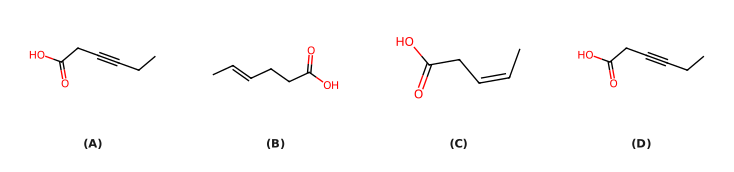
- AP EAPCET 2021Set eng-2021-08-19-FN1 markMCQQ.In the following reaction sequence, identify product 'Q' and reagent 'R': [FIGURE] (Me-CH2-C≡C-CH2-Br is treated with(i) Mg/Ether(ii) CO2(iii) H3O+ to give product Q; Q is then treated with reagent R to give Me-C≡C-CH2-C(=O)Cl) (A) [FIGURE] (Me-CH2-C≡C-CH2-COOH) and SOCl2 (B) [FIGURE] (Me-CH=CH-CH2-CH2-COOH, trans double bond) and SO2Cl2 (C) [FIGURE] (Me-CH=CH-CH2-COOH, cis double bond) and SOCl2 (D) [FIGURE] (Me-CH2-C≡C-CH2-COOH) and CH3SO2Cl2
›Reveal solutionSolution
Grignard formation + CO2 + H3O+ is a standard carboxylation that never touches the triple
bond; converting the resulting acid to an acid chloride is the textbook job of SOCl2.
Concept and Intuition
Forming a Grignard reagent from an alkyl (here propargylic) halide is a simple oxidative-insertion
of Mg into the C–Br bond — it does not isomerise or rearrange the carbon skeleton or move the
triple bond under these conditions (no acid/base or transition-metal catalyst is present to trigger
an allenic/propargylic shift). Bubbling CO2 through a Grignard reagent, then quenching with
aqueous acid, is the standard way to extend a carbon chain by one carbon and install a −COOH
group at the position that held the −MgBr.
Once a carboxylic acid needs to become an acid chloride, the reagent of choice (retaining the
carbon skeleton, releasing only gaseous by-products SO2 and HCl so the product is easy to
purify) is thionyl chloride, SOCl2.
Step-by-Step Solution
- Me−CH2−C≡C−CH2−BrMg/EtherMe−CH2−C≡C−CH2−MgBr — simple insertion, skeleton and triple-bond position unchanged.
- (ii) CO2 the Grignard carbon attacks CO2 to give a magnesium carboxylate: Me−CH2−C≡C−CH2−COOMgBr.
- (iii) H3O+ protonation gives the free acid, Q =Me−CH2−C≡C−CH2−COOH (a hex-3-ynoic acid).
- Converting Q's −COOH to −COCl with retention of the carbon skeleton requires R=SOCl2: R−COOH+SOCl2→R−COCl+SO2↑+HCl↑. …
🎓Unlock everything free for 14 days
- ✓Full step-by-step solutions
- ✓Concept-first explanations
- ✓Methods, shortcuts & mistakes
- ✓PYQ mapping + timed mock tests
Full access for 14 days. No credit card required.