Q.Differentiate between the following :
You're viewing a preview — the full solution, concept, methods & PYQ mapping are locked.
Start your 14-day free trial to unlock the full solution →Peptide and glycosidic linkages are both covalent bonds that join monomers into polymers, but peptide bonds link amino acids via amide formation (), while glycosidic bonds link monosaccharides via an oxygen bridge (). Essential amino acids cannot be synthesised by the human body and must come from diet; non-essential ones can be made internally. The key difference is source requirement for amino acids and bond type & monomers for linkages.
The Concept First: Why These Distinctions Matter
Biochemistry is the language of life's molecules. When you see "linkage," think "how are building blocks strung together?" A peptide linkage is the glue of proteins — it joins amino acids. A glycosidic linkage is the glue of carbohydrates — it joins sugars. The atoms involved and the chemistry of formation are completely different.
For amino acids, the classification into essential vs non-essential is purely about dietary necessity, not about importance. Both types are equally vital for your body; the difference is whether your cells can manufacture them from scratch.
A common mistake is to think "non-essential" means "unimportant." It does not. It simply means "the body can synthesise it." A deficiency in a non-essential amino acid can still be serious if the synthetic pathway is impaired.
(i) Peptide Linkage vs Glycosidic Linkage
1. What monomers are involved?
- Peptide linkage: Joins two amino acids. Each amino acid has an amino group () and a carboxyl group ().
- Glycosidic linkage: Joins two monosaccharides (simple sugars like glucose, fructose). Each sugar has multiple hydroxyl groups ().
2. How is the bond formed?
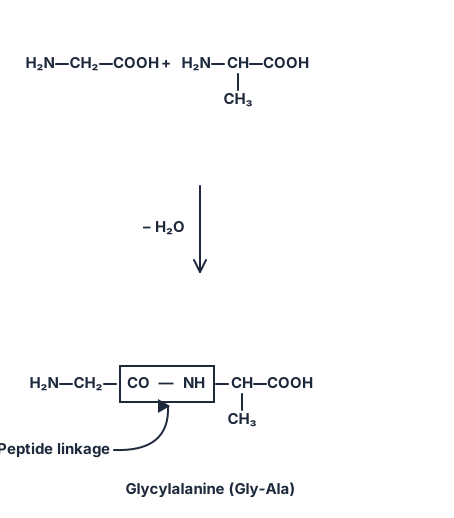
- Peptide bond: A condensation reaction (water is removed) between the carboxyl group of one amino acid and the amino group of another. The resulting bond is an amide bond: .
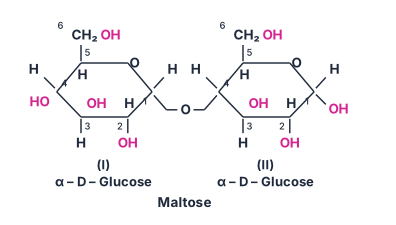
- Glycosidic bond: A condensation reaction between the hydroxyl group on the anomeric carbon (the carbon that becomes chiral in the ring form) of one sugar and any hydroxyl group of another sugar. The resulting bond is an ether bond: .
3. What is the chemical structure?
- Peptide: — note the carbonyl () and the nitrogen.
- Glycosidic: — just carbon, oxygen, carbon. No nitrogen involved.
4. Where do we find them?
- Peptide: In proteins and polypeptides (e.g., insulin, haemoglobin, enzymes).
- Glycosidic: In carbohydrates — disaccharides (sucrose, lactose), polysaccharides (starch, cellulose, glycogen).
A quick memory trick: Peptide = Protein (amino acids). Glycosidic = Glucose (sugars). Also, peptide bonds contain N (nitrogen); glycosidic bonds do not.
5. Can they be broken?
- Peptide: Hydrolysed by proteases (enzymes like pepsin, trypsin) — water is added back to split the bond.
- Glycosidic: Hydrolysed by glycosidases (e.g., amylase for starch, lactase for lactose).
Peptide bond formation:
Glycosidic bond formation:
(ii) Essential Amino Acids vs Non-Essential Amino Acids
1. The core definition
- Essential amino acids: Cannot be synthesised by the human body (or not in sufficient amounts). Must be obtained from food.
- Non-essential amino acids: Can be synthesised by the body from other compounds (often from intermediates of metabolism or from other amino acids).
2. How many are there?
- Essential: 9 for adults (histidine, isoleucine, leucine, lysine, methionine, phenylalanine, threonine, tryptophan, valine). For infants, arginine is also considered essential. …
Unlock everything free for 14 days
- Full step-by-step solutions
- Concept-first explanations
- Methods, shortcuts & mistakes
- PYQ mapping + timed mock tests
Full access for 14 days. No credit card required.