Q.Write the reaction involved in the following :
You're viewing a preview — the full solution, concept, methods & PYQ mapping are locked.
Start your 14-day free trial to unlock the full solution →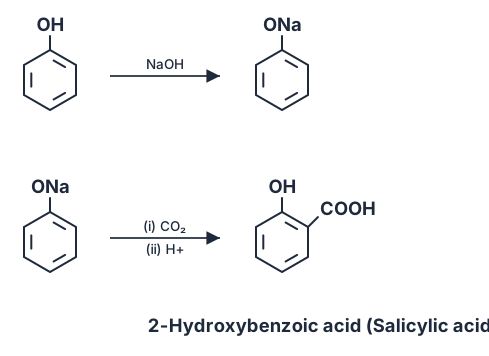
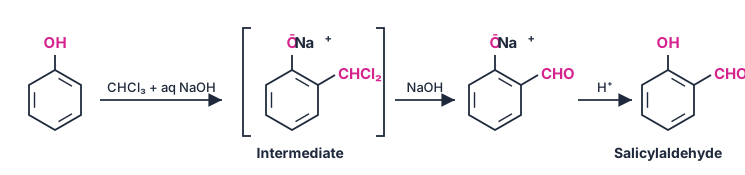
All three reactions are Electrophilic Aromatic Substitution (EAS) reactions where a strong electrophile is generated in situ and attacks the aromatic ring. (a) Reimer-Tiemann: (formyl group at ortho position).
(b) Kolbe's: (carboxyl group at ortho position).
(c) Friedel-Crafts acylation of anisole: (major product, para substitution).
The Core Idea: Electrophilic Aromatic Substitution (EAS)
All three reactions are classic examples of Electrophilic Aromatic Substitution. The benzene ring is electron-rich (due to its delocalised electrons) and acts as a nucleophile. It attacks a strong electrophile (an electron-deficient species). The key is that the electrophile is not added directly; it is generated in the reaction mixture (in situ) by the reagents.
The general mechanism is:
- Generation of the electrophile ().
- Attack by the aromatic ring on , forming a resonance-stabilised carbocation (the arenium ion or -complex).
- Loss of a proton () to restore aromaticity, giving the substituted product.
The position of substitution (ortho, meta, para) is controlled by the activating or deactivating nature of the substituent already on the ring. Phenol () and anisole () are strongly activating and ortho/para-directing.
(a) Reimer-Tiemann Reaction
1. The Goal: To introduce a formyl group () directly onto a phenol ring. Direct formylation is difficult because the formyl cation () is unstable.
2. Generating the Electrophile: The magic happens with chloroform () and a strong base (NaOH).
- The base deprotonates chloroform, forming a trichloromethyl carbanion: .
- This carbanion is unstable and loses a chloride ion () to form dichlorocarbene (). This is the key electrophile — a highly reactive, electron-deficient species.
3. The Attack: The electron-rich oxygen of the phenoxide ion (formed by deprotonation of phenol by NaOH) attacks the electron-deficient carbon of dichlorocarbene.
4. Hydrolysis: The intermediate formed is an ortho-substituted dichloromethyl phenol. Upon workup with aqueous acid, the two chlorine atoms are hydrolysed, yielding the aldehyde group.
The product is always the ortho-formyl phenol (salicylaldehyde). The para product is not formed because the bulky intermediate cannot easily form at the para position due to steric hindrance from the rest of the ring.
The Reaction:
(b) Kolbe's Reaction (Kolbe-Schmitt Reaction)
1. The Goal: To introduce a carboxyl group () onto a phenol ring. This is a specific case of electrophilic substitution using carbon dioxide () as the electrophile.
2. Generating the Nucleophile: The first step is to convert phenol into its much more reactive conjugate base, sodium phenoxide (). The phenoxide ion has a much higher electron density on the ring than phenol itself, making it a powerful nucleophile.
3. The Electrophile: Carbon dioxide () is a weak electrophile. However, the strongly nucleophilic phenoxide ion is capable of attacking the carbon atom of .
4. The Attack and Rearrangement: The phenoxide ion attacks , forming an ortho-substituted intermediate. This intermediate then rearranges to give the sodium salt of salicylic acid. The ortho position is favoured because the negative charge on the oxygen of the phenoxide can coordinate with the incoming , directing it to the ortho position.
The reaction requires high pressure and temperature (around 125°C, 4-7 atm) to force the weak electrophile to react. The para product is not formed because the ortho position is kinetically and thermodynamically favoured due to the chelation effect.
The Reaction:
--- …
Unlock everything free for 14 days
- Full step-by-step solutions
- Concept-first explanations
- Methods, shortcuts & mistakes
- PYQ mapping + timed mock tests
Full access for 14 days. No credit card required.