Q.(a)
You're viewing a preview — the full solution, concept, methods & PYQ mapping are locked.
Start your 14-day free trial to unlock the full solution →Concept understanding — Cannizzaro Reaction
The Cannizzaro Reaction: An Intuition
Imagine two identical molecules of an aldehyde meeting in a strongly basic solution. Normally, aldehydes with a hydrogen on the carbon next to the carbonyl (the -carbon) undergo aldol condensation. But what if that -carbon has no hydrogen at all? The molecule cannot do the usual reaction. Instead, something remarkable happens: one aldehyde molecule gets reduced to an alcohol, while the other gets oxidized to a carboxylic acid (which, in base, exists as its salt). One molecule gives away electrons; the other accepts them. This is a disproportionation — a single species (the aldehyde) acts as both the oxidising and the reducing agent.
The reaction requires concentrated alkali (typically NaOH or KOH). Dilute base will not work.
The Precise Statement
The Cannizzaro reaction is the base-catalysed disproportionation of an aldehyde that lacks an -hydrogen atom (i.e., the carbon adjacent to the group has no hydrogen attached). In the presence of concentrated aqueous or alcoholic alkali, two molecules of such an aldehyde yield one molecule of a primary alcohol and one molecule of the salt of a carboxylic acid.
The general equation (using benzaldehyde as the classic example):
Benzaldehyde gives benzyl alcohol and sodium benzoate.
Why "No -Hydrogen" Matters
The key is the mechanism. The first step is the attack of hydroxide ion () on the carbonyl carbon. This forms a tetrahedral intermediate. If an -hydrogen were present, this intermediate would lose water and form an enolate — leading to aldol condensation. Without that hydrogen, the intermediate cannot do that. Instead, it transfers a hydride ion () to a second molecule of aldehyde. That second molecule gets reduced to the alkoxide (which later picks up a proton to become the alcohol), while the first molecule becomes the carboxylate.
A common mistake: thinking the reaction works for any aldehyde. It does not. If the aldehyde has even one -hydrogen, the aldol pathway dominates. Only aldehydes like formaldehyde (), benzaldehyde (), and trimethylacetaldehyde () undergo the Cannizzaro reaction.
Crossed Cannizzaro Reaction …
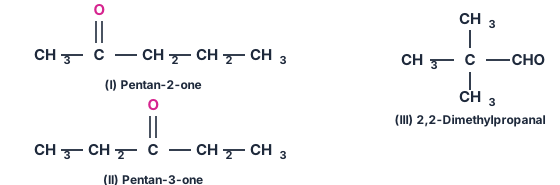
Part (a): = pentan-2-one (I), pentan-3-one (II), 2,2-dimethylpropanal (III); acetophenone->benzoic acid by haloform, ethylbenzene->benzoic acid by hot . Part (b): DNP-hydrazone of ; HCN reactivity di-tert-butyl ketone < acetone < acetaldehyde; distinguishes benzoic acid; DIBAL-H gives ethanal from ethanenitrile; cyclohexanol -> cyclohexanone.
(i) Deducing the isomers. One degree of unsaturation => a carbonyl (aldehyde/ketone).
- (I) No Tollens' test => not an aldehyde; positive iodoform => a (methyl ketone). The fit is pentan-2-one, .
- (II) No Tollens' (not an aldehyde) and no iodoform (no ) but undergoes aldol (needs -H). The only ketone with -H and no methyl-ketone group is pentan-3-one, . (Note: pentanal would give a Tollens' test, so it is ruled out.)
- (III) Cannizzaro is given only by aldehydes with no -hydrogen. Here that is 2,2-dimethylpropanal (pivalaldehyde), - its -carbon is quaternary.
(ii) Conversions to benzoic acid.
- (I) Acetophenone -> benzoic acid (haloform/iodoform oxidation of the methyl ketone):
then .
- (II) Ethylbenzene -> benzoic acid (the whole benzylic side chain is oxidised to as long as a benzylic H exists):
Concept understanding — Nucleophilic Addition
Nucleophilic Addition – From Intuition to Precision
Imagine you have a molecule with a carbon–oxygen double bond — a carbonyl group (). That oxygen is greedy for electrons; it pulls them away from carbon, leaving the carbon slightly positive () and the oxygen slightly negative (). Now, if you bring a species that is rich in electrons (a nucleophile, meaning "nucleus-loving"), it will naturally be attracted to that electron-deficient carbon. The nucleophile attacks the carbon, the bond breaks, and the oxygen picks up a proton (or some other electrophile) to become stable. That, in a nutshell, is nucleophilic addition.
The key idea: a nucleophile adds across a polar multiple bond (usually or ), breaking the bond and forming two new sigma bonds.
The Precise Statement
Nucleophilic addition is a reaction in which a nucleophile (an electron-rich species) forms a sigma bond with an electrophilic carbon atom of a polar multiple bond (typically a carbonyl group, , or a nitrile, ), while the bond breaks. The resulting intermediate then captures a proton (or another electrophile) to give a neutral product.
In general form:
The nucleophile () attacks the carbonyl carbon; the oxygen becomes negatively charged; then a proton () from the medium attaches to the oxygen, yielding an alcohol.
Why It Happens – The Driving Force
The carbonyl carbon is electrophilic because:
- Oxygen is more electronegative than carbon, so the bond is polarised: .
- The bond is weaker than a bond, so it can break relatively easily.
A nucleophile (like , , or ) has a lone pair or a negative charge. It seeks positive centres. The attack forms a new bond, and the electrons move entirely to oxygen, creating an alkoxide ion (). This intermediate is then quenched by a proton.
A common mistake: thinking the nucleophile attacks the oxygen. No — oxygen is already electron-rich; the nucleophile goes to the carbon because it is electron-deficient.
A Concrete Example – Addition of HCN to a Ketone
Take acetone () and hydrogen cyanide (). In the presence of a base, (the nucleophile) attacks the carbonyl carbon:
The alkoxide intermediate then picks up a proton from (or from water) to give a cyanohydrin:
The product is acetone cyanohydrin. Notice: two new sigma bonds formed ( and ), and the bond is gone.
What Makes a Good Nucleophile?
Strong nucleophiles are usually negatively charged or have lone pairs:
- , , , , (from hydride reagents like or )
- Neutral but polarisable: , (weaker, but can add under acidic conditions) …
Why this formula?
Nucleophilic Addition: Why the Mechanism Works the Way It Does
Let's build this from first principles — understanding why nucleophilic addition happens, not just memorising the steps.
1. The Core Problem: Why Does Addition Happen at All?
A carbonyl group () has a polarised double bond:
- Oxygen is more electronegative than carbon → it pulls electron density toward itself.
- This creates a partial positive charge on carbon () and a partial negative charge on oxygen ().
Key insight: The carbon is electron-deficient — it wants electrons. A nucleophile (Nu⁻) is electron-rich — it wants to give electrons. This is a natural match.
2. The Two-Step Mechanism (Why Two Steps?)
Step 1: Nucleophilic Attack (Slow, Rate-Determining)
The nucleophile donates its lone pair to the electrophilic carbonyl carbon.
Why this happens:
- The bond between C and O breaks — the electrons move entirely to oxygen.
- Oxygen now has a full negative charge (alkoxide ion).
- The carbon changes from (trigonal planar) to (tetrahedral).
This step is slow because the bond must break — it requires energy.
Step 2: Protonation (Fast)
The negatively charged oxygen picks up a proton () from the solvent or acid.
Why this happens:
- The alkoxide ion is a strong base — it wants to neutralise its charge.
- Protonation gives a stable neutral alcohol product.
3. The Key Formula: Rate Law Derivation
For a general nucleophilic addition:
The rate law comes from the slow step (Step 1):
Why this form?
- The reaction is bimolecular — two species must collide with correct orientation.
- Doubling either concentration doubles the rate (first order in each).
- This is second order overall.
Exam tip: This is why nucleophilic addition is often called addition-elimination when followed by loss of a leaving group (like in acyl substitution), but here it's just addition.
4. Why the Tetrahedral Intermediate Forms (And Why It's Unstable)
The intermediate is tetrahedral ( hybridised carbon):
- Bond angles: ~109.5°
- Four groups around carbon: Nu, R, R', O⁻
Why it's unstable:
- The negative charge on oxygen is high-energy.
- The tetrahedral geometry is sterically crowded (especially with bulky R groups).
- The intermediate collapses quickly — either back to starting materials or forward to product. …
Part (a): = pentan-2-one (I), pentan-3-one (II), 2,2-dimethylpropanal (III); acetophenone->benzoic acid by haloform, ethylbenzene->benzoic acid by hot . Part (b): DNP-hydrazone of ; HCN reactivity di-tert-butyl ketone < acetone < acetaldehyde; distinguishes benzoic acid; DIBAL-H gives ethanal from ethanenitrile; cyclohexanol -> cyclohexanone.
- 2,4-Dinitrophenylhydrazone of benzaldehyde. Benzaldehyde condenses with 2,4-DNPH () losing water:
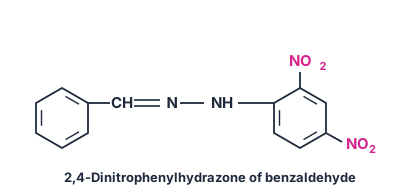
Structure of the 2,4-dinitrophenylhydrazone of benzaldehyde, with a CH=N-NH bridge joining the benzene ring to the 2,4-dinitrophenyl ring (NO groups at positions 2 and 4 of the hydrazine ring.) - Reactivity toward HCN. Nucleophilic addition is faster with less steric hindrance and a more electrophilic (less +I) carbonyl carbon. Acetaldehyde (one small H + one ) is most reactive; acetone (two ) is intermediate; di-tert-butyl ketone (two bulky -Bu groups) is least reactive. Increasing order: di-tert-butyl ketone < acetone < acetaldehyde. …
Unlock everything free for 14 days
- Full step-by-step solutions
- Concept-first explanations
- Methods, shortcuts & mistakes
- PYQ mapping + timed mock tests
Full access for 14 days. No credit card required.