Q.Write the reactions of D-Glucose with the following :
🔒You're viewing a preview — the full solution, concept, methods & PYQ mapping are locked.
🔒 Start your 14-day free trial to unlock the full solution →Concept understanding — Glucose Cyclization
Glucose Cyclization: From a Straight Chain to a Ring
Imagine you have a long, flexible chain with a hook at one end and an eyelet at the other. If you swing that chain around, the hook can snap into the eyelet, forming a loop. That's the core idea behind glucose cyclization.
Glucose in its simplest written form is a straight chain of six carbon atoms with an aldehyde group (−CHO) at one end. But in water (like in your blood), this chain doesn't stay straight. The aldehyde group reacts with the alcohol group on the fifth carbon, forming a stable six-membered ring.
Why does this happen?
The aldehyde carbon is electrophilic (electron-poor), and the oxygen on carbon-5 has lone pairs (nucleophilic). They attack each other, forming a new bond. This creates a hemiacetal — a carbon bonded to both an −OH and an −OR group. The ring is more stable than the open chain in solution.
The open-chain form of glucose exists in equilibrium with the cyclic form, but at any given time, over 99% of glucose molecules are in the cyclic form.
The precise statement
Glucose cyclization is an intramolecular nucleophilic addition where the aldehyde group at C1 reacts with the hydroxyl group at C5, forming a six-membered pyranose ring (named after pyran, a six-membered oxygen heterocycle). This reaction creates a new chiral center at C1, giving two possible stereoisomers called anomers: α and β.
The two anomers
When the ring forms, the oxygen from C5 becomes part of the ring. The carbon that was the aldehyde (now C1) becomes a new chiral center. The −OH group at this new center can point:
- Down (relative to the ring plane) → α-D-glucose
- Up → β-D-glucose
The α and β anomers are diastereomers, not enantiomers. They differ only at the anomeric carbon (C1). In solution, they interconvert through the open-chain form — a process called mutarotation.
How to draw it (Haworth projection)
- Draw a hexagon with an oxygen atom at the top-right corner.
- Number the carbons clockwise from the oxygen: C1 is the carbon to the right of oxygen, C2 next, and so on.
- For α-D-glucose, the −OH at C1 points down (opposite to the CH2OH group at C5).
- For β-D-glucose, the −OH at C1 points up (same side as the CH2OH group). …
Why this formula?
Glucose Cyclization: Why the Ring Forms
Glucose cyclization is a classic example of an intramolecular reaction — a molecule reacting with itself. Let's build the understanding step by step.
1. The Starting Point: Open-Chain Glucose
Glucose (C6H12O6) in its open-chain form has:
- An aldehyde group (−CHO) at carbon 1 (C1)
- A hydroxyl group (−OH) at carbon 5 (C5)
The aldehyde is electrophilic (electron-deficient at the carbonyl carbon), and the hydroxyl is nucleophilic (electron-rich oxygen with lone pairs).
2. Why Cyclization Happens: Thermodynamic & Kinetic Favorability
The Key Insight
The molecule is flexible — it can bend so that the C5 hydroxyl oxygen approaches the C1 aldehyde carbon. This brings two reactive groups into close proximity.
- Entropy is favorable: One molecule becomes one ring — no loss of translational entropy (unlike two separate molecules reacting).
- Ring strain is manageable: A 5- or 6-membered ring (furanose or pyranose) has minimal angle strain (close to tetrahedral angles).
Result: The reaction is reversible but strongly favors the cyclic form — in aqueous solution, >99% of glucose exists as the ring.
3. The Reaction: Hemiacetal Formation
The nucleophilic oxygen of the C5 hydroxyl attacks the electrophilic carbonyl carbon of C1:
R-CHO+R’-OH⇌R-CH(OH)(OR’)
This is a hemiacetal — a carbon bonded to both an −OH and an −OR group.
Mechanism (simplified)
- Protonation of the carbonyl oxygen (acid-catalyzed) makes C1 more electrophilic.
- Nucleophilic attack by the C5 oxygen.
- Deprotonation yields the cyclic hemiacetal.
4. The Key Formula(e): Ring Size & Anomeric Carbon
Ring Size Determination
The ring size depends on which hydroxyl attacks:
- C5 hydroxyl → pyranose (6-membered ring: 5 carbons + 1 oxygen)
- C4 hydroxyl → furanose (5-membered ring: 4 carbons + 1 oxygen)
For D-glucose, the C5 attack is overwhelmingly favored, giving the pyranose form.
The Anomeric Carbon
The new chiral center formed at C1 is called the anomeric carbon. Two stereoisomers arise:
- α-anomer: −OH at C1 is trans to the −CH2OH group (axial in the chair conformation)
- β-anomer: −OH at C1 is cis to the −CH2OH group (equatorial in the chair conformation)
Why two forms? The attack can occur from either face of the planar carbonyl group — leading to two possible configurations at the new stereocenter.
5. The Equilibrium Constant & Mutarotation
The interconversion between α and β anomers is called mutarotation:
α-D-glucopyranose⇌open chain⇌β-D-glucopyranose
At equilibrium (in water at 20°C):
- β-D-glucopyranose: ~64%
- α-D-glucopyranose: ~36%
- Open chain: <0.1% …
Concept: Reactions of glucose — reduction, oxidation at the aldehyde group, and oxidation at both ends.
(a) HI (reduction)
Hot concentrated HI reduces the open-chain aldehyde group as well as all the −OH groups, converting glucose into n-hexane (a straight-chain hydrocarbon).
C6H12O6+7HI→CH3(CH2)4CH3+3I2+3H2O
(b) Br2 water (mild oxidation)
Bromine water selectively oxidises the aldehyde (−CHO) group to a carboxylic acid (−COOH) without affecting the other −OH groups. The product is gluconic acid.
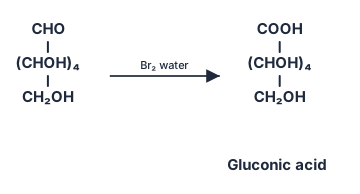
C6H12O6+Br2+H2O→C6H12O7+2HBr
(c) Conc. HNO3 (strong oxidation) …
D-Glucose reacts differently with each reagent: HI reduces it to n-hexane (complete deoxygenation), Br₂ water selectively oxidises the aldehyde group to give gluconic acid, and conc. HNO₃ oxidises both ends to yield a dicarboxylic acid — glucaric acid (saccharic acid).
The Concept — Why These Reagents Target Different Parts of Glucose
D-Glucose is a polyhydroxy aldehyde (an aldohexose). It has:
- An aldehyde group at C1 (the reducing end)
- Five hydroxyl groups (on C2 through C6)
- A primary alcohol group at C6
Each reagent in this question attacks a specific functional group or structural feature. The key is to recognise what each reagent does to an organic molecule — not just memorise products, but understand why that product forms.
HI is a strong reducing agent that cleaves C–O bonds. It doesn't care about the aldehyde — it strips away all oxygen atoms, leaving only a hydrocarbon chain.
Br₂ water is a mild oxidising agent. In neutral or slightly acidic conditions, it oxidises only the most easily oxidised group — the aldehyde — without touching the alcohol groups.
Conc. HNO₃ is a powerful oxidising agent. It oxidises both the aldehyde at C1 and the primary alcohol at C6, turning both ends into carboxylic acids.
Let's work through each one.
(a) Reaction with HI
What happens: HI cleaves all C–O bonds (both the C–O of alcohols and the C–O of the cyclic ether/aldehyde). Every –OH group is replaced by –I, and then the iodine atoms are further reduced to hydrogen. The result is a straight-chain alkane.
Step-by-step:
-
D-Glucose has the open-chain formula:
CHO–(CHOH)4–CH2OH
-
Hot concentrated HI breaks every C–O bond. Each –OH group gets converted to –I, and the aldehyde oxygen is also replaced. This gives a polyiodo intermediate:
CHI2–(CHI)4–CH2I
-
Excess HI, especially in the presence of red phosphorus (often added), reduces all C–I bonds to C–H bonds. This is a reductive dehalogenation.
-
The final product is the straight-chain alkane with the same number of carbons: n-hexane.
CH3–CH2–CH2–CH2–CH2–CH3
A common mistake is to think HI only reduces the aldehyde to an alcohol or that it leaves some oxygen atoms behind. HI is brutal — it removes every oxygen. The product is a pure hydrocarbon, not an alcohol or aldehyde.
This reaction is a classic way to determine the carbon skeleton of a sugar. Since glucose gives n-hexane, we know it has an unbranched six-carbon chain.
(b) Reaction with Br₂ water
What happens: Bromine water (Br₂ in H₂O) is a mild oxidising agent. It selectively oxidises the aldehyde group (–CHO) to a carboxylic acid (–COOH) without affecting the alcohol groups.
Step-by-step:
-
In aqueous solution, Br₂ exists as Br₂ molecules. The aldehyde group is easily oxidised; the Br₂ gets reduced to HBr.
-
The reaction is:
R–CHO+Br2+H2O→R–COOH+2HBr
-
For D-glucose, R is the rest of the chain: –(CHOH)₄–CH₂OH. So the product is:
COOH–(CHOH)4–CH2OH
-
This compound is called gluconic acid.
The aldehyde at C1 becomes a carboxyl group, while all other hydroxyls and the primary alcohol at C6 remain unchanged.
Br₂ water is also used as a test for reducing sugars. Glucose decolourises bromine water because it gets oxidised, confirming the presence of a free aldehyde group (or a hemiacetal that can open to an aldehyde).
(c) Reaction with conc. HNO₃
What happens: Concentrated nitric acid is a strong oxidising agent. It oxidises both terminal carbon atoms — the aldehyde at C1 and the primary alcohol at C6 — to carboxylic acid groups. The secondary alcohol groups (–CHOH–) in the middle are not oxidised under these conditions.
Step-by-step:
- The aldehyde at C1 is oxidised to –COOH (as in the Br₂ case). …
Showing the 12 most recent of 15 on this concept.
- CBSE 2026Set 56/1/11 markMCQQ.Assertion (A) : The pentaacetate of glucose does not react with H2N−OH. Reason (R) : It indicates the presence of free −CHO group in glucose. (A) Both Assertion (A) and Reason (R) are true and Reason (R) is the correct explanation of the Assertion (A). (B) Both Assertion (A) and Reason (R) are true, but Reason (R) is not the correct explanation of the Assertion (A). (C) Assertion (A) is true, but Reason (R) is false. (D) Assertion (A) is false, but Reason (R) is true.
›Reveal solutionSolution
Glucose forms a cyclic hemiacetal, so its aldehyde group is locked in a ring and not free. The pentaacetate of glucose has all five –OH groups acetylated, but the ring remains closed — no free –CHO exists to react with hydroxylamine. Hence Assertion is true, Reason is false. The correct option is (C).
Glucose is famously a reducing sugar — it reduces Tollens’ reagent, Fehling’s solution, and so on. That reducing behaviour comes from its aldehyde group. But here’s the twist: in solution, glucose exists almost entirely as a cyclic hemiacetal (a six-membered pyranose ring). The aldehyde group is not free; it’s tied up in the ring as a hemiacetal linkage. The open-chain aldehyde form is present only in trace amounts (about 0.02% at equilibrium). Yet glucose still behaves as a reducing sugar because the ring can open to regenerate the aldehyde under the reaction conditions.
Now, the pentaacetate of glucose is made by acetylating all five –OH groups of glucose. That locks the ring structure completely. The ring cannot open because the anomeric –OH (the one at C1) is now acetylated — there’s no free –OH to participate in ring-opening. So the aldehyde group is permanently trapped in the cyclic form. Hydroxylamine (H2N−OH) reacts with free carbonyl groups (aldehydes and ketones) to form oximes. Since no free –CHO exists in the pentaacetate, no reaction occurs. That makes Assertion (A) true.
Reason (R) claims that this non-reactivity indicates the presence of a free –CHO group in glucose. That’s backwards. The non-reactivity of the pentaacetate actually shows that the –CHO group is not free in the cyclic form — it’s masked. The free –CHO is present only in the open-chain form, which is a tiny fraction. So Reason (R) is false.
Let’s walk through the logic step by step.
-
Glucose cyclizes to a hemiacetal.
The –CHO group at C1 reacts with the –OH at C5 to form a six-membered ring (pyranose). The C1 carbon becomes a chiral centre (the anomeric carbon) and the oxygen of the original –CHO is now part of a C–O–C linkage. No free aldehyde remains in the cyclic form.
-
Acetylation of glucose gives the pentaacetate.
All five –OH groups (including the anomeric –OH at C1) are converted to acetate esters. The ring stays intact. The anomeric acetate is not a hemiacetal — it’s a full acetal (specifically a glycosidic bond analogue). Acetals do not equilibrate with the open-chain aldehyde under mild conditions.
-
Hydroxylamine reacts only with free carbonyls. …
-
- CBSE 2026Set 56/2/11 markMCQQ.Which of the following reactions is not explained by the open chain structure of glucose ? (A) Glucose on prolonged heating with HI forms n-hexane. (B) Glucose reacts with hydroxylamine to form an oxime. (C) Glucose gets oxidized to gluconic acid on reaction with bromine water. (D) Glucose exists in two different crystalline forms, alpha (α) and beta (β).
›Reveal solutionSolution
The open-chain structure of glucose (an aldohexose) explains its aldehyde chemistry—reduction to hexane, oxime formation, and oxidation to an acid—but cannot account for the existence of two distinct crystalline forms (α and β), which arise only from cyclic hemiacetal formation.
Why cyclization matters
Glucose was long thought to be a simple open-chain aldehyde with five hydroxyl groups. That structure does explain many reactions: the aldehyde group can be reduced, can form derivatives like oximes, and can be oxidized. But one experimental fact stubbornly refused to fit—glucose crystallizes in two forms with different melting points and optical rotations, and freshly dissolved samples show mutarotation (a slow change in rotation). An open-chain aldehyde has no mechanism to produce two distinct solid forms; the molecule would always be the same.
The resolution came when it was recognized that glucose exists predominantly as a cyclic hemiacetal, formed by intramolecular attack of the C-5 hydroxyl on the C-1 aldehyde. This cyclization creates a new chiral center at C-1 (the anomeric carbon), giving rise to two stereoisomers—α-D-glucose and β-D-glucose—that can be isolated as separate crystals.
Examining each reaction
-
Prolonged heating with HI → n-hexane
Hydroiodic acid is a powerful reducing agent. The aldehyde group at C-1 is reduced to −CHX2OH, then all five hydroxyl groups (including the newly formed one) are replaced by iodine and subsequently reduced to hydrogen, yielding CHX3(CHX2)X4CHX3. This is classic aldehyde reduction chemistry; the open-chain structure with an aldehyde at one end fully accounts for it.
-
Reaction with hydroxylamine → oxime
Aldehydes react with NHX2OH to form oximes via nucleophilic addition-elimination:
R−CHO+NHX2OHR−CH=N−OH+HX2O
Glucose, with its free (or equilibrium-accessible) aldehyde group, forms glucose oxime. Again, the open-chain aldehyde structure explains this perfectly.
- Oxidation with bromine water → gluconic acid Bromine water is a mild oxidizing agent that selectively oxidizes aldehydes to carboxylic acids without attacking alcohols: CHX2OH−(CHOH)X4−CHOBrX2/HX2OCHX2OH−(CHOH)X4−COOH …
-
- CBSE 2026Set 56/2/11 markMCQQ.Assertion (A) : Glucose gets oxidized to six carbon gluconic acid on reaction with bromine water. Reason (R) : The carbonyl group is absent in the open chain structure of glucose.
›Reveal solutionSolution
Glucose has an aldehyde group in its open-chain form, which is selectively oxidized by bromine water to a carboxylic acid, giving gluconic acid. The reason is false because the carbonyl group is present, not absent.
The key to this question lies in understanding the structure of glucose and the specific action of bromine water as an oxidizing agent. Many students get confused because glucose usually exists as a cyclic hemiacetal, but in solution, a tiny amount of the open-chain aldehyde form is always present — and that’s what reacts.
Let’s break it down.
-
Glucose exists in equilibrium between cyclic and open-chain forms.
In aqueous solution, glucose is predominantly in its cyclic pyranose form (about 99.9%). However, a very small fraction (roughly 0.1%) exists as the open-chain aldehyde. This equilibrium is dynamic — as the open-chain form is consumed in a reaction, more cyclic molecules open up to replenish it.
-
Bromine water is a mild oxidizing agent.
Unlike strong oxidizers like nitric acid (which can oxidize both ends of glucose to give saccharic acid), bromine water selectively oxidizes the aldehyde group (−CHO) to a carboxylic acid (−COOH). It does not attack the primary alcohol group at C-6 under these conditions.
-
The reaction produces gluconic acid.
When the open-chain aldehyde form of glucose reacts with bromine water, the aldehyde group at C-1 is oxidized to a carboxyl group. The product is gluconic acid, which still has six carbons — the chain length is preserved.
Glucose (open-chain)Br2/H2OGluconic acid
The reaction can be written as:
C6H12O6+Br2+H2O→C6H12O7+2HBr
- Now examine the Assertion and Reason. …
-
- CBSE 2026Set ANNUAL1 markMCQQ.In the next two parts of Question No.-1, there are two statements labelled as Assertion (A) and Reason (R). From the following options (i), (ii),(iii) and (iv), select the correct answer. Assertion (A): All monosaccharides are reducing sugars. Reason (R): Monosaccharides either have an aldehyde group or an aldehyde group is formed in solution as a result of tautomerism.(a)(i) Both A and R are correct and R is the correct explanation of A.(b)(ii) Both A and R are correct but R is not the correct explanation of A.(c)(iii) A is correct but R is incorrect.(d)(iv) Both A and R are incorrect.
›Reveal solutionSolution
A is true (all monosaccharides are reducing sugars) and R is true and is the correct explanation — aldoses carry a free –CHO, while ketoses form an aldehyde in solution via tautomerism, and it is this aldehyde group that is oxidised. Correct option: (i).
Concept. A reducing sugar is one that can reduce Tollens' reagent (silver mirror) or Fehling's/Benedict's solution (red Cu2O). Reduction requires a free (or potentially free) aldehyde/keto group at the anomeric carbon.
Why the Assertion is true. Every monosaccharide — whether an aldose (e.g. glucose) or a ketose (e.g. fructose) — is a reducing sugar because its anomeric carbon is not locked as a glycoside.
Why the Reason is the correct explanation.
- Aldoses already possess a free −CHO group, which is directly oxidised. …
- CBSE 2026Set ANNUAL1 markMCQQ.Which of the following characters of D-(+)-Glucose CANNOT be explained by the open chain structure?(a) D- and L- forms(b) (+) and (–) forms(c) α- and β- forms(d) pentaacetate formation
›Reveal solutionSolution
The open-chain structure lacks the cyclic hemiacetal (anomeric) carbon, so it cannot account for the α- and β-anomers of glucose — option (C).
The open-chain structure of D-(+)-glucose (an aldohexose, CHO−(CHOH)4−CH2OH) explains most of its reactions: aldehyde reactions, formation of the pentaacetate (five –OH groups), and its optical activity/D–L designation.
However, some observations cannot be explained by the open chain:
- Glucose does not give certain characteristic aldehyde tests (e.g. it fails to react with Schiff's reagent / NaHSO3 readily). …
- CBSE 2025Set 56/4/11 markMCQQ.In the Haworth structure of the following carbohydrate, various carbon atoms have been numbered. The anomeric carbon is numbered as : (Drawn: the Haworth ring of beta-D-glucopyranose with carbons numbered 1-5 - ring oxygen at the top right; C1 at the right bearing OH above and H below; C5 at the top bearing the CH_2OH group; OH below at C2, OH above at C3, HO at C4.) (A) 1 (B) 2 (C) 3 (D) 5
›Reveal solutionSolution
The anomeric carbon is the new chiral centre created when a linear sugar cyclizes — in β-D-glucopyranose, this is the carbon that becomes attached to both the ring oxygen and a hemiacetal OH group, which is C1.
The question shows a Haworth projection of β-D-glucopyranose with carbons numbered 1 through 5 around the ring. You are asked to identify which of these is the anomeric carbon.
The term "anomeric carbon" comes directly from the cyclization of glucose. In the open-chain form, glucose has an aldehyde group at C1. When the ring closes, the OH group on C5 attacks that aldehyde carbon, forming a hemiacetal. That carbon — originally the aldehyde carbon — becomes a new stereocentre. It is bonded to the ring oxygen, to a hydrogen, to an OH group, and to the rest of the ring. This carbon is called the anomeric carbon, and the two possible stereochemical arrangements at this centre are called the α and β anomers.
In the drawn structure, the ring oxygen is at the top right. The carbon immediately to the right of that oxygen, bearing an OH group above the ring and an H below, is C1. That is the carbon that was the aldehyde carbon in the open chain. It is the only carbon in the ring that is attached to two oxygens — one from the ring and one from the OH group. No other ring carbon has this feature.
Let’s walk through the numbering systematically.
-
Identify the ring oxygen. In the standard Haworth drawing of β-D-glucopyranose, the oxygen is placed at the top right corner of the hexagon. This oxygen is not numbered — it is the bridging atom from the cyclization.
-
Locate C1. The carbon immediately clockwise from the ring oxygen (at the rightmost position of the ring) is C1. In the β anomer, the OH at C1 points upward (on the same side as the CH2OH group at C5). This carbon is the hemiacetal carbon.
-
Check the other carbons. Moving clockwise around the ring: the next carbon (at the bottom right) is C2, with an OH below. Then C3 at the bottom left, with OH above. Then C4 at the top left, with OH below. Finally, C5 at the top, bearing the CH2OH group. None of these carbons are attached to two oxygens — they each have only one OH group and are part of the ring. …
-
- CBSE 2025Set 56/6/11 markMCQQ.Pyranose ring of glucose is formed due to the reaction between : (A) C1 and C3 (B) C1 and C5 (C) C1 and C4 (D) C1 and C2
›Reveal solutionSolution
Glucose cyclizes when its aldehyde group (C1) reacts with the hydroxyl on C5, forming a six-membered pyranose ring. The answer is (B).
Why glucose forms a ring
Glucose exists predominantly as a cyclic structure in solution, not as the open-chain aldehyde you might first draw. This happens because the hydroxyl groups within the same molecule can attack the carbonyl carbon, forming a stable ring through intramolecular hemiacetal formation.
The name "pyranose" tells you the ring size: it comes from pyran, a six-membered ring containing five carbons and one oxygen. When glucose forms this ring, it creates a structure analogous to pyran.
Understanding the cyclization mechanism
In the open-chain form of D-glucose, you have:
- An aldehyde group at C1 (the carbonyl carbon)
- Hydroxyl groups at C2, C3, C4, and C5
For a stable ring to form, the hydroxyl oxygen needs to be positioned close enough in space to attack the electrophilic carbonyl carbon. The question is: which hydroxyl?
Step-by-step ring formation
-
The nucleophilic attack
The hydroxyl group on C5 acts as a nucleophile and attacks the carbonyl carbon at C1. This is geometrically favorable because when you draw the chain in its extended zigzag form and allow rotation around single bonds, the C5 hydroxyl can easily reach C1.
-
Hemiacetal formation
The attack converts the aldehyde into a hemiacetal:
R−CHO+RX′−OHR−CH(OH)−O−RX′
Here, the oxygen from the C5 hydroxyl becomes part of the ring, and the former carbonyl carbon (C1) now bears both an −OH group and is bonded to the ring oxygen.
-
The six-membered ring
Count the atoms in the ring: C1, C2, C3, C4, C5, and the oxygen (originally from the C5 hydroxyl). That's six atoms total—a pyranose ring.
-
The anomeric carbon
C1 becomes the anomeric carbon, a new chiral center. The newly formed hydroxyl can be either axial (α-anomer) or equatorial (β-anomer) in the chair conformation. …
- CBSE 2025Set A1 markQ.Fill in the blank: Glucose occurs freely in nature as well as in the ______ form.
›Reveal solutionSolution
Glucose is found both as a free monosaccharide and combined (bonded via glycosidic linkages) within larger carbohydrates.
Glucose occurs freely in ripe fruits and in honey. It also occurs in the combined form, i.e. joined to other sugar units through glycosidic bonds, as a building block of larger carbohydrates — for example, in sucrose (glucose + fructose), in the disaccharide m …
- CBSE 2024Set 56/1/11 markMCQQ.Which functional groups of glucose interact to form cyclic hemiacetal leading to pyranose structure? (A) Aldehyde group and hydroxyl group at C-4 (B) Aldehyde group and hydroxyl group at C-5 (C) Ketone group and hydroxyl group at C-4 (D) Ketone group and hydroxyl group at C-5
›Reveal solutionSolution
Glucose cyclizes when its aldehyde group (C-1) reacts with the hydroxyl group on C-5, forming a six-membered pyranose ring via a hemiacetal linkage. The correct option is (B).
Glucose is an aldohexose — it has an aldehyde group at C-1 and hydroxyl groups on every other carbon. In solution, it doesn't stay as a straight chain. Instead, the aldehyde reacts with one of its own hydroxyl groups to form a cyclic hemiacetal. The key question is: which hydroxyl group attacks?
The ring size depends entirely on which carbon's OH does the attacking. If the OH at C-4 attacks, you get a five-membered ring (furanose). If the OH at C-5 attacks, you get a six-membered ring (pyranose). Glucose overwhelmingly prefers the six-membered pyranose form — and that means the attacking group is the hydroxyl on C-5.
Let's walk through the reasoning step by step.
-
Identify the reactive groups. Glucose has an aldehyde group at C-1. In the open-chain form, this aldehyde carbon is electrophilic. Any nearby alcohol (OH) can act as a nucleophile and attack it. The product is a hemiacetal — a carbon bonded to both an OH and an OR group.
-
Which OH is close enough? For a stable ring to form, the attacking OH must be able to reach the aldehyde without excessive strain. In glucose, the OH on C-5 is perfectly positioned to form a six-membered ring (atoms: C-1 through C-5 plus the oxygen bridge). This is the pyranose ring, named after pyran (a six-membered oxygen heterocycle).
-
What about C-4? The OH on C-4 can also attack, but that gives a five-membered furanose ring. While glucose can form a furanose in small amounts, the pyranose form is far more stable and predominant (over 99% in solution). The question specifically asks about the pyranose structure, so we need the C-5 OH.
-
Check the options. …
-
- CBSE 2023Set 56/1/11 markMCQQ.The glycosidic linkage involved in linking the glucose units in amylose part of starch is : (A) α-C1−C6 linkage (B) β-C1−C6 linkage (C) α-C1−C4 linkage (D) β-C1−C4 linkage
›Reveal solutionSolution
Amylose is a linear polymer of glucose units joined by α-C1–C4 glycosidic linkages. The correct answer is (C).
Understanding Glycosidic Linkages in Polysaccharides
When glucose molecules polymerize to form polysaccharides like starch, they connect through glycosidic bonds — covalent linkages formed between the anomeric carbon (usually C1) of one sugar and a hydroxyl group on another. The nature of this linkage determines the structure and digestibility of the resulting polymer.
Two features define any glycosidic bond:
- The stereochemistry at C1: α (hydroxyl below the ring plane) or β (hydroxyl above)
- The position of attachment: which carbon on the second glucose receives the bond
Starch, the storage polysaccharide in plants, has two components: amylose (linear) and amylopectin (branched). The question asks specifically about amylose.
Step-by-Step Analysis
-
Glucose cyclization and the anomeric carbon
When glucose cyclizes into its pyranose (six-membered ring) form, C1 becomes the anomeric carbon. In α-D-glucose, the −OH on C1 points downward (same side as C6); in β-D-glucose, it points upward.
-
Amylose structure
Amylose is an unbranched chain of glucose units. Each glucose connects to the next through its anomeric carbon (C1) linking to the C4 hydroxyl of the adjacent glucose. This creates a linear polymer.
-
The α configuration
In amylose, all glycosidic bonds have the α configuration at C1. This means the oxygen bridge connecting two glucose units lies below the plane of the ring at the anomeric carbon. This α-linkage allows the chain to adopt a helical structure.
-
Why not C1–C6?
A C1–C6 linkage creates a branch point, not a linear extension. This type of bond appears in amylopectin (the branched component of starch) and glycogen, where side chains sprout from the main backbone. Amylose has no branches, so it uses only C1–C4 linkages. …
- CBSE 2023Set A1 markQ.Match the following. Column A item: 'Aldohexose'. Choose its correct match from Column B:(a) Ether(b) Primary amine(c) Lactose(d) C12H22O11(e) Glucose(f) Negative ions(g) C6H5SO2Cl(h) +7
›Reveal solutionSolution
Glucose is the classic example of an aldohexose — a six-carbon sugar bearing an aldehyde group.
…
- CBSE 2023Set ANNUAL1 markQ.Write the names of the anomers of glucose.
›Reveal solutionSolution
When open-chain glucose cyclises to its 6-membered (pyranose) ring form, C-1 becomes a new stereocentre called the anomeric carbon, giving rise to two anomers: α-D-glucose and β-D-glucose.
Glucose exists predominantly in a cyclic hemiacetal (pyranose) form, formed by intramolecular reaction between the −CHO at C-1 and the −OH at C-5. This converts C-1 into a new chiral centre — the anomeric carbon, bearing an −OH group whose orientation can be either of two ways relative to the reference −CH2OH group (C-6):
- α-D-glucose: the −OH at C-1 lies on the same side (below the ring plane, cis) as the −OH used to define the D-configuration (i.e. trans to the CH2OH at C-5 in the Haworth structure), melting point 419 K, [α]D=+111∘. …
🎓Unlock everything free for 14 days
- ✓Full step-by-step solutions
- ✓Concept-first explanations
- ✓Methods, shortcuts & mistakes
- ✓PYQ mapping + timed mock tests
Full access for 14 days. No credit card required.