Q.A cell of internal resistance r connected across an external resistance R can supply maximum current when (A) R=r (B) R>r (C) R=2r (D) R=0
Concept understanding — Internal Resistance
Internal Resistance – The Battery That Fights Itself
Imagine you have a bucket of water with a tap at the bottom. When you open the tap fully, water flows out freely. But if the pipe is narrow or clogged, the flow is weaker even though the bucket is full. A battery behaves the same way: it has a "full bucket" of electrical energy (its emf, or electromotive force), but inside the battery, there is always some "clogged pipe" that resists the flow of charge. That clog is called internal resistance.
The Intuition
Every real battery is not a perfect source of voltage. If you connect a small bulb to a fresh battery, it glows brightly. But if you connect a powerful motor that draws a large current, the same battery might struggle — the voltage at its terminals drops, and the motor runs slower. Why? Because inside the battery, the chemical reactions and the materials themselves have a natural opposition to the flow of charge. This opposition is internal resistance, denoted by r (or sometimes Rint).
Think of it this way: the battery has two "battles" to fight. First, it must push charge through the external circuit (the bulb, the motor, the wires). Second, it must push charge through its own internal structure. The harder it has to push (i.e., the larger the current), the more voltage it "loses" inside itself.
The Precise Statement
Internal resistance is the opposition to the flow of electric current offered by the materials and chemical processes inside a source of emf (like a battery, cell, or generator). It is measured in ohms (Ω).
For a cell or battery, the relationship between the emf (E), the terminal voltage (V), the current (I), and the internal resistance (r) is given by:
V=E−Ir
This is the single most important equation to remember.
V=E−Ir
Here:
- E is the electromotive force — the maximum voltage the battery can provide when no current flows (open circuit). Think of it as the "ideal" voltage.
- V is the terminal voltage — the actual voltage you measure across the battery's terminals when it is delivering current.
- I is the current flowing through the circuit (and therefore through the battery itself).
- r is the internal resistance.
The term Ir is the voltage drop inside the battery. It is the "price" the battery pays for delivering current.
What Happens in Different Situations?
| Condition | Current I | Terminal Voltage V | Why? |
|---|---|---|---|
| Open circuit (no load) | I=0 | V=E | No current means no internal drop. |
| Small load (e.g., a dim bulb) | Small I | V≈E | The Ir term is tiny. |
| Large load (e.g., a powerful motor) | Large I | V<E significantly | The Ir drop becomes noticeable. |
| Short circuit (wires directly across terminals) | Very large I | V≈0 | Almost all voltage is lost inside the battery; the battery heats up and may be damaged. |
A common mistake is to think that internal resistance is a "bad" thing that can be eliminated. It cannot — every real source has some internal resistance. Even a brand new AA battery has a small r (typically 0.1 to 0.5 Ω). Old or weak batteries have much larger r, which is why they fail to power high-current devices.
Why Does Internal Resistance Matter?
- Power loss inside the battery: The power dissipated as heat inside the battery is Ploss=I2r. This is why batteries get warm when delivering large currents.
- Maximum power transfer: There is a famous theorem (Maximum Power Transfer Theorem) that says a source delivers maximum power to an external load when the load resistance equals the internal resistance (Rload=r). But this is inefficient — half the power is wasted inside the source.
- Battery health: As a battery ages, its internal resistance increases. Measuring r is a common way to test if a battery is still good.
A Simple Example
A cell has an emf of 1.5 V and an internal resistance of 0.2 Ω. It is connected to a 3.0 Ω resistor. Find the current and the terminal voltage.
Solution:
The total resistance in the circuit is Rtotal=Rload+r=3.0+0.2=3.2 Ω.
Using Ohm's law for the whole circuit: I=RtotalE=3.21.5=0.46875 A.
Terminal voltage: V=E−Ir=1.5−(0.46875×0.2)=1.5−0.09375=1.40625 V.
Notice that the terminal voltage (1.41 V) is less than the emf (1.5 V). The difference is small here because the current is modest. If you short-circuited the cell (Rload=0), the current would be I=0.21.5=7.5 A, and the terminal voltage would drop to zero.
The Big Picture
Internal resistance is not a flaw — it is a fundamental property of every real voltage source. It explains why batteries have limits, why they heat up, and why you cannot get infinite current from them. Whenever you see a battery symbol in a circuit diagram, remember that there is always a tiny resistor hiding inside it, silently opposing the flow.
Internal resistance of a cell and the terminal-voltage equation V = ε − Ir form a core part of the NCERT Class 12 Physics chapter on current electricity, tested extensively in CBSE board numericals, JEE Main and NEET. Students revising "internal resistance of a cell formula numericals class 12 physics" will find this emf-versus-terminal-voltage explanation matches the NCERT derivation.
Why this formula?
Internal Resistance: Why the Key Formulas Hold
Internal resistance is a fundamental concept in real-world circuits. No battery is perfect — every practical source has some internal resistance (r) that opposes the flow of current inside the source itself.
1. The Core Idea: A Real Battery = An Ideal Source + A Resistor
Think of a real battery as:
- An ideal EMF source (E) — provides constant voltage with zero internal resistance.
- A small resistor (r) — connected in series inside the battery.
Why series? Because the current that leaves the battery must first pass through its internal material (electrolyte, electrodes), which offers resistance.
2. The Terminal Voltage Formula
When the battery delivers current I to an external circuit:
- The ideal source produces E.
- The internal resistor r drops some voltage: Vdrop=Ir (Ohm's law).
- The voltage available at the terminals (V) is what's left:
V=E−Ir
Why this makes sense:
- If I=0 (open circuit), V=E — you measure the full EMF.
- If I increases, V decreases — the internal drop grows.
- If I is huge (short circuit), V→0 and all voltage is lost inside.
3. The Short-Circuit Current Formula
If you connect the terminals directly (external resistance R=0):
- The only resistance in the circuit is r.
- By Ohm's law: Ishort=rE
Why this holds:
- The entire EMF is now dropped across r alone.
- This is the maximum current the battery can deliver — limited by its internal resistance.
- In practice, this can damage the battery (heating, chemical damage).
4. Power Delivered to External Load
When the battery is connected to an external load R:
- Total circuit resistance: R+r
- Current: I=R+rE
- Power delivered to the external load (Pout):
Pout=I2R=(R+rE)2R
Why this matters:
- Power is not simply E2/R — because r limits current.
- Maximum power transfer occurs when R=r (derivable by differentiating Pout with respect to R).
5. Why Internal Resistance Exists Physically
| Cause | Effect |
|---|---|
| Electrolyte resistance | Ions moving through liquid face friction |
| Electrode resistance | Metal plates have small but real resistance |
| Contact resistance | Junctions between components |
| Chemical reaction rate | Slow reactions limit current flow |
All these combine into a single equivalent series resistance r.
Key Exam Takeaways
- Always treat a real battery as E in series with r.
- Terminal voltage drops when current flows — V=E−Ir.
- Short-circuit current = E/r (maximum possible).
- Internal resistance wastes power as heat: Ploss=I2r.
Remember: Internal resistance is not a separate component you add — it's a property of the source itself. The formulas above are just Ohm's law applied to the hidden resistor inside every real battery.
Concept: Internal Resistance – the cell itself opposes current flow, so the total circuit resistance is R+r.
Reasoning:
- By Ohm’s law, the current in the circuit is I=R+rE, where E is the emf of the cell.
- For a fixed E, I is maximum when the denominator R+r is minimum.
- The smallest possible value of R is zero (a short circuit). Hence Imax=rE occurs when R=0.
Do not confuse maximum current with maximum power transfer. Maximum power is delivered when R=r, but maximum current flows when the external resistance is zero.
The cell supplies maximum current when R=0, so option (D) is correct.
Maximum current from a cell is limited by the total circuit resistance. Since current I=R+rE, the current is largest when the denominator is smallest — that is, when R=0. The correct option is (D).
The key idea here is deceptively simple: a cell (or battery) has an internal resistance r that is always present, like a small resistor hidden inside. When you connect an external resistor R, the total resistance in the circuit is R+r. The current that flows is given by Ohm’s law for the whole circuit:
I=R+rE
where E is the electromotive force (emf) of the cell — a fixed value for a given cell.
Now, the question asks: for what value of R is this current maximum? Since E is constant, I is maximum when the denominator R+r is minimum. The smallest possible value of R is zero (a short circuit). So the maximum current occurs when R=0.
Let’s walk through the reasoning step by step.
- Write the expression for current. For a cell of emf E and internal resistance r, connected to an external resistance R, the total resistance in the circuit is R+r. The current is:
I=R+rE
-
Identify the variable.
E and r are fixed for a given cell. Only R can be changed. So I is a function of R alone.
-
Maximise I by minimising the denominator.
Since E is positive and constant, I increases as R+r decreases. The smallest possible value of R is 0 (you cannot have negative resistance in a passive circuit). Therefore:
Imax=0+rE=rE
This is the short-circuit current of the cell.
- Check the options.
- (A) R=r gives I=2rE, which is half the maximum.
- (B) R>r gives an even smaller current.
- (C) R=r/2 gives I=1.5rE, still less than E/r.
- (D) R=0 gives I=E/r, the maximum possible.
A common mistake is to confuse maximum current with maximum power transfer. The maximum power transfer theorem states that maximum power is delivered to the load when R=r. But here the question is about current, not power. For current, you want the smallest total resistance — which means R=0.
Think of it this way: the internal resistance r is like a bottleneck inside the cell. No matter what you do outside, the current can never exceed E/r. To get as close as possible to that limit, you must make the external resistance as small as possible — ideally zero.
The correct option is (D) R=0.
Showing the 12 most recent of 23 on this concept.
- CBSE 2026Set A1 markMCQQ.A cell of internal resistance r is connected to an external resistance R. The current will be maximum in R, if (A) R = r/2 (B) R = r (C) R > r (D) R < r
›Reveal solutionSolution
I = ε/(R+r); smaller R ⇒ larger current, so current is maximum for R < r (ideally R → 0).
The circuit current is I=R+rε.
For a fixed emf ε and fixed internal resistance r, the current increases as the external resistance R decreases. Hence the current through R is maximum when R is as small as possible. Among the given choices, this corresponds to R < r (the extreme being R = 0, a short circuit).
(Note: R = r is the condition for maximum power transfer, not maximum current.)
✓Final answer(D) R < r.
- CBSE 2026Set ANNUAL1 markMCQQ.The electromotive force of an accumulator battery is 10 V and internal resistance 0.5Ω. The maximum electric current obtained from the battery will be(a) 5 A(b) 10 A(c) 20 A(d) 0.05 A
›Reveal solutionSolution
The maximum current a cell can deliver is its short-circuit current, I = EMF / internal resistance.
A real battery has EMF (epsilon) and internal resistance r. When connected to an external circuit of resistance R, the current is I = epsilon/(R+r), which is largest when R = 0 (short circuit), giving I_max = epsilon/r.
Here epsilon = 10 V, r = 0.5 ohm, so I_max = 10/0.5 = 20 A.
✓Final answer(c) 20 A.
- CBSE 2026Set ANNUAL1 markQ.Fill in the blank: The quantity measured across a cell without drawing any current from it, is ..... .
›Reveal solutionSolution
The potential difference measured across a cell's terminals when no current is drawn from it equals the cell's EMF.
When current I flows, the terminal voltage is V=ε−Ir (less than the EMF ε due to the voltage drop across internal resistance r). When no current is drawn (I=0, open circuit, e.g. measured with an ideal voltmeter/potentiometer), V=ε — the terminal reading directly equals the EMF.
✓Final answerThis quantity is the EMF of the cell.
- CBSE 2026Set ANNUAL1 markMCQQ.The internal resistance of a cell depends on:(a) the area of the plates(b) the distance between the plates(c) the concentration of the electrolyte(d) All of the above
›Reveal solutionSolution
A cell's internal resistance behaves like the resistance of the electrolyte column between its electrodes, so it depends on every geometric and chemical factor that affects that column.
Inside a cell, current flows through the electrolyte between the two electrodes. Treating the electrolyte as a conducting medium, its resistance follows the same rule as any conductor: r=ρAl, where ρ is the electrolyte's resistivity, l the distance between the plates, and A the area of the plates. So (i) a larger plate area A gives a lower resistance (more parallel paths for current), (ii) a larger separation l between plates gives a higher resistance (longer path), and (iii) the concentration of the electrolyte changes its resistivity ρ directly — a more concentrated (up to a point) or purer electrolyte conducts better, lowering r. All three factors genuinely affect internal resistance simultaneously.
✓Final answer(d) All of the above
- CBSE 2025Set ANNUAL1 markMCQQ.The maximum current that can be drawn from a cell is when(a) R = 0(b) r = 0(c) R > r(d) r > R
›Reveal solutionSolution
Current from a cell I=E/(R+r) is largest when the total resistance (R+r) is smallest, i.e. when the external resistance R = 0.
For a cell of emf E and internal resistance r connected to an external resistance R, the current is
I=R+rE
Since E and r are fixed, I increases as R decreases. I is therefore maximum when R = 0 (the cell is short-circuited), giving the short-circuit current
Imax=rE
✓Final answerThe correct option is (a) R = 0 — this gives the maximum (short-circuit) current I=E/r.
- CBSE 2024Set 55/5/11 markMCQQ.A battery supplies 0.9 A current through a 2Ω resistor and 0.3 A current through a 7Ω resistor when connected one by one. The internal resistance of the battery is ______. (A) 2Ω (B) 1.2Ω (C) 1Ω (D) 0.5Ω
›Reveal solutionSolution
A real battery has an internal resistance that causes its terminal voltage to drop when current is drawn. By analyzing the battery's behavior under two different load conditions, we can determine its internal resistance, which is 0.5Ω.
A battery is not an ideal voltage source; it possesses an inherent internal resistance, denoted by r. This internal resistance is effectively in series with the battery's electromotive force (EMF), E. When a current I is drawn from the battery through an external resistor R, a voltage drop occurs across this internal resistance, equal to Ir.
The voltage available across the terminals of the battery, known as the terminal voltage V, is therefore less than the EMF E. It is given by:
V=E−Ir
This terminal voltage is also the voltage across the external resistor R, so V=IR.
Equating these two expressions for V, we get:
IR=E−Ir
Rearranging this equation to solve for the EMF E:
E=I(R+r)
This equation is fundamental for analyzing circuits with real batteries. The EMF E and the internal resistance r are constant properties of the battery. We can use the two given scenarios to form a system of equations and solve for r.
-
Formulate equations for each scenario.
We are given two distinct situations where the battery is connected to a different external resistor, resulting in a different current. We will apply the formula E=I(R+r) to each case.
- Scenario 1: The battery supplies a current I1=0.9A through an external resistor R1=2Ω. Using the formula E=I(R+r):
E=0.9A×(2Ω+r)
E=1.8+0.9r(Equation 1)
* **Scenario 2:** The battery supplies a current $I_2 = 0.3\,\text{A}$ through an external resistor $R_2 = 7\,\Omega$. Using the formula $E = I(R + r)$:E=0.3A×(7Ω+r)
E=2.1+0.3r(Equation 2)
- Solve the system of equations for r. Since the EMF E and the internal resistance r are constant for the given battery, we can equate the expressions for E from Equation 1 and Equation 2:
1.8+0.9r=2.1+0.3r
Now, we need to solve this linear equation for $r$. Subtract $0.3r$ from both sides:1.8+0.9r−0.3r=2.1
1.8+0.6r=2.1
Subtract $1.8$ from both sides:0.6r=2.1−1.8
0.6r=0.3
Divide by $0.6$:r=0.60.3
r=21
r=0.5Ω
> [!TIP] > You can also find the EMF $E$ by substituting $r = 0.5\,\Omega$ back into either Equation 1 or Equation 2. > Using Equation 1: $E = 1.8 + 0.9(0.5) = 1.8 + 0.45 = 2.25\,\text{V}$. > Using Equation 2: $E = 2.1 + 0.3(0.5) = 2.1 + 0.15 = 2.25\,\text{V}$. > This confirms the consistency of our calculated internal resistance.✓Final answerThe internal resistance of the battery is 0.5Ω.
-
- CBSE 2024Set 55/1/11 markMCQQ.Consider the circuit shown in the figure. The potential difference between points A and B is : (A) 6 V (B) 8 V (C) 9 V (D) 12 V
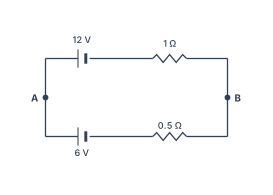
›Reveal solutionSolution
Two cells with internal resistances in parallel drive current through each other; the terminal voltage VAB is found by treating each branch as a source with EMF and internal resistance, then using the parallel-source formula. The answer is 8 V.
Why this approach works: cells with internal resistance in parallel
When two cells are connected in parallel between the same two points A and B, they don't simply "add up" like batteries in series. Each cell has an EMF (electromotive force) and an internal resistance, and they can drive current through each other. The stronger cell (higher EMF per unit resistance) will actually charge the weaker one.
The key insight: treat each branch as a source characterized by its EMF E and internal resistance r. The terminal voltage VAB across the parallel combination is the voltage that appears at the terminals when both sources are connected together. This is given by the weighted average of the EMFs, where the weights are the conductances (reciprocals of internal resistances).
VAB=r11+r21r1E1+r2E2
This formula comes from applying Kirchhoff's laws: the current from each source adjusts so that both branches have the same terminal voltage.
Step-by-step solution
1. Identify the parameters of each branch from the circuit
Figure: two-branch circuit between A and B Reading the circuit:
- Upper branch: EMF E1=12 V, internal resistance r1=1Ω
- Lower branch: EMF E2=6 V, internal resistance r2=0.5Ω
2. Calculate the "weighted EMFs" (EMF divided by internal resistance)
These represent the short-circuit current each source can deliver:
r1E1=112=12 A
r2E2=0.56=12 A
Interestingly, both branches have the same short-circuit current capability.
3. Calculate the sum of conductances
r11+r21=11+0.51=1+2=3Ω−1
4. Apply the parallel-source formula
VAB=312+12=324=8 V
This is the common terminal voltage across both branches.
TipNotice that VAB=8 V lies between the two EMFs (6 V and 12 V), which is always the case for parallel sources. The 12 V cell is discharging (its terminal voltage drops below its EMF), while the 6 V cell is being charged (its terminal voltage rises above its EMF).
Watch outA common mistake is to assume VAB equals the larger EMF (12 V) or to try to "add" the voltages. In parallel, the terminal voltage is determined by the balance of currents from both sources, not by simple addition.
✓Final answerThe potential difference between points A and B is 8 V. The correct option is (B).
- CBSE 2023Set 55/1/11 markMCQQ.The potential difference across a cell in an open circuit is 8 V. It falls to 4 V when a current of 4 A is drawn from it. The internal resistance of the cell is :(a) 4 Ω(b) 3 Ω(c) 2 Ω(d) 1 Ω
›Reveal solutionSolution
The key idea is that the open-circuit voltage is the cell’s EMF (E=8 V), and the drop to 4 V when 4 A flows is due entirely to the voltage drop across the internal resistance r. Using V=E−Ir, we get r=1 Ω, so the correct option is (d).
Every real cell behaves like a perfect EMF source E in series with a small internal resistance r. When no current flows (open circuit), the terminal voltage equals E — there’s no drop across r. But the moment you draw current, r steals some voltage: Vterminal=E−Ir. That’s the whole physics in one line.
Here, the open-circuit reading gives E=8 V. When 4 A is drawn, the terminal voltage crashes to 4 V. That 4 V loss is Ir. So:
- Write the terminal voltage equation:
V=E−Ir
- Plug in the numbers:
4=8−(4)r
- Solve for r:
4r=8−4=4⇒r=1 Ω
Watch outA common mistake is to think the 4 V drop is the internal resistance voltage, but then forget to divide by the current. The drop is 4 V, and since Vdrop=Ir, we have r=4 V/4 A=1 Ω — not 4 Ω or 2 Ω.
TipYou can also think: the internal resistance “eats” half the EMF when 4 A flows. That means r must be such that Ir=4 V, so r=1 Ω. No algebra needed if you see the pattern.
✓Final answerThe internal resistance is 1 Ω, which corresponds to option (d).
- CBSE 2023Set 55/3/11 markMCQQ.Two statements are given – one labelled Assertion (A) and the other labelled Reason (R). Select the correct answer from the codes (a), (b),(c) and(d) below.(a) Both Assertion (A) and Reason (R) are true and Reason (R) is the correct explanation of the Assertion (A).(b) Both Assertion (A) and Reason (R) are true, but Reason (R) is not the correct explanation of the Assertion (A).(c) Assertion (A) is true, but Reason (R) is false.(d) Assertion (A) is false and Reason (R) is also false. Assertion (A) : The internal resistance of a cell is constant. Reason (R) : Ionic concentration of the electrolyte remains same during use of a cell.
›Reveal solutionSolution
Both statements are false: a cell's internal resistance increases as the electrolyte concentration changes and ions are consumed during discharge, making the correct answer (d).
Why internal resistance matters
The internal resistance of a cell arises from the opposition to ion flow within the electrolyte and at the electrode-electrolyte interfaces. If the cell were an ideal voltage source, it would have zero internal resistance. Real cells, however, have finite r that affects the terminal voltage under load: V=E−Ir, where E is the emf and I is the current drawn.
The question asks whether this internal resistance stays constant and whether the electrolyte concentration remains unchanged during use. Both claims touch on what happens inside a cell as it discharges.
Examining the Assertion
Assertion (A): The internal resistance of a cell is constant.
This is false. Internal resistance depends on several factors:
-
Electrolyte concentration: As a cell discharges, chemical reactions consume the active materials. In a typical electrochemical cell, ions are converted or depleted, changing the ionic concentration of the electrolyte. Lower ion concentration means fewer charge carriers, which increases resistivity and thus internal resistance.
-
Temperature: Internal resistance decreases with rising temperature (ions move more freely) and increases when the cell cools.
-
Age and usage: Over time, electrode surfaces may become coated with reaction products (polarization), further increasing resistance.
-
State of charge: A nearly exhausted cell has significantly higher internal resistance than a fresh one.
In practice, r increases noticeably as a cell is used, which is why old batteries deliver lower terminal voltages under the same load.
Examining the Reason
Reason (R): Ionic concentration of the electrolyte remains same during use of a cell.
This is also false. During discharge, electrochemical reactions at the electrodes consume reactants and produce products, directly altering the electrolyte composition.
For example, in a lead-acid cell:
- At the anode: Pb+SO42−→PbSO4+2e−
- At the cathode: PbO2+4H++SO42−+2e−→PbSO4+2H2O
Sulfuric acid (H2SO4) is consumed, reducing the concentration of H+ and SO42− ions. The electrolyte becomes more dilute, which is why the specific gravity of the acid drops as the battery discharges.
Watch outA common misconception is that only the electrodes participate in the reaction. In reality, the electrolyte is an active participant in most cells, and its composition changes continuously during operation.
Connecting the two statements
Even if we hypothetically accepted the Reason as true (constant ionic concentration), it would actually support the Assertion—constant concentration would help maintain constant resistance. But since the Reason is false and describes the very mechanism that causes the Assertion to be false, the Reason cannot explain the Assertion in any meaningful way.
Both statements misrepresent the physics of real electrochemical cells.
✓Final answerThe correct option is (d): both Assertion (A) and Reason (R) are false.
-
- CBSE 2023Set ANNUAL1 markQ.State the condition for maximum current to be drawn from a cell.
›Reveal solutionSolution
Maximum current is drawn when the external resistance matches the internal resistance.
For a cell of EMF ε and internal resistance r connected to an external resistance R, the current is I=R+rε. Although I is largest when R→0, the condition normally asked for — maximum power transfer to the external resistor — occurs when R=r, giving Imax=2rε and maximum power delivered to R equal to 4rε2.
✓Final answerMaximum current is drawn (for maximum power transfer) when the external resistance equals the internal resistance of the cell, R=r, giving Imax=ε/2r.
- CBSE 2022Set ANNUAL1 markQ.What do you understand by internal resistance of a Cell?
›Reveal solutionSolution
Internal resistance r is the opposition to current flow offered by the cell's own electrolyte/electrodes.
Every real cell has some resistance to the flow of charge within itself, arising from the electrolyte and the electrode material -- this is called its internal resistance, denoted r. Because of r, when a cell of emf ε drives a current I through an external resistance R, the terminal potential difference is V=ε−Ir, which is less than the emf. Internal resistance depends on the nature of the electrolyte, the distance between the electrodes, the area of the electrodes, and the temperature -- it increases as the electrolyte gets used up.
✓Final answerThe internal resistance of a cell is the resistance offered by the electrolyte and electrodes inside the cell to the flow of current, causing the terminal voltage to be less than the emf when current is drawn.
- CBSE 2022Set ANNUAL1 markQ.Under what condition, is terminal voltage of a cell equal to its Electromotive Force?
›Reveal solutionSolution
Terminal voltage equals emf when the cell delivers no current, i.e. on open circuit.
For a cell of emf ε and internal resistance r supplying current I, the terminal voltage is
V=ε−Ir.
The drop Ir across the internal resistance vanishes only when
I=0,
so that V=ε.
This happens when the circuit is open (no current is drawn), or equivalently when the terminals are connected to an ideal (infinite-resistance) voltmeter or balanced by a potentiometer at the null point.
✓Final answerWhen no current flows through the cell (open circuit, I=0).
🎓Unlock everything free for 14 days
- ✓Full step-by-step solutions
- ✓Concept-first explanations
- ✓Methods, shortcuts & mistakes
- ✓PYQ mapping + timed mock tests
Full access for 14 days. No credit card required.