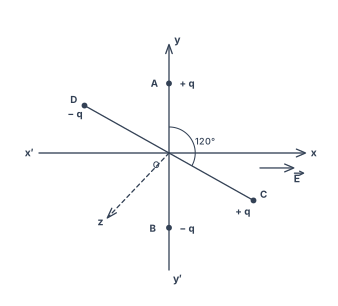
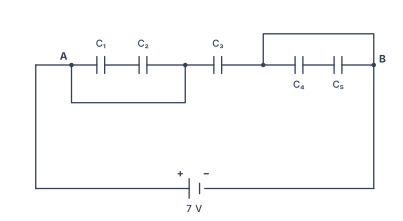
Q.Two small identical electric dipoles AB and CD, each of dipole moment p, are kept at an angle of 120° to each other in an external electric field E pointing along the x-axis as shown in the figure. Find the
🔒You're viewing a preview — the full solution, concept, methods & PYQ mapping are locked.
🔒 Start your 14-day free trial to unlock the full solution →Part (a)Concept understanding — Electric Dipole in a Field
Electric Dipole in a Uniform Field — First Look
Imagine you have a tiny bar magnet. If you place it in a uniform magnetic field, it doesn't get pulled anywhere — but it does twist to align with the field. An electric dipole behaves in exactly the same way when placed in a uniform electric field.
An electric dipole is simply a pair of equal and opposite charges, +q and −q, separated by a small distance d. Think of it as a tiny "stretched" charge. The dipole has a dipole moment p, a vector that points from the negative charge to the positive charge, with magnitude p=qd.
Now place this dipole in a uniform electric field E. Uniform means the field has the same strength and direction everywhere in that region.
What happens? Two forces, one twist
The positive charge feels a force F+=+qE in the direction of the field. The negative charge feels a force F−=−qE opposite to the field. These two forces are equal in magnitude but opposite in direction — so they cancel out as far as net force is concerned. The dipole as a whole does not accelerate linearly.
But the forces are not along the same line. They are separated by the distance d, so they form a couple — a pair of equal, opposite, parallel forces that produce a torque. This torque tries to rotate the dipole so that its dipole moment p aligns with the field E.
No net force means the centre of mass of the dipole stays put. Only rotation happens.
The torque formula
Let the dipole make an angle θ with the field direction (so θ=0 when p and E point the same way). The lever arm for each force about the centre is (d/2)sinθ. The torque from each force is F×lever arm=qE⋅(d/2)sinθ. Since both forces contribute in the same rotational sense, the total torque is:
τ=2⋅qE⋅2dsinθ=qdEsinθ
But qd=p, the dipole moment. So:
τ=pEsinθ
The direction of the torque is such that it tries to reduce θ — to bring p into alignment with E. In vector form:
τ=p×E
What does this mean physically?
- When θ=0 (dipole aligned with field), sin0=0, so torque is zero. This is the stable equilibrium position.
- When θ=90∘ (dipole perpendicular to field), torque is maximum: τmax=pE. …
Part (b)Concept understanding — Capacitor Network Analysis
Capacitor Network Analysis
Imagine you have a bucket of water and a pipe. The bigger the bucket, the more water it can hold for a given water pressure. A capacitor does the same thing with electric charge — it stores charge when a voltage is applied. The "size" of the bucket is called capacitance (C), measured in farads (F).
Now, what happens when you connect several buckets together with pipes? That's a capacitor network. The analysis is about finding one equivalent bucket (a single capacitor) that behaves exactly like the whole network.
The Core Idea: Charge and Voltage Must Match
When you connect capacitors, two things are always true:
- Charge conservation: Total charge in a closed part of the circuit stays the same unless a battery pushes more in.
- Voltage is shared: The voltage across each capacitor depends on how they're wired.
There are only two basic ways to connect them. Everything else is a combination of these two.
Series Connection: One Path, Shared Charge
Connect capacitors end-to-end, like train cars. The same current flows through each, so each capacitor stores the same amount of charge Q.
But the total voltage across the combination is the sum of the individual voltages:
Vtotal=V1+V2+V3+…
Since V=Q/C for each capacitor, we get:
CeqQ=C1Q+C2Q+C3Q+…
Cancel Q (it's the same everywhere):
Ceq1=C11+C21+C31+…
Intuition: Adding capacitors in series makes the equivalent capacitance smaller than the smallest individual one. Why? Because you're effectively making the "bucket" longer and narrower — harder to fill.
A common mistake: students treat series capacitors like series resistors (adding reciprocals for resistors, but adding directly for capacitors). It's the opposite. For resistors in series: Req=R1+R2. For capacitors in series: 1/Ceq=1/C1+1/C2.
Parallel Connection: Multiple Paths, Same Voltage
Connect capacitors side by side, like buckets with their bottoms connected by a wide pipe. Each capacitor sees the same voltage V across it.
But the total charge stored is the sum of charges on each:
Qtotal=Q1+Q2+Q3+…
Since Q=CV for each:
CeqV=C1V+C2V+C3V+…
Cancel V:
Ceq=C1+C2+C3+…
Intuition: Adding capacitors in parallel makes the equivalent capacitance larger — you're just adding more bucket area. Easy to fill.
| Connection | Equivalent Formula | What happens to Ceq |
|------------|-------------------|----------------------------------|
| Series | 1/Ceq=∑1/Ci | Gets smaller than smallest |
| Parallel | Ceq=∑Ci | Gets larger than largest |
How to Analyze Any Network
- Spot the pattern: Look for capacitors that are clearly in series (only two terminals, no branching between them) or clearly in parallel (both ends connected together).
- Replace step by step: Replace each simple series or parallel group with its equivalent capacitor. Redraw the circuit after each step.
- Repeat until you have one capacitor.
This is exactly like simplifying resistor networks — but with the reciprocal formula for series. If you can do resistor networks, you can do capacitor networks. Just flip the series formula.
A Worked Example
Suppose you have three capacitors: C1=2 μF, C2=3 μF, C3=6 μF. C2 and C3 are in parallel, and that combination is in series with C1. …
Part (a)
The two dipoles, each of moment p, are at 120∘. Their resultant (parallelogram law) is
pnet=p2+p2+2p2cos120∘=2p2−p2=p,
directed along the bisector, i.e. 60∘ from each dipole, which is 30∘ from the field (x-axis).
(b) Net torque. With pnet at 30∘ to E,
τ=pnetEsin30∘=pE⋅21=21pE, …
(a) Two equal dipoles at 120∘ give a net moment of magnitude p at 30∘ to the field; the net torque is 21pE directed into the plane of the paper.
(b) With the shorting wires only C3 is active: CAB=4 μF, Qmax=28 μC, U=98 μJ.
Part (a)
Net dipole moment
Two identical dipoles p1,p2 (each magnitude p) are inclined at 120∘. By the parallelogram law,
pnet=p2+p2+2p2cos120∘=2p2+2p2(−21)=p2=p.
The resultant bisects the 120∘ angle, so it lies 60∘ from each dipole. From the figure this places pnet at 30∘ above the field direction (x-axis). (Equivalently, pnet=2pcos60∘=p.)
Net torque
The torque on the arrangement in the uniform field is τ=pnet×E. With the angle between pnet and E equal to 30∘,
τ=pnetEsin30∘=pE⋅21=21pE. …
Showing the 12 most recent of 26 on this concept.
- CBSE 2026Set ANNUAL1 markMCQQ.The size of ideal dipole is :(a) Zero(b) Infinite(c) One(d) None of the above
›Reveal solutionSolution
An ideal dipole is the point-dipole limit: separation → 0 with dipole moment finite, so its size is zero.
An electric dipole consists of two equal and opposite charges +q and −q separated by a small distance 2a, with dipole moment p = q(2a). An 'ideal' (or point) dipole is the mathematical limit in which the separation 2a is made vanishingly small (2a → 0) while simultaneously making q very large …
- CBSE 2026Set SEM31 markMCQQ.Three capacitors having capacitances 1·0 μF, 2·0 μF and 5·0 μF are connected in series with a source of 10 V. The potential difference between the two ends of the capacitor having capacitance 2·0 μF will be(a) 100 V / 17(b) 20 V / 17(c) 50 V / 17(d) 10 V
›Reveal solutionSolution
In series, all capacitors carry the same charge. C_eq = 10/17 μF, Q = 100/17 μC, and V₂ = Q/(2 μF) = 50/17 V. Option (c).
Step 1 — equivalent series capacitance:
1/C_eq = 1/1 + 1/2 + 1/5 = (10 + 5 + 2)/10 = 17/10, so C_eq = 10/17 μF.
Step 2 — common charge (series capacitors share the same charge):
Q = C_eq × V = (10/17 μF)(10 V) = 100/17 μC.
Step 3 — potential difference across the 2·0 μF capacitor: …
- CBSE 2025Set X11 markQ.An electric dipole placed in a uniform electric field experiences a net ________.
›Reveal solutionSolution
torque In a uniform field the forces on the two charges of the dipole are equal and opposite, so the net force is zero, but they act along different lines and constitute a couple that produces a …
- CBSE 2025Set ANNUAL1 markQ.[Case/Source-based passage] An electric dipole consists of two charges +q and −q separated by a small distance 2a. Its total charge is zero. It is characterized by a dipole moment vector p whose magnitude is q×2a and which points in the direction from −q to +q.(i) Write the unit of electric dipole moment.
›Reveal solutionSolution
Dipole moment p=q×2a has units of charge × distance.
The electric dipole moment is defined as p=q×(2a), the product of the magnitude of either charge and the separation between the two charges. Since charge is measured in coulombs (C) and separation in metres (m), the SI unit …
- CBSE 2025Set ANNUAL1 markQ.[Case/Source-based passage] An electric dipole consists of two charges +q and −q separated by a small distance 2a. Its total charge is zero. It is characterized by a dipole moment vector p whose magnitude is q×2a and which points in the direction from −q to +q.(iii) What is polar molecule?
›Reveal solutionSolution
Polar molecules have a built-in charge asymmetry that gives them a permanent dipole moment.
A polar molecule is one in which the centre of the positive charge distribution and the centre of the negative charge distribution do not coincide, due to the asymmetric arrangement of atoms and the unequal sharing of electrons between them (unequal electronegativities). As a result, such a molecule possesses a permanent (built-in) electric dipole moment, which exists even in the absence of any external electric field. Common examples include water (H₂O), HCl, and NH₃. This is in contrast to a non-polar molecule (like O2 or CO2), where the positive and negative charge centres coincide, giving zero perma …
- CBSE 2025Set ANNUAL1 markQ.Define the electric dipole moment.
›Reveal solutionSolution
An electric dipole moment measures the strength and orientation of a pair of equal and opposite charges separated by a small distance.
An electric dipole consists of two equal and opposite point charges +q and −q separated by a small distance 2a. Its electric dipole moment is defined as the vector:
p=q(2a)
…
- CBSE 2025Set ANNUAL1 markMCQQ.What orientation of an electric dipole in uniform electric field is said to be in stable equilibrium ?(a) θ = 0(b) θ = 90(c) θ = 120(d) θ = 180
›Reveal solutionSolution
A dipole is in stable equilibrium when its dipole moment is parallel to the field, i.e. θ = 0°.
The torque on a dipole in a uniform field is τ=pEsinθ, and its potential energy is U=−pEcosθ.
Both θ = 0° and θ = 180° give zero torque (equilibrium positions), but they are not equally stable:
- At θ = 0°, U=−pE (minimum energy) → any small angular displacement creates a restoring torque that brings p back to alignment with E. This is stable equilibrium. …
- CBSE 2025Set ANNUAL1 markMCQQ.When two identical capacitors are in series, they have 3 uF resultant capacitance and when parallel 12 uF. What is the capacitance of each?(i) 6 uF(ii) 3 uF(iii) 12 uF(iv) 9 uF
›Reveal solutionSolution
Each capacitor is 6 uF.
…
- CBSE 2024Set 55/1/11 markMCQQ.Ten capacitors, each of capacitance 1 μF, are connected in parallel to a source of 100 V. The total energy stored in the system is equal to : (A) 10−2 J (B) 10−3 J (C) 0.5×10⁻³ J (D) 5.0×10⁻² J
›Reveal solutionSolution
For capacitors in parallel, the total capacitance is the sum of individual capacitances. Here, Ceq=10 μF. Energy stored is 21CeqV2=21×10×10−6×(100)2=0.05 J=5.0×10⁻² J. The correct option is (D).
When capacitors are connected in parallel, the voltage across each capacitor is the same — equal to the source voltage. This is the key difference from series connections, where the charge is the same but voltage divides. Because all ten capacitors are identical and each sees the full 100 V, the total energy is simply the sum of the energies stored in each capacitor individually.
The energy stored in a single capacitor of capacitance C at voltage V is 21CV2. For ten such capacitors, the total energy is 10×21CV2=21(10C)V2. Notice that 10C is exactly the equivalent capacitance of ten 1 μF capacitors in parallel. So the problem reduces to finding the energy stored in a single 10 μF capacitor charged to 100 V.
Let’s work through the numbers carefully.
-
Find the equivalent capacitance.
For parallel combination: Ceq=C1+C2+⋯+C10=10×1 μF=10 μF.
In SI units: 10 μF=10×10−6 F=10−5 F.
-
Apply the energy formula.
The energy stored in a capacitor network (or a single equivalent capacitor) is U=21CeqV2, where V is the voltage across the combination.
Here V=100 V, so:
U=21×(10−5)×(100)2=21×10−5×104=21×10−1=0.05 J. …
-
- CBSE 2024Set A11 markMCQQ.The electric dipole placed in uniform electric field is unstable, if the angle between electric field and dipole moment is(a) 0∘(b) 60∘(c) 90∘(d) 180∘
›Reveal solutionSolution
- CBSE 2024Set IMPROVEMENT1 markMCQQ.Assertion (A): In water molecule H2O there is permanent dipole moment even in absence of external electric field. Reason (R): In some molecules the centres of negative and positive charges do not coincide.(a) Both A and R are correct and R is the correct explanation of A.(b) Both A and R are correct but R is not the correct explanation of A.(c) A is correct but R is incorrect.(d) Both A and R are incorrect.
›Reveal solutionSolution
Water is a polar molecule because its bent geometry separates the centres of positive and negative charge, giving it a permanent dipole moment.
Assertion (A) is correct: the water molecule H2O possesses a permanent electric dipole moment even without any external field, because it is a polar molecule. Reason (R) is also correct: a permanent dipole moment arises in molecules whose positive and negative charge centres do not coincide — in H2O, the bent (non-linear) shape of the molecule means the centre of the negative charge (near the oxygen) does …
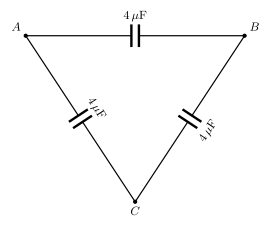
- CBSE 2024Set ANNUAL1 markMCQQ.Three capacitors are connected in triangle as shown in figure. The equivalent capacitance between the points A and C is :
 (a) 4 μF(b) 2 μF(c) 8 μF(d) 6 μF
›Reveal solutionSolution
The direct A-C capacitor is in parallel with the series A-B-C path (which reduces to 2μF), giving a total equivalent capacitance of 6μF between A and C.
Working
Three 4μF capacitors form a triangle with vertices A, B, C: one directly between A and C, one between A and B, and one between B and C.
Between the terminals A and C, there are two parallel paths:
- The capacitor directly connecting A to C: C1=4μF.
- The path A → B → C, formed by the A-B and B-C capacitors in series: …
🎓Unlock everything free for 14 days
- ✓Full step-by-step solutions
- ✓Concept-first explanations
- ✓Methods, shortcuts & mistakes
- ✓PYQ mapping + timed mock tests
Full access for 14 days. No credit card required.