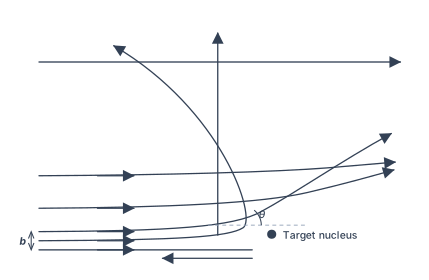
Q.In Geiger-Marsden scattering experiment, the trajectory of -particles in Coulomb's field of a heavy nucleus is shown in the figure.
You're viewing a preview — the full solution, concept, methods & PYQ mapping are locked.
Start your 14-day free trial to unlock the full solution →The impact parameter is the perpendicular distance between the initial velocity direction of an -particle and the centre of the target nucleus. The scattering angle is the angle by which the -particle is deflected from its original path. For (no deflection), is very large (effectively infinite). For (head-on collision), .
The Geiger-Marsden experiment (Rutherford’s gold foil experiment) revealed that the atom has a tiny, dense, positively charged nucleus. The key to understanding the results lies in the Coulomb repulsion between the positively charged -particle and the nucleus. The path an -particle takes depends entirely on how close it comes to the nucleus — and that closeness is measured by the impact parameter.
Think of it like throwing a ball at a pillar. If you aim directly at the centre, the ball hits head-on and bounces straight back. If you aim slightly off-centre, the ball glances off at an angle. If you aim far away, the ball barely changes direction. The impact parameter is the “miss distance” — how far off-centre you are aiming.
Step-by-step reasoning
-
What represents
The impact parameter is the perpendicular distance between the initial velocity vector of the -particle (when it is far away from the nucleus) and the centre of the nucleus.
In the figure above, is shown as the offset distance on the left side, before the particle reaches the nucleus.
-
What represents
The scattering angle is the angle through which the -particle is deflected from its original straight-line path.
In the figure, is marked near the nucleus, between the incoming direction (extended) and the outgoing direction.
A larger means a more severe deflection.
-
Relation between and
From Coulomb’s law and conservation of energy and angular momentum, the scattering angle is related to the impact parameter by:
where is the kinetic energy of the -particle, is the nuclear charge, and .
This formula tells us:
- When is large, is large, so is small → is small (near ).
- When is small, is small, so is large → is large (near ).
- When , , which means , so .
- Case (i): If the -particle is not deflected at all, it must have passed very far from the nucleus. The Coulomb force is negligible. Mathematically, implies , so . …
Unlock everything free for 14 days
- Full step-by-step solutions
- Concept-first explanations
- Methods, shortcuts & mistakes
- PYQ mapping + timed mock tests
Full access for 14 days. No credit card required.