Q.(a) Derive the condition of balance for Wheatstone bridge.
You're viewing a preview — the full solution, concept, methods & PYQ mapping are locked.
Start your 14-day free trial to unlock the full solution →A Wheatstone bridge balances when the ratio of resistances in one arm equals the ratio in the other: , making the galvanometer current zero. The meter bridge implements this principle using a uniform wire, locating the null point to measure unknown resistance.
Part (a): Deriving the Balance Condition
The Wheatstone bridge exploits a beautiful symmetry. When four resistors are arranged in a diamond configuration with a galvanometer connecting the middle nodes, we can adjust them until no current flows through the galvanometer. At that moment, the bridge is "balanced," and the resistances obey a simple ratio.
The Circuit Setup
Consider four resistances , , , and arranged as:
- and in series along the top path (from point to )
- and in series along the bottom path (from point to )
- A galvanometer connecting the junction between and (call it ) to the junction between and (call it )
- A battery of emf connected between and
Why Balance Occurs
The galvanometer reads zero when points and are at the same potential. If they're at the same potential, there's no reason for current to flow between them.
Step-by-Step Derivation
-
Apply Kirchhoff's laws when the galvanometer current .
Let current flow through and , and current flow through and . Since no current flows through the galvanometer at balance, the same current that enters exits through , and likewise for and .
-
Write the potential difference from to along the upper arm:
- Write the potential difference from to along the lower arm:
- Since at balance (no galvanometer current):
- Now consider the potential from to and from to :
- Again, since :
- Divide equation (i) by equation (ii):
The currents cancel:
This is the balance condition for a Wheatstone bridge. Cross-multiplying gives the equivalent form .
The balance condition is independent of the battery emf and the galvanometer resistance. It depends only on the four resistances, making the bridge a precise null method for measuring resistance.
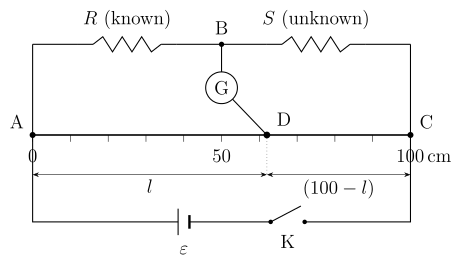
Part (b): Meter Bridge Circuit and Its Connection to Wheatstone Bridge
The meter bridge is a practical realization of the Wheatstone bridge using a uniform resistance wire.
Circuit Description
- A uniform resistance wire AC of length 100 cm (typically made of constantan or manganin) is stretched along a meter scale.
- Two gaps in the metallic strip below the wire: one contains the known resistance , the other contains the unknown resistance .
- These two resistances are connected in series between points and through the gaps.
- A galvanometer with one terminal connected to point (the junction between and ).
- The other terminal of the galvanometer is connected to a jockey (a sliding contact) that can touch the wire at any point .
- A battery is connected across and with a key .
How It Implements Wheatstone Bridge
The uniform wire AC acts as two resistances in series: …
Unlock everything free for 14 days
- Full step-by-step solutions
- Concept-first explanations
- Methods, shortcuts & mistakes
- PYQ mapping + timed mock tests
Full access for 14 days. No credit card required.