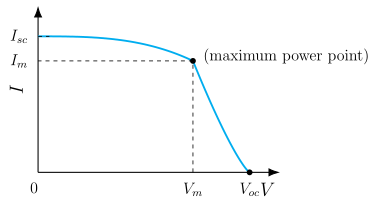
Q.What is the function of a solar cell ? Briefly explain its working and draw its I-V characteristic curve.
You're viewing a preview — the full solution, concept, methods & PYQ mapping are locked.
Start your 14-day free trial to unlock the full solution →A solar cell converts light energy directly into electrical energy through the photovoltaic effect. When photons strike a p-n junction, they generate electron-hole pairs that are separated by the built-in electric field, producing a voltage and current. The I-V curve shows that current decreases from to zero as voltage increases from zero to .
Function of a Solar Cell
A solar cell is a semiconductor device that converts light energy (photons) directly into electrical energy through the photovoltaic effect. It acts as an energy transducer, transforming electromagnetic radiation into usable electric power without any moving parts or chemical reactions.
The fundamental principle relies on the behavior of a p-n junction when exposed to light. Unlike a regular diode that operates in darkness, a solar cell is designed to absorb photons and use their energy to create charge carriers that can drive an external current.
Working Principle
The operation hinges on three key processes:
1. Photon Absorption and Carrier Generation
When light strikes the solar cell, photons with energy greater than the band gap of the semiconductor are absorbed. Each absorbed photon excites an electron from the valence band to the conduction band, creating an electron-hole pair. Silicon solar cells typically use , which matches well with the solar spectrum.
2. Charge Separation by the Built-in Field
The p-n junction creates a depletion region with a built-in electric field pointing from the n-side to the p-side. This field is crucial: when electron-hole pairs are generated in or near the depletion region, the field sweeps electrons toward the n-side and holes toward the p-side before they can recombine. This spatial separation of charges creates a potential difference across the junction.
3. Current Collection
The separated charges accumulate on opposite sides of the junction, with the n-side becoming negative and the p-side positive. When an external circuit is connected, electrons flow from the n-side through the load to the p-side, delivering electrical power. The illuminated junction thus acts as a current source, with the light-generated current flowing opposite to the normal diode current.
The solar cell is essentially a diode that operates in the fourth quadrant of the I-V plane (negative current, positive voltage), delivering power rather than consuming it.
Current-Voltage Characteristic
The I-V relationship of an illuminated solar cell is given by:
where is the light-generated current, is the reverse saturation current, is electron charge, is Boltzmann's constant, and is temperature.
Key points on the characteristic:
-
Short-circuit current (): When (terminals shorted), . This is the maximum current the cell can deliver.
-
Open-circuit voltage (): When (open terminals), solving gives . This is the maximum voltage across the cell. …
Unlock everything free for 14 days
- Full step-by-step solutions
- Concept-first explanations
- Methods, shortcuts & mistakes
- PYQ mapping + timed mock tests
Full access for 14 days. No credit card required.