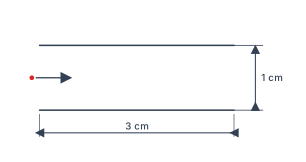
Q.A beam of electrons moving horizontally with a velocity of 3×10⁷ m/s enters a region between two plates as shown in the figure. A suitable potential difference is applied across the plates such that the electron beam just strikes the edge of the lower plate. Answer the following questions based on the above :
🔒You're viewing a preview — the full solution, concept, methods & PYQ mapping are locked.
🔒 Start your 14-day free trial to unlock the full solution →Part (a)Concept understanding — Force on a Charge in a Uniform Electric Field
Force on a Charge in a Uniform Electric Field
A charge q placed in an electric field E experiences a force
F=qE,
of magnitude F=qE, directed along E for a positive charge and opposite for a negative one. The force is independent of the charge's mass and (in a uniform field) of its position.
Many problems balance this force against gravity: a charged drop or particle is held stationary (or 'suspended') when qE=mg, giving E=mg/q. Once released, the particle moves under a constant acceleration
a=mqE, …
Part (b)Concept understanding — Magnetic Force Balance
Magnetic Force Balance
When a current-carrying wire or coil sits in a magnetic field, it feels a force F=BILsinθ (or, for a point charge, F=qvBsinθ). On its own that force just pushes the conductor - but in many real situations the push is deliberately set up to CANCEL another force, so the whole system sits in equilibrium. That equilibrium condition - magnetic force balanced against weight, against another wire's magnetic force, or against a mechanical counterweight - is what "magnetic force balance" means, and it is also historically how the ampere itself was defined.
The balance condition
Whenever a conductor is in equilibrium under a magnetic force and one other force, the two must be equal and opposite:
BILsinθ=Fother
Solving this equation for whichever quantity is unknown (B, I, L, or the other force) is the entire skill in this class of problem - the only new step, beyond the force law itself, is correctly identifying what the magnetic force is opposing.
Case 1: a wire suspended against gravity
A straight horizontal wire of mass m and length l, carrying current I, can be held up ("floated") in mid-air by a horizontal magnetic field perpendicular to it. The upward magnetic force must equal the downward weight:
BIl=mg⟹B=Ilmg
For example, a 200g, 1.5m wire carrying 2A needs B=(2)(1.5)(0.2)(9.8)≈0.65T to stay suspended.
Case 2: two wires balancing each other
Two long parallel wires carrying currents I1,I2 exert a force per unit length on each other of 2πdμ0I1I2 (attractive if the currents run the same way, repulsive if opposite). If one wire is free to move, this magnetic force can itself balance that wire's weight:
2πhμ0I2L=mg⟹h=2πmgμ0I2L
This is exactly how a "current balance" apparatus works, and historically it is how the ampere was defined: the current that, flowing in two infinite parallel wires one metre apart, produces a force of exactly 2×10⁻⁷N per metre of length.
Case 3: balancing on a beam
A current-carrying coil arm hanging from one pan of a beam balance feels an extra force F=NBIl when only that arm sits in an external field. Re-balancing the beam means adding a mass m so that mg=NBIl.
Always check which length enters the formula - for a coil of N turns the force multiplies by N; for a single suspended straight wire it doesn't. …
Why this formula?
Magnetic Force Balance: Why the Key Formulas Hold
The Magnetic Force Balance describes when the magnetic force on a charged particle or current-carrying conductor is exactly balanced by another force (gravity, electric force, or tension). Let's build the reasoning step-by-step.
1. The Core Idea: What Does "Balance" Mean?
A force balance means the net force on an object is zero:
Fnet=0
For magnetic forces we use the Lorentz force law:
- On a moving charge: Fm=q(v×B)
- On a current-carrying wire: Fm=I(L×B)
When this is balanced by another force (say gravity Fg=mg):
Fm+Fother=0
2. Case 1: Charged Particle in Crossed Fields (Velocity Selector)
A charged particle moves perpendicular to both electric field E and magnetic field B.
- Electric force: Fe=qE (along E)
- Magnetic force: Fm=q(v×B) (perpendicular to both v and B)
For straight-line motion (no deflection), the two forces must cancel:
qE=qvB⇒v=BE
Key insight: Only particles with this exact speed pass undeflected — this is how velocity selectors work in mass spectrometers.
3. Case 2: Current-Carrying Wire Balanced by Gravity
A horizontal wire carrying current I sits in a perpendicular magnetic field B, suspended by strings.
The magnetic force on a straight wire is Fm=ILBsinθ; for a wire perpendicular to the field (θ=90∘), Fm=ILB. Setting this equal to the weight Fg=mg for equilibrium:
ILB=mg
Key insight: This balance lets you measure B if I, L, and m are known — the principle behind a current balance experiment.
4. Case 3: Circular Motion of a Charged Particle …
(Plate dimensions read from the figure: plate length L=3 cm, plate separation d=1 cm; the beam enters mid-way and just grazes the lower edge, so vertical deflection y=d/2=0.5 cm.)
Part (a)
- Time to cross: horizontal speed is constant (v=3×10⁷ m/s):
t=vL=3×1070.03=1×10⁻⁹ s=1 ns.
- Shape: a parabola — constant horizontal velocity together with a constant vertical acceleration a=eE/m (exactly like a horizontal projectile under gravity).
- Potential difference: y=21at2=21mdeVt2⇒V=et22ymd. …
The electron crosses the plates in t=1 ns; its path is a parabola; the required deflecting voltage is ≈57 V. To make the same beam travel straight, a magnetic field B≈1.9×10⁻⁴ T pointing out of the page balances the electric force.
(Values taken from the figure: plate length L=3 cm, separation d=1 cm; the beam enters midway and grazes the lower edge, giving vertical deflection y=d/2=0.5 cm.)
Part (a)
The electric field between the plates is perpendicular to the entry velocity, so the motion separates into two independent one-dimensional problems — uniform horizontal motion and uniformly accelerated vertical motion, exactly like projectile motion.
- Transit time. No horizontal force acts, so vx=3×10⁷ m/s is constant:
t=vxL=3×1070.03=1×10⁻⁹ s=1 ns.
- Shape of the path. The vertical electric force gives a constant acceleration ay=meE; with constant vx and y=21ayt2 the trajectory is a parabola (a circular path would need a magnetic, not electric, force).
- Potential difference. The vertical deflection over the plate length is
Substituting y=5×10⁻³ m, m=9.1×10⁻³¹ kg, d=0.01 m, e=1.6×10⁻¹⁹ C, t=10−9 s: …
y=21ayt2=21meEt2=21mdeVt2 ⇒ V=et22ymd.
Showing the 12 most recent of 17 on this concept.
- CBSE 2026Set ANNUAL1 markQ.Write dimensional formula of magnetic permeability.
›Reveal solutionSolution
From B = μ₀nI and force relations, [μ₀] = [M L T⁻² A⁻²].
Magnetic permeability μ₀ can be found from the force per unit length between two parallel current-carrying wires: F/l = μ₀ I₁I₂/(2πd). Rearranging, μ₀ = (F/l)(2πd)/(I₁I₂).
Dimensions:
- Force per unit length F/l has dimensions [M L T⁻²]/[L] = [M T⁻²]. …
- CBSE 2025Set D1 markMCQQ.Which of the following has unit volt-metre^-1? (A) Electric flux (B) Electric potential (C) Electric field (D) Electric capacity
›Reveal solutionSolution
Volt per metre (V/m) is the unit of electric field.
Electric field is force per unit charge, E = F/q, giving N/C. It is also the negative gradient of potential, E = −dV/dx, giving volt/metre. These two units are identical: 1 N/C = 1 V/m.
…
- CBSE 2025Set ANNUAL1 markMCQQ.An electron placed in an electric field experiences an electrical force equal to its weight. The magnitude of the field is(a) mge(b) mg/e(c) e/mg(d) e^2g/2m
›Reveal solutionSolution
When the electric force on a charge exactly balances its weight, eE = mg, so the field magnitude is E = mg/e.
An electron of mass m and charge magnitude e placed in a uniform electric field E experiences an electric force of magnitude F = eE.
It is given that this electric force equals the electron's weight:
eE = mg
Solving for E:
E = mg/e
…
- CBSE 2025Set ANNUAL1 markMCQQ.The electrostatic force per unit charge is known as ______.(a) Electric current(b) Electric potential(c) Electric field
›Reveal solutionSolution
The electrostatic force experienced per unit positive test charge, placed at a point, is by definition the electric field at that point.
The electric field E at a point is defined operationally as the force F that a small positive test charge q0 would experience at that point, divided by the magnitude of the test charge:
E=q0F …
- CBSE 2025Set ANNUAL1 markQ.The test charge used to measure electric field at a point should be vanishingly small. Why?
›Reveal solutionSolution
A vanishingly small test charge is used so it does not alter the very field/source-charge distribution it is being used to measure.
Electric field at a point is defined as E=limq0→0q0F, where q0 is a small positive test charge placed at that point.
If the test charge were large, it would exert a significant force of its own on the source charge(s) creating the field, causing them to shift position (if free to move) or altering the charge distribution. This would change the very field being measured, giving an inaccurate value. By taking the limit as q0→0, we ens …
- CBSE 2024Set ANNUAL1 markMCQQ.The electrostatic force experienced by a unit positive charge at a point in space is called -(a) Electric Current(b) Electric Potential(c) Electric Field(d) Electric Space
›Reveal solutionSolution
The force per unit positive test charge at a point defines the electric field there.
By definition, the electric field E at a point in space is the electrostatic force F experienced by a very small unit positive test charge placed at that point: E=F/q0. This is distinct from …
- CBSE 2024Set A1 markMCQQ.The dimensional formula of intensity of electric field is (A) [MLT^-2 A^-1] (B) [MLT^-3 A^-1] (C) [MLT^-3 A] (D) [ML^2 T^-3 A^-1]
›Reveal solutionSolution
E = Force/charge → [MLT⁻²]/[AT] = [MLT⁻³A⁻¹].
Electric field intensity is force per unit charge: E=qF.
Dimensions of force = [MLT⁻²]. Dimensions of charge = current × time = [AT]. …
- CBSE 2024Set ANNUAL1 markMCQQ.Which one of the following is the unit of Electric field?(a) Coulomb(b) Newton(c) Volt(d) NC⁻¹
›Reveal solutionSolution
Electric field is force per unit charge, so its SI unit follows directly from N/C.
Electric field at a point is defined as the force experienced per unit positive test charge placed there:
E=q0F
Force is measured in newtons (N) and charge in coulombs (C), so the SI unit of E is newton per coulomb (NC⁻¹) — this is numerically the same as volt per metre (V/m), but NC⁻¹ is the unit that comes directly from the defining equation.
…
- CBSE 2023Set 55/3/11 markMCQQ.An electron experiences a force (1.6×10⁻¹⁶ N)i^ in an electric field E. The electric field E is :(a) (1.0×10³ CN)i^(b) −(1.0×10³ CN)i^(c) (1.0×10⁻³ CN)i^(d) −(1.0×10⁻³ CN)i^
›Reveal solutionSolution
The force on a charge in an electric field is F=qE; since the electron has negative charge and the force points in +i^, the field must point in −i^ with magnitude 1.0×10³N/C. The answer is (b).
The relationship between electric force and electric field is one of the most fundamental in electrostatics. A charge q placed in an electric field E experiences a force given by
F=qE
This is the defining equation for the electric field: the field is the force per unit positive charge. The key insight here is that the sign of the charge matters. A positive charge experiences force in the same direction as the field, but a negative charge experiences force opposite to the field direction.
An electron carries charge q=−e=−1.6×10⁻¹⁹C.
Let me work through this systematically:
-
Write down what we know.
The force on the electron is F=(1.6×10⁻¹⁶N)i^, pointing in the positive x-direction. The electron's charge is q=−1.6×10⁻¹⁹C.
-
Apply the force-field relationship.
From F=qE, we can solve for the electric field:
E=qF
- Substitute the values.
E=−1.6×10⁻¹⁹C(1.6×10⁻¹⁶N)i^
- Simplify the magnitude. …
-
- CBSE 2023Set F1 markMCQQ.The force, acting on per unit charge is called (A) Electric current (B) Electric potential (C) Electric field (D) Electric space
›Reveal solutionSolution
Electric field E = F/q₀ — the force experienced per unit positive test charge.
The electric field at a point is defined as the electrostatic force experienced by a small positive test charge placed there, divided by the magnitude of that charge:
E=q0F
…
- CBSE 2023Set F1 markMCQQ.Which of the following physical quantities is a vector? (A) Electric flux (B) Electric potential (C) Electric potential energy (D) Electric intensity
›Reveal solutionSolution
Electric intensity (field) is a vector; flux, potential, PE are scalars.
- Electric flux Φ=E⋅A is a dot product → scalar.
- Electric potential V → scalar (energy per unit charge).
- Electric potential energy → scalar (energy). …
- CBSE 2022Set I1 markMCQQ.Intensity of electric field at a point is (A) E = Fq (B) E = F/q (C) E = ½Fq (D) E = q/F
›Reveal solutionSolution
Electric field intensity E = F/q.
The electric field at a point is defined as the force experienced per unit positive test charge placed at that point:
E=qF
…
🎓Unlock everything free for 14 days
- ✓Full step-by-step solutions
- ✓Concept-first explanations
- ✓Methods, shortcuts & mistakes
- ✓PYQ mapping + timed mock tests
Full access for 14 days. No credit card required.