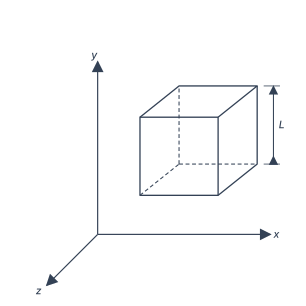
Q.(a)
🔒You're viewing a preview — the full solution, concept, methods & PYQ mapping are locked.
🔒 Start your 14-day free trial to unlock the full solution →Part (a)Concept understanding — Gauss Law
Gauss's Law is a shortcut. Instead of adding up the Coulomb contribution of every charge — a nightmare of vectors and integrals — it lets you read the field straight off the symmetry of a problem. The whole idea rests on one quantity: electric flux.
Flux — field-lines counted through a surface. For a uniform field E crossing a flat area A, the flux is Φ = E·A = EA cosθ, where θ is the angle between the field and the normal to the surface. Picture the field as a bundle of lines; flux is how many pierce the surface. When E is edge-on (θ = 90°) nothing passes through and Φ = 0; when E is ⊥ to the surface (θ = 0) the count is maximal. For a closed surface, Φ is the net number of lines leaving it — lines that enter and exit cancel.
The law itself. Gauss's law states that the net flux out of any closed surface depends only on the charge trapped inside:
Φ = q_enclosed / ε₀.
Two consequences do most of the work. First, only enclosed charge counts — a charge outside sends as many lines in as out, so its net contribution is exactly zero. Second, the surface's shape is irrelevant; move the charge around inside or deform the surface, and Φ never changes.
Why symmetry makes it powerful. By itself Φ = q/ε₀ has E buried in an integral. It becomes a tool only when you pick a Gaussian surface matched to the symmetry — one where E is constant and everywhere either ⊥ to the surface (so Φ = EA) or ∥ to it (contributing nothing). Then E slides out and you solve in one line. This works for exactly three geometries:
1 — Infinite line charge (linear density λ). Use a coaxial cylinder: E = λ / 2πε₀r, falling off as ∝ 1/r.
2 — Infinite sheet (surface density σ). Use a pillbox pierced through the sheet: E = σ / 2ε₀ — uniform and completely independent of distance. The field near a large charged plane simply doesn't weaken as you step back. …
Why this formula?
Gauss's Law: Why It Holds
Gauss's Law is one of the four Maxwell's equations and a cornerstone of electromagnetism. Let's build the understanding from the ground up — not just the formula, but the why.
1. The Core Idea: Flux as "Flow" of Field
Imagine an electric field E passing through a small patch of area dA. The electric flux through that patch is:
dΦE=E⋅dA=EdAcosθ
where θ is the angle between E and the outward normal to the surface.
Why this definition?
- If E is perpendicular to the surface (θ=0), maximum field "flows through".
- If E is parallel (θ=90∘), no flux — the field just slides along the surface.
Total flux through a closed surface S is:
ΦE=∮SE⋅dA
2. The Key Insight: Flux Depends Only on Enclosed Charge
Consider a single point charge +q at the centre of a spherical surface of radius r.
- By Coulomb's law, at every point on the sphere: E=4πε01r2q, radially outward.
- The area vector dA is also radially outward.
- So E⋅dA=EdA everywhere.
The total flux:
ΦE=∮EdA=E∮dA=(4πε01r2q)(4πr2)=ε0q
Notice: The r2 cancels! The flux is independent of the radius.
3. Why Shape Doesn't Matter
Now, what if the surface is not spherical but any closed shape enclosing the charge?
- Draw a small cone from the charge to the surface.
- The flux through a patch dA at distance r is dΦ=4πε01r2qcosθdA.
- But r2cosθdA is exactly the solid angle dΩ subtended by dA at the charge.
So dΦ=4πε0qdΩ.
Integrating over the entire closed surface: ∮dΩ=4π (total solid angle around a point).
Hence:
ΦE=4πε0q⋅4π=ε0q
Result: For any closed surface enclosing q, the flux is ε0q.
4. Multiple Charges: Superposition
If there are many charges q1,q2,…,qn inside the surface, the total electric field is the vector sum of individual fields:
E=E1+E2+⋯+En
Flux is linear: …
Part (b)Concept understanding — Electric Potential
Electric Potential
The Idea
When you lift a book onto a shelf you do work against gravity, and the book gains gravitational potential energy that depends on where it sits. Electric charges behave the same way in an electric field. Electric potential is the electrical analogue of "height" in a gravitational field: it tells you the potential energy a unit charge would have at a given point.
Formally, the electric potential at a point is the work done in bringing a unit positive charge from infinity to that point, slowly (without giving it kinetic energy), against the electric field.
V=q0W
Here W is the work done to move a small test charge q0 from infinity to the point. Because both W and q0 are scalars, electric potential is a scalar quantity — it has magnitude but no direction. Its SI unit is the volt:
1 V=1 J/C
Potential Due to a Point Charge
For a single point charge q, the potential at a distance r from it is
V=4πε01rq
Notice it falls off as 1/r, whereas the electric field of a point charge falls off as 1/r2. The potential is taken as zero at infinity, our chosen reference. A positive charge makes the potential around it positive; a negative charge makes it negative.
Potential Difference
Usually we care about the potential difference between two points A and B:
VA−VB=q0WB→A
the work per unit charge needed to move a charge from B to A. This is the quantity a voltmeter reads and the "voltage" that drives current in a circuit.
Relation Between Field and Potential
Field and potential are two views of the same thing. The electric field is the negative rate of change of potential with distance:
E=−drdV
The minus sign says the field points from high potential toward low potential — a positive charge, left free, rolls "downhill" in potential. Where the potential changes steeply, the field is strong.
Superposition
Because potential is a scalar, the potential due to several charges is just the algebraic sum of their individual potentials — no vectors, no angles:
V=4πε01(r1q1+r2q2+⋯)
This makes potential far easier to compute than the field, which needs vector addition. Once you have V everywhere, you can get the field by differentiating.
Equipotential Surfaces
An equipotential surface is a surface on which the potential has the same value everywhere.
- No work is done in moving a charge along an equipotential surface (since ΔV=0).
- The electric field is always perpendicular to an equipotential surface. …
Part (a)
(i) Electric flux. The measure of electric field lines crossing a surface, ϕ=∫E⋅dA. SI unit: Nm2C−1 (or Vm).
(ii) Field of an infinite charged plane sheet (charge density σ). By symmetry E⊥ sheet. Take a cylindrical Gaussian pillbox of end‑cap area A piercing the sheet. Curved surface gives no flux; each cap gives EA, so net flux =2EA, and enclosed charge =σA:
2EA=ε0σA⇒E=2ε0σ,
directed away from (toward) a positive (negative) sheet.
(iii) Net charge in the cube. With E=(Ax+B)i^, only the two faces ⊥x give flux.
Right face (x=x1+L): ϕ2=[A(x1+L)+B]L2; left face (x=x1, outward normal −i^): ϕ1=−(Ax1+B)L2. …
Part (a): ϕ=∫E⋅dA (unit Nm2C−1); an infinite sheet gives E=σ/2ε0; the cube encloses q=ε0AL3.
Part (b): V = work per unit charge (volt); series capacitors give 1/Ceq=1/C1+1/C2; and Q=12q/5 makes the system's potential energy zero.
Part (a)
(i) Electric flux and its unit
Electric flux through a surface measures the electric field lines threading it:
ϕ=∫E⋅dA.
SI unit: Nm2C−1 (equivalently Vm).
(ii) Field of a uniformly charged infinite plane sheet
Let the surface charge density be σ. By symmetry the field is perpendicular to the sheet and equal in magnitude on both sides. Choose a cylindrical Gaussian pillbox of cross‑section A passing through the sheet.
- Flux through the curved side =0 (E∥ surface).
- Flux through each flat cap =EA, so total flux =2EA.
- Charge enclosed =σA.
Gauss's law ∮E⋅dA=ε0qenc gives
2EA=ε0σA⇒E=2ε0σ.
It is independent of distance from the sheet and points away from a positively charged sheet.
(iii) Net charge enclosed by the cube
The field E=(Ax+B)i^ points along x, so only the two faces perpendicular to the x‑axis contribute; the other four are parallel to E and carry no flux.
- Right face at x=x1+L (outward normal +i^): ϕright=[A(x1+L)+B]L2.
- Left face at x=x1 (outward normal −i^): ϕleft=−(Ax1+B)L2.
ϕnet=ϕright+ϕleft=[A(x1+L)+B−(Ax1+B)]L2=AL⋅L2=AL3.
The position x1 and constant B cancel. By Gauss's law, …
Showing the 12 most recent of 81 on this concept.
- CBSE 2026Set 55/1/11 markMCQQ.A conducting wire connects two charged metallic spheres A and B of radii r1 and r2 respectively. The distance between the spheres is very large compared to their radii. The ratio of electric fields, (EBEA) at the surfaces of spheres A and B will be (A) r2r1 (B) r1r2 (C) r22r12 (D) r12r22
›Reveal solutionSolution
When two widely separated conducting spheres are connected by a wire, they reach the same electric potential. Since surface field E=r2kQ and potential V=rkQ, combining these gives E∝1/r. Therefore the ratio of surface fields is EA/EB=r2/r1, which corresponds to option (B).
The key insight here is about what happens when conductors are connected by a wire. Charge flows until both spheres are at the same electric potential — that's the fundamental condition for electrostatic equilibrium in a conductor. Once you grasp that, the rest is just algebra.
Let's think about why potential equality is the right starting point. A conducting wire means the two spheres form a single conductor. In electrostatics, the entire surface of a conductor is an equipotential. So spheres A and B must have the same potential V.
Now, for an isolated conducting sphere of radius r carrying charge Q, the potential at its surface (taking infinity as zero) is:
V=4πϵ01rQ
And the electric field just outside its surface is:
E=4πϵ01r2Q
Notice the relationship: E=V/r. That's a neat shortcut we'll use.
TipFor any isolated conducting sphere, E=V/r directly. This saves you from carrying the Q through the algebra — just remember it comes from V=kQ/r and E=kQ/r2.
Let's work through it step by step.
- Set potentials equal. Since the wire connects them, VA=VB. Using V=kQ/r (where k=1/4πϵ0):
kr1QA=kr2QB
Cancel k and rearrange:
QBQA=r2r1
- Write the surface field ratio. For each sphere, E=kQ/r2. So: EBEA=kQB/r22kQA/r12=QBQA⋅r12r22 …
- CBSE 2026Set 55/3/11 markMCQQ.A particle of mass m and charge q starts from rest and moves in an electric field E=E0i^. After travelling a distance x in the field along the x-axis, the kinetic energy of the particle will be : (A) qE0x2 (B) qE0x (C) q2E0x (D) 2q2E0x
›Reveal solutionSolution
Work done by a constant electric field equals force times displacement; since the particle starts from rest, all that work converts to kinetic energy, giving K=qE0x.
The heart of this problem is the work-energy theorem: the work done by all forces on a particle equals its change in kinetic energy. When a charged particle moves through an electric field, the field exerts a force that does work, and if the particle starts from rest, every joule of work becomes kinetic energy.
A uniform electric field E=E0i^ exerts a force F=qE on a charge q. This force is constant in magnitude and direction, so the work done is simply force times displacement along the direction of the force.
Step-by-step reasoning
- Identify the force on the particle. The electric force on a charge q in field E is
F=qE=qE0i^
The magnitude is F=qE0, directed along the positive x-axis.
- Calculate the work done by this force. The particle moves a distance x along the x-axis, in the same direction as the force. Work done by a constant force is
W=F⋅d=qE0⋅x=qE0x
- Apply the work-energy theorem. The particle starts from rest, so initial kinetic energy Ki=0. The work-energy theorem states
W=ΔK=Kf−Ki
Therefore,
Kf=W=qE0x
The kinetic energy after travelling distance x is simply the work done by the electric field. …
- CBSE 2026Set A1 markMCQQ.S.I. unit of electric flux is (A) Vm (B) Vm^2 (C) Jm (D) NC^-1
›Reveal solutionSolution
Φ = E·A → (V/m)(m²) = V·m.
Electric flux is Φ=E⋅A.
Unit of electric field E = N/C = V/m (volt per metre).
Unit of area A = m².
…
- CBSE 2026Set A1 markMCQQ.The surface charge densities on the surface of two conducting spheres of radii r1 and r2 are equal. The ratio of electric field intensities on the surfaces is (A) r1/r2 (B) r1^2/r2^2 (C) r2^2/r1^2 (D) 1 : 1
›Reveal solutionSolution
Just outside a charged conductor E = σ/ε₀; with equal σ the fields are equal (1:1).
The electric field just outside the surface of a charged conductor is
E=ε0σ,
which depends only on the local surface charge density σ, not on the radius.
…
- CBSE 2026Set ANNUAL1 markMCQQ.Electric flux is a(a) scalar quantity(b) vector quantity(c) scalar or vector quantity(d) constant quantity
›Reveal solutionSolution
Electric flux is a scalar quantity, even though it is defined using two vectors.
Electric flux through a surface is defined as
Φ=∮E⋅dA
Although E (electric field) and dA (area vector, normal to the surface element) are both vectors, their dot product E⋅dA=EdAcosθ is a single number (magnitude only, with a sign depending on θ) — it …
- CBSE 2026Set ANNUAL1 markMCQQ.A charge Q, is enclosed by a Gaussian spherical surface of radius R. If the radius is doubled, then the outward electric flux will(a) decrease to half(b) increase two times(c) remain unchanged(d) increase four times
›Reveal solutionSolution
Gauss's law: flux through any closed surface = Q_enclosed / epsilon_0, and this does NOT depend on the surface's size or shape.
Gauss's law states that for any closed (Gaussian) surface,
flux (phi) = Q_enclosed / epsilon_0
Here the same charge Q sits at the centre of the sphere both before and after the radius is doubled - the enclosed charge Q_enclosed is unchanged. Since flux depends ONLY on Q_enclosed and the permittivity of free space epsilon_0 (both unchanged here), the flux does not change even though the surface area (4piR^2) has increased fourfold. Doubling R spreads the same total flux over 4 ti …
- CBSE 2026Set ANNUAL1 markMCQQ.SI unit of electric potential is:(a) Ohm(b) Volt(c) Coulomb(d) Ampere
›Reveal solutionSolution
Electric potential is defined as work done per unit charge, so its SI unit is the Volt.
Electric potential at a point is V=qW, i.e. the work done in bringing a unit positive charge from infinity to that point. Since work is measured in joules (J) and charge in coulombs (C), the unit o …
- CBSE 2026Set ANNUAL1 markMCQQ.[Case study, continued] The charges q1 and q2 produce a potential, which at any point P will be(a) V1,2 = 1/(4πε₀) × (q1/r1P² + q2/r2P²)(b) V1,2 = 1/(4πε₀) × (q1/r1P + q2/r2P)(c) V1,2 = 1/(4πε₀) × (q1/r1P - q2/r2P)(d) V1,2 = 1/(4πε₀) × (2q1/r1P + 3q2/r2P)
›Reveal solutionSolution
The potential due to a group of point charges at any point is just the plain algebraic (scalar) sum of the potentials each charge produces there — the superposition principle for potential.
Electric potential obeys the superposition principle: the total potential at any point due to several charges equals the SCALAR sum (not vector sum, since potential is a scalar) of the potentials due to each individual charge, each given by V=4πε01rq (distance to the first power).
For two charges q1 (at distance r1P from P) and q2 (at distance r2P from P):
V1,2=4πε01(r1Pq1+r2Pq2)
…
- CBSE 2026Set ANNUAL1 markMCQQ.A hollow metal sphere of radius R is uniformly charged. The electric field due to the sphere at a distance r from the centre(a) increases as r increases for r<R and for r>R(b) is zero as r increases for r<R and decreases as r increases for r>R(c) is zero as r increases for r<R and increases as r increases for r>R(d) decreases as r increases for r<R and for r>R
›Reveal solutionSolution
A charged conducting (hollow metal) sphere carries all its charge on the outer surface. Gauss's law gives E=0 inside and E∝1/r2 (decreasing) outside.
Setting up Gauss's law
For a hollow, uniformly charged conducting sphere of radius R and total charge Q, all the charge resides on the outer surface (a fundamental property of conductors in electrostatic equilibrium — free charges repel each other and move to the surface where the electric field inside the conducting material is zero).
Take a concentric spherical Gaussian surface of radius r.
Case 1: r<R (inside the shell)
The Gaussian surface of radius r encloses no charge, because all the charge Q lies on the surface at radius R>r.
∮E⋅dA=ε0Qenc=0⟹E=0
This is true for every r<R — the field is zero throughout the interior, it does not "increase" or "decrease," it is simply zero.
Case 2: r>R (outside the shell)
Now the Gaussian surface encloses the entire charge Q. By spherical symmetry, E is radial and has the same magnitude everywhere on the Gaussian sphere, so
…
- CBSE 2026Set ANNUAL1 markMCQQ.The standard potential of earth is :(a) Zero(b) Infinite(c) One(d) None of the above
›Reveal solutionSolution
The Earth is the chosen reference for potential, so its standard potential is taken as zero.
Electric potential is always measured relative to some reference. Because the Earth is a very large conductor whose potential is practically unaffected by adding or removing charge, it is universally chosen as the reference (zero) level of potential.
…
- CBSE 2026Set ANNUAL1 markQ.Match the Column A with Column B and write the correct pair. Column A: Electric flux. Column B:(i) μ₀nI,(ii) Volt × second,(iii) μ₀nI/2,(iv) Volt × meter,(v) Volt × meter⁻¹,(vi) Volt.
›Reveal solutionSolution
Electric flux φ_E = E·A; unit = (V/m)(m²) = V·m, option (iv).
Electric flux through a surface is φ_E = E·A (for a uniform field perpendicular to area A). The SI unit of electric field E is volt per metre (V/m) = N/C, and area is in m². Therefore the unit of electric flux is
…
- CBSE 2026Set ANNUAL1 markQ.Match the Column A with Column B and write the correct pair. Column A: Potential gradient. Column B:(i) μ₀nI,(ii) Volt × second,(iii) μ₀nI/2,(iv) Volt × meter,(v) Volt × meter⁻¹,(vi) Volt.
›Reveal solutionSolution
Potential gradient dV/dx has unit V/m = Volt × metre⁻¹, option (v).
The potential gradient is the rate of change of electric potential with distance, dV/dx. Its SI unit is volt per metre (V/m), i.e. Volt × metre⁻¹. In magnitude it equals th …
🎓Unlock everything free for 14 days
- ✓Full step-by-step solutions
- ✓Concept-first explanations
- ✓Methods, shortcuts & mistakes
- ✓PYQ mapping + timed mock tests
Full access for 14 days. No credit card required.