Q.(a) Draw a graph showing the variation of binding energy per nucleon as a function of mass number A. The binding energy per nucleon for heavy nuclei (A>170) decreases with the increase in mass number. Explain.
🔒You're viewing a preview — the full solution, concept, methods & PYQ mapping are locked.
🔒 Start your 14-day free trial to unlock the full solution →Part (a)Concept understanding — Nuclear Binding Energy per Nucleon
The Intuition: Why Are Nuclei Stuck Together?
Imagine a nucleus as a tight cluster of protons and neutrons. Protons all carry positive charge, so they should be violently repelling each other. Yet the nucleus holds together. That means there must be an even stronger attractive force — the strong nuclear force — acting between nucleons (protons and neutrons). But here's the catch: this force is extremely short-range. A nucleon only feels the pull from its immediate neighbours, not from nucleons far across the nucleus.
So the nucleus is a tug-of-war. The strong force pulls nucleons together, but the electrostatic repulsion between protons tries to blow the nucleus apart. For a nucleus to be stable, the strong force must win.
Now, if you want to break a nucleus apart into its individual protons and neutrons, you have to do work against the strong force — you have to supply energy. That energy, once supplied, is stored in the separated nucleons as extra mass. This is the core idea: the mass of a stable nucleus is always less than the sum of the masses of its individual protons and neutrons. The missing mass is called the mass defect, and the energy equivalent of that missing mass (via E=mc2) is the binding energy.
Binding energy is the energy you must put in to completely separate a nucleus into its constituent nucleons. It is not energy stored inside the nucleus like fuel; it is the energy that holds the nucleus together.
The Precise Statement
For a nucleus with Z protons, N neutrons, and mass mnucleus:
Mass defect Δm=Zmp+Nmn−mnucleus
where mp and mn are the masses of a free proton and neutron. Then the total binding energy is:
BE=Δmc2
But a big nucleus has more nucleons, so its total binding energy will naturally be larger. To compare how tightly bound different nuclei are, we use binding energy per nucleon:
BE/A=ABE
where A=Z+N is the mass number. This is the average energy you'd need to remove one nucleon from the nucleus. A higher BE/A means a more stable nucleus.
The Famous Curve: Why Iron is Special
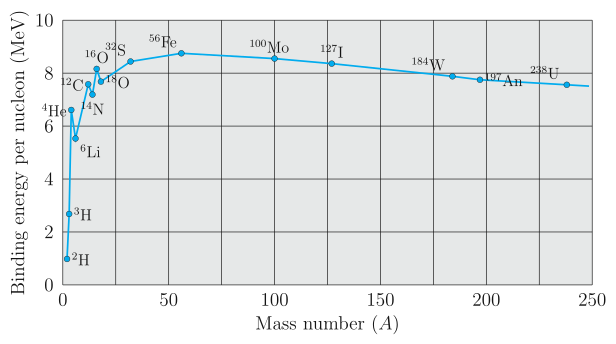
If you plot BE/A against mass number A, you get a curve that rises steeply for light nuclei, peaks at iron-56 (about 8.8 MeV per nucleon), and then slowly falls for heavier nuclei.
Iron-56 has the highest binding energy per nucleon of any nuclide. It is the most stable nucleus in nature.
This shape tells you two things:
1. Fusion of light nuclei releases energy. If you take two very light nuclei (like hydrogen isotopes) and smash them together to form a medium-mass nucleus, the product has a higher BE/A than the reactants. The difference in binding energy is released as kinetic energy of the products. This is how stars burn.
2. Fission of heavy nuclei releases energy. If you split a very heavy nucleus (like uranium-235) into two medium-mass fragments, those fragments also have higher BE/A than the original. Again, the difference comes out as energy. This is how nuclear reactors work. …
Part (b)Concept understanding — Bohr Model Quantization
Why does an electron not spiral into the nucleus?
Imagine you're pushing a child on a swing. If you push at random moments, the swing jerks and slows down. But if you push exactly in rhythm with the swing's natural motion, each push adds energy smoothly and the swing goes higher and higher. The swing "prefers" to move at specific frequencies — its natural modes.
An electron orbiting a nucleus is similar, but with a crucial twist from the quantum world. Classical physics says an accelerating charge (like an electron going in a circle) must continuously radiate energy. If that were true, the electron would lose energy, spiral into the nucleus, and atoms would collapse in a flash of light. But atoms are stable. So something is fundamentally different.
The radical idea: allowed orbits only
Niels Bohr proposed in 1913 that the electron cannot occupy just any orbit. It can only exist in certain stationary states — orbits where it does not radiate energy. These are like the swing's natural frequencies, but for an electron.
The key condition that picks out these special orbits is called quantization of angular momentum.
L=n2πh,n=1,2,3,…
Here L is the orbital angular momentum of the electron, h is Planck's constant, and n is a positive integer called the principal quantum number.
What this means physically
Angular momentum for a circular orbit is L=mvr, where m is the electron mass, v its speed, and r the orbit radius. So the quantization condition becomes:
mvr=n2πh
This is not a formula you derive — it is a postulate, a rule that nature follows. Bohr had no deeper explanation for why this rule works; he simply noticed it gave the right answers for hydrogen's spectrum.
The quantity 2πh appears so often that it has its own symbol: ℏ (h-bar). So the condition is often written as L=nℏ.
What it predicts
Combining this quantization with Newton's law for circular motion (centripetal force = Coulomb attraction) gives:
- Radius of the nth orbit: rn=n2a0, where a0=0.529A˚ is the Bohr radius (the smallest orbit, n=1).
- Energy of the nth orbit: En=−n213.6eV
The negative sign means the electron is bound to the nucleus. As n increases, the orbit gets larger and the energy becomes less negative (closer to zero).
The key insight for exams
Bohr quantization is not a derivation — it is a condition you apply. When you see a problem about hydrogen-like atoms (one electron), you:
- Write mvr=nℏ
- Write the force balance: rmv2=r2kZe2 (for nuclear charge Ze)
- Solve for r and v in terms of n …
Why this formula?
Why Angular Momentum is Quantised in the Bohr Model
The Bohr model's most famous result — that angular momentum comes only in integer multiples of 2πh — is not an arbitrary assumption. It follows directly from a single, elegant idea: the electron's wave must close on itself.
The core problem Bohr faced
By 1913, physicists knew two things that seemed contradictory:
- Rutherford's nuclear model showed electrons orbiting the nucleus.
- Maxwell's equations predicted that any accelerating charge (like an orbiting electron) must radiate energy, spiral inward, and collapse in about 10−11 seconds.
Atoms are stable. Something was missing.
Bohr's breakthrough was to combine the newly discovered quantum idea (Planck's constant h) with classical mechanics, but only for allowed orbits. The key constraint came from thinking of the electron not as a tiny planet, but as a standing wave.
The de Broglie wavelength argument (the cleanest derivation)
A few years after Bohr, de Broglie proposed that every moving particle has a wavelength:
λ=ph=mvh
For an electron in a circular orbit of radius r, the circumference is 2πr. For the wave to be stable — not cancelling itself out — the circumference must contain an integer number of wavelengths:
2πr=nλ,n=1,2,3,…
Substitute λ=h/(mv):
2πr=n⋅mvh
Rearrange:
mvr=n⋅2πh
That's it. The left side mvr is the angular momentum L. So:
L=nℏ,where ℏ=2πh
This is not a separate postulate — it is a consequence of requiring the electron wave to be a standing wave. If the wave doesn't close on itself, it interferes destructively and the orbit cannot exist.
Why this fixes the energy levels
Once angular momentum is quantised, the rest follows from classical physics. For a circular orbit, the centripetal force is provided by the Coulomb attraction:
rmv2=4πϵ01r2e2
Combine this with mvr=nℏ and solve for r and E:
rn=me24πϵ0ℏ2⋅n2=a0n2
En=−8ϵ02h2me4⋅n21=−n213.6 eV …
Part (a)
The binding energy per nucleon (B.E./A) rises steeply for light nuclei, peaks at about 8.8 MeV near A≈56 (iron), then falls slowly for heavier nuclei. A graph of B.E./A (MeV) versus mass number A shows this: sharp rise up to A≈20, a broad flat maximum around A=56, and a gentle decline beyond. …
Part (a): the binding-energy-per-nucleon curve peaks near iron (A≈56) and falls for A>170 because the long-range Coulomb repulsion grows faster than the short-range saturated nuclear attraction. Part (b): using Bohr's postulates, the radius of the nth orbit of hydrogen is rn=πme2ε0n2h2∝n2.
Part (a)
The curve
Binding energy per nucleon is the average energy needed to remove one nucleon. Plotted against A, it rises sharply for light nuclei, reaches a broad maximum (≈8.8 MeV) near A≈56 (iron), then declines gently toward ≈7.6 MeV for uranium.
Why it decreases for heavy nuclei (A>170)
Two forces compete:
- Nuclear force — short-range and saturating. Each nucleon attracts only its nearest few neighbours, so the total nuclear binding grows roughly like A; the binding per nucleon it contributes is nearly constant.
- Coulomb repulsion — long-range. Every proton repels every other proton, so the disruptive Coulomb energy grows like Z2/R∝Z2/A1/3, i.e. much faster than linearly.
As A increases beyond ∼170, the Coulomb penalty keeps growing while the nuclear attraction per nucleon stays flat, so the average binding energy per nucleon steadily falls. This is also why very heavy nuclei can release energy by fission (moving up the curve toward iron). …
Showing the 12 most recent of 44 on this concept.
- CBSE 2026Set 55/1/11 markMCQQ.For questions 13 to 16, two statements are given – one labelled Assertion (A) and the other labelled Reason (R). Select the correct answer from the codes (A), (B), (C) and (D) below: (A) Both Assertion (A) and Reason (R) are true and Reason (R) is the correct explanation of the Assertion (A). (B) Both Assertion (A) and Reason (R) are true, but Reason (R) is not the correct explanation of the Assertion (A). (C) Assertion (A) is true, but Reason (R) is false. (D) Both Assertion (A) and Reason (R) are false. Assertion (A) : The mass of a nucleus is less than the sum of the masses of the constituent nucleons. Reason (R) : Energy is absorbed when the nucleons are bound together to form a nucleus.
›Reveal solutionSolution
The key idea is mass defect: the mass of a stable nucleus is always less than the sum of its individual nucleon masses because the binding energy released during formation reduces the total mass. The Assertion is true, but the Reason is false — energy is released, not absorbed, when nucleons bind.
This question tests your understanding of mass defect and binding energy — two of the most beautiful consequences of Einstein’s mass-energy equivalence, E=mc2.
When nucleons (protons and neutrons) come together to form a nucleus, they attract each other via the strong nuclear force. To pull them apart into isolated nucleons, you must supply energy — that energy is called the binding energy. Conversely, when they bind, that same amount of energy is released into the surroundings (usually as gamma rays).
Here’s the crucial link: because energy is released, the system loses mass. The mass of the bound nucleus is less than the sum of the masses of its individual nucleons. This missing mass, multiplied by c2, exactly equals the binding energy. That’s the mass defect.
Now let’s examine each statement carefully.
-
Assertion (A): “The mass of a nucleus is less than the sum of the masses of the constituent nucleons.”
This is a well-established experimental fact for every stable nucleus. For example, a helium-4 nucleus has mass 4.0026 u, but two protons and two neutrons add up to 4.0330 u. The difference (0.0304 u) is the mass defect. So Assertion (A) is true.
-
Reason (R): “Energy is absorbed when the nucleons are bound together to form a nucleus.” …
-
- CBSE 2026Set 55/2/11 markMCQQ.In Bohr model of hydrogen atom, for large values of n, the distance between the consecutive orbits is proportional to (A) n (B) n (C) n2 (D) n3
›Reveal solutionSolution
In the Bohr model, the orbital radius scales as rn∝n2. For large n, the gap between consecutive orbits Δr=rn+1−rn behaves like 2n+1, which is proportional to n — so the answer is (B).
The Bohr model gives a beautifully simple picture of the hydrogen atom: electrons orbit the nucleus in fixed circular paths, with quantised angular momentum. The radius of the n-th orbit is
rn=πme2n2h2ε0or, more compactly,rn=a0n2,
where a0≈0.529A˚ is the Bohr radius. So the radius grows as n2.
The question asks about the distance between consecutive orbits — that is, the difference rn+1−rn — for large n. Many students instinctively think this difference is constant, or that it grows like n2 because the radii themselves do. But a difference between two quadratic terms behaves differently from either term alone. Let’s work it out.
- Write the radii for two neighbouring orbits:
rn=a0n2,rn+1=a0(n+1)2.
- The gap between them is
Δr=rn+1−rn=a0[(n+1)2−n2].
- Expand (n+1)2=n2+2n+1. Then
Δr=a0(n2+2n+1−n2)=a0(2n+1).
- For large n, the constant 1 becomes negligible compared to 2n. So
Δr≈2a0n.
Thus the spacing between consecutive orbits is proportional to n itself — not n2, not n, not n3. …
- CBSE 2026Set A1 markMCQQ.The radius of the lowest Bohr's orbit in hydrogen atom is r0. The radius of Bohr's second orbit is (A) r0 (B) 2r0 (C) 4r0 (D) r0/2
›Reveal solutionSolution
Bohr radii scale as n², so r₂ = 4 r₀.
In Bohr's model of hydrogen the radius of the n-th orbit is:
rn=n2r0
…
- CBSE 2026Set ANNUAL1 markMCQQ.If the first Bohr radius of hydrogen atom be R, then the radius of the third orbit is(a) 9R(b) R/3(c) 3R(d) R/9
›Reveal solutionSolution
Bohr radius of the nth orbit scales as n2, so the third orbit's radius is 9R.
In the Bohr model, the radius of the nth orbit of the hydrogen atom is
rn=n2r1
…
- CBSE 2026Set ANNUAL1 markQ.If the binding energy of oxygen nucleus 16/8 O is 128 MeV, then calculate the binding energy per nucleon.
›Reveal solutionSolution
Binding energy per nucleon is simply the total binding energy divided by the number of nucleons (mass number A).
For 16/8 O, mass number A = 16 (8 protons + 8 neutrons), and total binding energy = 128 MeV (given). …
- CBSE 2026Set ANNUAL1 markMCQQ.Case study: Bohr's model addressed the instability of the Rutherford model by introducing quantization. The model is based on three postulates, which successfully explained the discrete line spectrum of hydrogen. According to the model, the radius of the nth stationary orbit is r_n ∝ n², and the total energy is E_n = −13.6 eV / n², when an electron jumps from a higher energy level (E_i) to a lower one (E_f), a photon of energy hν = E_i − E_f is emitted. Transitions ending at the n = 1 level form the Lyman series. According to Bohr's second postulate, which quantity is quantized?(a) Energy of electron(b) Orbital angular momentum(c) Linear momentum(d) Frequency of revolution
›Reveal solutionSolution
Bohr's second postulate quantizes the electron's orbital angular momentum in integer multiples of h/2π.
Bohr's second postulate states that an electron can revolve only in those orbits for which its orbital angular momentum is an integral multiple of ℏ=h/2π: …
- CBSE 2026Set ANNUAL1 markMCQQ.Which of the following statements is true regarding the stability of a nucleus?(a) Binding energy alone determines nuclear stability.(b) Binding energy per nucleon is a better indicator of nuclear stability than total binding energy.(c) Neither binding energy nor binding energy per nucleon is related to nuclear stability.(d) Only the number of protons and neutrons determine nuclear stability.
›Reveal solutionSolution
Total binding energy grows almost monotonically with the number of nucleons and so cannot distinguish stability between nuclei of different sizes; binding energy per nucleon — which rises, peaks near iron (A≈56), and then falls for heavier nuclei — is the quantity that correctly tracks relative nuclear stability.
Why total binding energy is a poor stability measure
Binding energy (BE) is the energy required to completely separate a nucleus into its individual protons and neutrons (equivalently, the energy released when the nucleus is assembled from free nucleons):
BE=[Zmp+(A−Z)mn−Mnucleus]c2
As the mass number A (number of nucleons) increases, there are simply more nucleon–nucleon bonds contributing to the total, so total BE tends to increase with A across the periodic table — a very heavy nucleus like uranium has a much larger total binding energy than a light nucleus like helium, purely because it has far more nucleons, not necessarily because each individual nucleon is more tightly (stably) bound.
Why binding energy per nucleon is the right measure
Binding energy per nucleon, BE/A, measures the average energy binding each individual nucleon into the nucleus — this is what actually reflects how stable/tightly bound the nucleus is, independent of how many nucleons it happens to have.
When BE/A is plotted against A:
- It rises steeply for light nuclei, …
- CBSE 2026Set ANNUAL1 markMCQQ.The mass of a 37Li nucleus is 0.042 u less than the sum of the masses of all its nucleons. The average binding energy per nucleon of 37Li nucleus is nearly :(a) 23 MeV(b) 46 MeV(c) 5.6 MeV(d) 3.9 MeV
›Reveal solutionSolution
Converting the given mass defect to energy and dividing by the 7 nucleons of 37Li gives a binding energy per nucleon of about 5.6 MeV.
Working
Total binding energy: BE=Δm×931.5 MeV/u (using E=mc2 with mass in atomic mass units).
Given Δm=0.042 u:
BE=0.042×931.5≈39.12 MeV
…
- CBSE 2025Set 55/5/11 markMCQQ.Assertion (A): During the formation of a nucleus, the mass defect produced is the source of the binding energy of the nucleus. Reason (R): For all nuclei, the value of binding energy per nucleon increases with mass number. (A) Both A and R are true and R is the correct explanation of A. (B) Both A and R are true, but R is not the correct explanation of A. (C) A is true, but R is false. (D) Both A and R are false.
›Reveal solutionSolution
The mass defect does provide the binding energy (A is true), but binding energy per nucleon does not increase monotonically with mass number—it peaks around iron-56 and then decreases (R is false). The answer is (C).
Understanding Mass Defect and Binding Energy
When protons and neutrons come together to form a nucleus, something remarkable happens: the mass of the resulting nucleus is less than the sum of the masses of its constituent nucleons. This "missing" mass hasn't vanished—it has been converted into energy that holds the nucleus together.
Einstein's mass-energy equivalence E=mc2 tells us that mass and energy are interchangeable. The mass defect Δm is precisely the source of the binding energy:
BE=Δm⋅c2
This binding energy is what you would need to supply to completely disassemble the nucleus back into separate protons and neutrons. The assertion (A) captures this fundamental principle correctly.
The Binding Energy Per Nucleon Curve
Now let's examine the reason (R), which claims that binding energy per nucleon increases with mass number for all nuclei. This is where we need to look at experimental data.
The binding energy per nucleon, ABE (where A is the mass number), does not increase monotonically. Instead, it follows a characteristic curve:
-
Light nuclei (hydrogen, helium): relatively low binding energy per nucleon, around 1–7 MeV.
-
Medium nuclei (iron-56, nickel-62): the curve reaches its maximum at approximately 8.8 MeV per nucleon. Iron-56 sits near the peak of nuclear stability.
-
Heavy nuclei (uranium, plutonium): the binding energy per nucleon decreases to around 7.5 MeV.
ImportantThe binding energy per nucleon curve peaks around A≈56 (iron) and then decreases for heavier elements. This is why both fusion (combining light nuclei) and fission (splitting heavy nuclei) release energy—both processes move toward the more stable middle region.
Region Mass Number Range BE/nucleon Trend Light A<20 1–7 MeV Increasing Medium 20<A<100 7.5–8.8 MeV Peak around Fe-56 Heavy A>100 7.5–8 MeV Decreasing The decrease in binding energy per nucleon for heavy nuclei occurs because: …
-
- CBSE 2025Set X11 markMCQQ.Binding energy per nucleon of a nucleus is a measure of its(a) radius(b) mass(c) volume(d) stability
›Reveal solutionSolution
(d) stability The binding energy per nucleon (BE/A) tells how tightly each nucleon is bound. A higher BE/A means more energy is needed to remove a nucleon, so the nucleus is more stable. It is …
- CBSE 2025Set ANNUAL1 markMCQQ.According to Bohr's hypothesis the following physical quantity is quantised(a) angular momentum(b) angular velocity(c) potential energy(d) momentum
›Reveal solutionSolution
Bohr's key postulate (beyond classical mechanics) was that only orbits where the electron's angular momentum is an integer multiple of h/2π are allowed.
Bohr's second postulate states that the electron can revolve only in those orbits for which its orbital angular momentum is an integral multiple of h/2π:
L=mvr=2πnh,n=1,2,3,…
…
- CBSE 2025Set ANNUAL1 markMCQQ.The radius of Bohr's stable orbit for hydrogen is r. The radius of Bohr's second orbit is(a) r(b) r/2(c) 2r(d) 4r
›Reveal solutionSolution
In the Bohr model, the radius of the nth orbit of hydrogen scales as n^2, so if the (first, ground-state) orbit has radius r, the second orbit has radius 4r.
Bohr's model gives the radius of the nth stationary orbit of hydrogen as:
r_n = n^2 r_1
where r_1 is the radius of the first (n=1) orbit. Taking the given "stable orbit" radius r to be r_1, the second orbit (n=2) has radius:
…
🎓Unlock everything free for 14 days
- ✓Full step-by-step solutions
- ✓Concept-first explanations
- ✓Methods, shortcuts & mistakes
- ✓PYQ mapping + timed mock tests
Full access for 14 days. No credit card required.