Q.A potential difference is applied across a conductor of length and uniform cross-section area . How will the
You're viewing a preview — the full solution, concept, methods & PYQ mapping are locked.
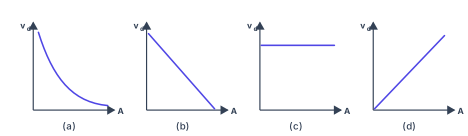
Start your 14-day free trial to unlock the full solution →Electric field, drift velocity and current density all scale linearly with ; doubling or halving doubles each quantity.
Understanding the Chain: Field → Drift → Current
When a potential difference drives current through a conductor, three linked quantities emerge. The electric field is the force-per-charge that accelerates electrons. This field imparts a systematic drift velocity to the charge carriers (superimposed on their random thermal motion). Finally, the drift of charge creates a current density , the current per unit area.
The key insight is that all three depend on the ratio , not on or separately. The electric field is simply the potential gradient, drift velocity is proportional to the field (through mobility), and current density follows from the drift of charge carriers.
Step-by-Step Analysis
1. Electric Field
The electric field in a uniform conductor is the potential drop per unit length:
This is a definition: field measures how rapidly potential changes with distance. If the conductor is uniform, the field is constant throughout.
2. Drift Velocity
Electrons accelerate under the field but constantly collide with the lattice, reaching a steady average velocity:
where is the mobility ( = electron charge, = mean collision time, = electron mass). Since :
The drift velocity is proportional to the field, hence to .
Mobility is a material property (depends on temperature and lattice structure) and remains constant when we vary or .
3. Current Density
Current density is the charge crossing unit area per unit time. If is the number density of charge carriers:
Substituting :
where is the conductivity. Again, .
Effect of Changes
(a) When is doubled (keeping , constant)
The ratio doubles.
| Quantity | Original | After doubling | Factor |
|---|---|---|---|
All three quantities double.
(b) When is halved (keeping , constant) …
Unlock everything free for 14 days
- Full step-by-step solutions
- Concept-first explanations
- Methods, shortcuts & mistakes
- PYQ mapping + timed mock tests
Full access for 14 days. No credit card required.