Q.(a) Establish the relation between drift velocity of electrons () and electric current () in a conductor.
You're viewing a preview — the full solution, concept, methods & PYQ mapping are locked.
Start your 14-day free trial to unlock the full solution →Drift velocity is the average velocity electrons acquire under an electric field, and it relates directly to current via . When the conductor’s length is doubled at constant voltage, the electric field halves, so drift velocity also halves — .
Why drift velocity? The core idea
Current in a metal is the flow of free electrons. But electrons don’t zoom straight through — they collide with atoms, bounce around, and only drift slowly in the direction of the field. That average net velocity is the drift velocity . It’s tiny (mm/s), yet it carries the current because there are so many electrons.
The key link: current is the charge passing a cross-section per second. If each electron carries charge , and electrons per unit volume drift with speed through area , then in one second the charge crossing is . That’s the current.
(a) Deriving
-
Set up the picture
Consider a conductor of cross-sectional area . Let be the number of free electrons per unit volume. Each electron has charge (magnitude ). Under an electric field , electrons drift with average velocity along the field direction.
-
Charge crossing in time
In a small time , an electron moves a distance . So all electrons within a cylinder of length and area will cross a given cross-section in that time. The volume of this cylinder is .
-
Number of electrons and total charge
Number of electrons in that volume = .
Total charge crossing = .
-
Current = charge per unit time
That’s the fundamental relation. Rearranging gives .
Notice is inversely proportional to — thinner wires have faster drift for the same current. That’s why thin wires heat up more: faster electrons collide more often.
(b) Effect of doubling length at constant voltage
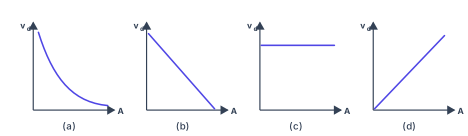
Now the conductor’s length is doubled, but the applied voltage stays the same. What happens to ?
- Electric field depends on length For a uniform conductor, the electric field inside is . If doubles, halves:
- Drift velocity is proportional to field …
Unlock everything free for 14 days
- Full step-by-step solutions
- Concept-first explanations
- Methods, shortcuts & mistakes
- PYQ mapping + timed mock tests
Full access for 14 days. No credit card required.