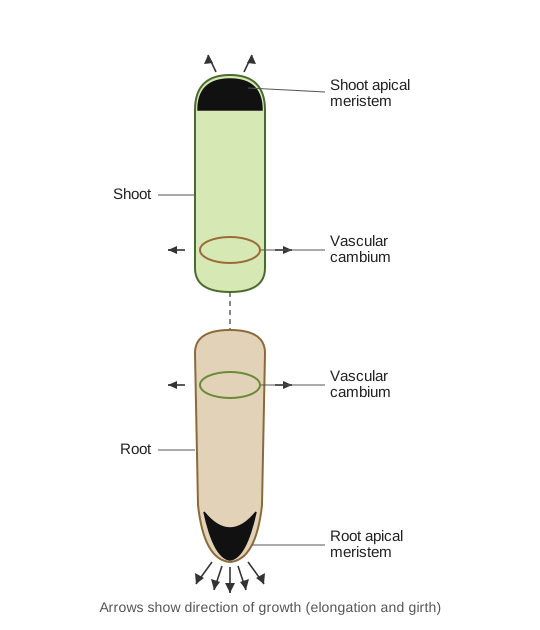
A meristem (Gk. meristos = divisible; term coined by C. Nageli, 1858) is a tissue whose cells retain the ability to divide repeatedly and indefinitely, and it is one of the two principal categories every plant tissue falls into (the other being permanent tissue, which has lost that ability). Meristematic cells share a recognisable set of features suited to constant division: they are isodiametric (oval, spherical or polygonal, never markedly elongated), have a dense cytoplasm around a large, prominent nucleus, keep their vacuoles small or entirely absent, and are bounded by a thin, elastic, purely cellulosic wall - none of the thick, rigid or lignified walls seen in mature tissue. Because dividing meristematic cells constantly regenerate their own population even as they hand off daughter cells to differentiate into permanent tissue, meristems are described as self-perpetuating. Meristem is classified along four independent axes rather than one: by position in the plant body (apical, at root/shoot tips, driving growth in length; intercalary, between mature tissues, elongating internodes; lateral, running the length of the axis, driving growth in girth - vascular cambium and cork cambium); by developmental origin (primary, derived straight from the embryo; secondary, arising later, e.g. cork cambium); by ultimate fate/function (protoderm, gives epidermal tissue; procambium, gives primary xylem/phloem; ground meristem, gives everything else); and by the plane its cells divide in (mass meristem, all planes; rib/file meristem, anticlinal in one plane; plate meristem, anticlinal in two planes). Apical meristems in particular have several rival organisational models (apical cell theory, histogen theory, tunica-corpus theory for the shoot; equivalent root-apex theories) describing how their dividing cells are laid out and which daughter zone becomes which permanent tissue.