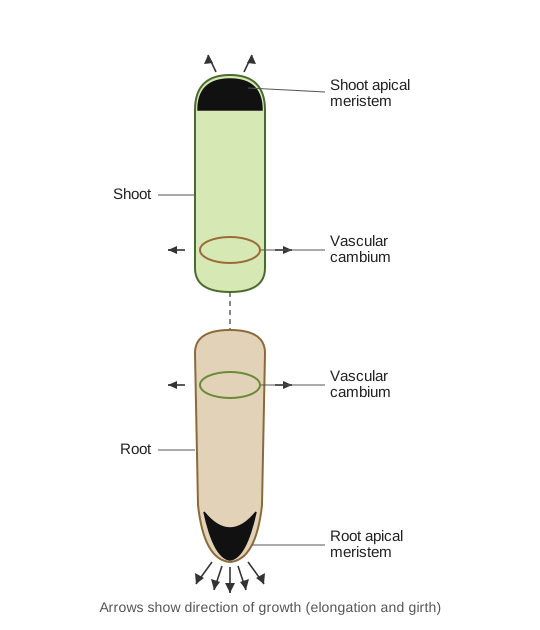
Q.Identify the following diagram (a), label it and prepare a chart of characteristics.
You're viewing a preview — the full solution, concept, methods & PYQ mapping are locked.
Start your 14-day free trial to unlock the full solution →Concept understanding — Meristematic Tissue
A meristem (Gk. meristos = divisible; term coined by C. Nageli, 1858) is a tissue whose cells retain the ability to divide repeatedly and indefinitely, and it is one of the two principal categories every plant tissue falls into (the other being permanent tissue, which has lost that ability). Meristematic cells share a recognisable set of features suited to constant division: they are isodiametric (oval, spherical or polygonal, never markedly elongated), have a dense cytoplasm around a large, prominent nucleus, keep their vacuoles small or entirely absent, and are bounded by a thin, elastic, purely cellulosic wall - none of the thick, rigid or lignified walls seen in mature tissue. Because dividing meristematic cells constantly regenerate their own population even as they hand off daughter cells to differentiate into permanent tissue, meristems are described as self-perpetuating. Meristem is classified along four independent axes rather than one: by position in the plant body (apical, at root/shoot tips, driving growth in length; intercalary, between mature tissues, elongating internodes; lateral, running the length of the axis, driving growth in girth - vascular cambium and cork cambium); by developmental origin (primary, derived straight from the embryo; secondary, arising later, e.g. cork cambium); by ult …
Unlock everything free for 14 days
- Full step-by-step solutions
- Concept-first explanations
- Methods, shortcuts & mistakes
- PYQ mapping + timed mock tests
Full access for 14 days. No credit card required.