Biology · Ch 9 — Control and Co-ordination
Forebrain: Olfactory Lobes and Cerebrum
Forebrain: Olfactory Lobes and Cerebrum
A. The Human brain : The human brain -- studied as a whole under the name encephalology -- divides into three main parts: forebrain, midbrain and hindbrain. The forebrain itself begins with the olfactory lobes, which are highly reduced in humans and covered by the cerebrum on every side except the ventral surface; each lobe has an olfactory peduncle and an olfactory bulb.
Chart 9.8 Parts of Brain
- Forebrain (Prosencephalon) = Telencephalon: Rhinencephalon (the 2 reduced olfactory lobes) + cerebrum, divided incompletely into two cerebral hemispheres; and Diencephalon: Epithalamus, Thalamus, Hypothalamus.
- Midbrain (Mesencephalon) = Cerebral peduncles or crura cerebri + Corpora quadrigemina.
- Hindbrain (Rhombencephalon) = Metencephalon: Cerebellum + Pons varolii; and Myelencephalon: Medulla oblongata.
ii. Cerebrum : The cerebrum is the brain's largest part, making up about 85% of its total mass. A deep median longitudinal fissure splits it into right and left cerebral hemispheres, which stay internally connected by a thick band of nerve fibres, the corpus callosum (the largest commissure of the mammalian brain, with an anterior fold, the genu, and a posterior fold, the splenium). The cerebrum's outer surface, the cerebral cortex, is grey matter; its deep interior, the cerebral medulla, is white matter. The surface is thrown into many folds -- convolutions (gyri) and grooves (sulci) -- that massively increase the surface area available to pack in neurons. Three deep sulci divide each hemisphere into four main lobes: the central sulcus separates the frontal from the parietal lobe, the parieto-occipital sulcus separates the parietal from the occipital lobe, and the lateral (Sylvian) sulcus separates the temporal lobe from the frontal and parietal lobes; because these sulci are incomplete, the lobes are not sharply demarcated, and a fifth, median lobe -- the insula -- lies folded deep within the lateral sulcus.
Can you recall?
Label the various parts of the diagram of the brain and recall their functions.
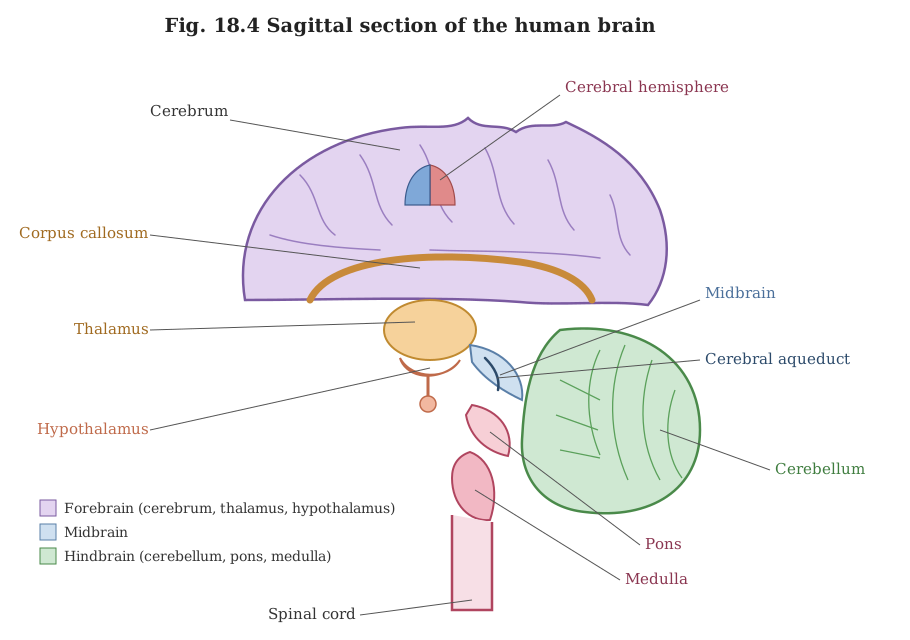
Drawn by us to help you understand the concept clearly, and verified to make sure it's accurate. For exams, practice from your textbook's own diagram.
What this figure shows. A midline (sagittal) section through the whole human brain and upper spinal cord, labelling the cerebrum with the parieto-occipital and central sulci on its surface, the corpus callosum beneath it, the thalamus and hypothalamus of the diencephalon, the midbrain, the pineal gland, the pituitary gland hanging below the hypothalamus, the arbor-vitae pattern and lateral ventricle, the pons varolii, the cerebellum with its choroid plexus, and the medulla oblongata continuing down into the spinal cord.
9.9: Sagittal section of brain. …
…