Biology · Ch 4 — Molecular Basis of Inheritance
Packaging in Prokaryotes
Packaging in Prokaryotes
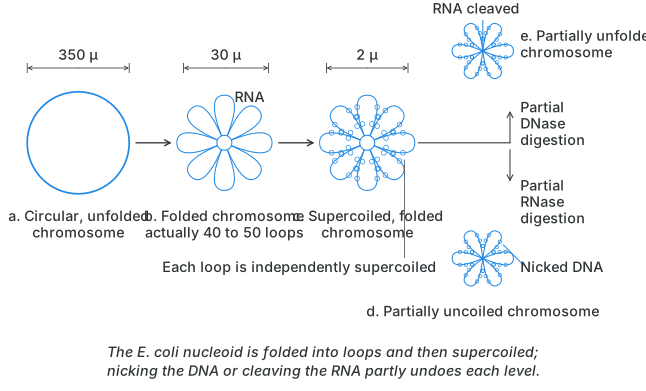
Packaging in Prokaryotes: Bacteria such as E. coli have no nuclear membrane or nucleolus; instead their DNA exists as a small, circular, highly folded structure called the nucleoid. In E. coli this nucleoid is about 1100 micrometres in circumference and carries roughly 4.6 million base pairs, yet it must be packed into a cell only about 2-3 micrometres long. This is achieved in stages: the negatively charged circular DNA first folds down to about 350 micrometres in diameter, and RNA-assisted looping then organises it into 40-50 independently supercoiled domains, reducing the effective diameter to about 30 micrometres. Each domain is then further coiled and supercoiled -- with the help of positively charged HU proteins (histone-like DNA-binding proteins) and enzymes such as DNA gyrase and DNA topoisomerase I, which introduce and mai …
Drawn by us to help you understand the concept clearly, and verified to make sure it's accurate. For exams, practice from your textbook's own diagram.
What this figure shows. A stepwise size-reduction diagram showing how the circular bacterial nucleoid is packaged: an unfolded circular chromosome of about 350 micrometres diameter is folded by RNA-assisted looping into 40-50 independently supercoiled domains that reduce the effective diameter to about 30 micrometres, and further coiling by HU proteins condenses it further to about 2 micrometres, small enough to fit inside the 2-3 micrometre bacterial cell; side panels also show that partial RNase or DNase digestion of an individual loop unwinds only that loop, …