Biology · Ch 4 — Molecular Basis of Inheritance
Transcription
Transcription
Can you recall?
- What is transcription?
- How many nucleotides are present in a codon?
- Name the molecule which carries the anticodon.
- What is mutation?
A. Transcription: During transcription, only one strand of a gene's DNA -- the template (antisense) strand -- is copied into RNA, a reaction catalysed by the enzyme RNA polymerase. In eukaryotes, transcription occurs in the nucleus (during the G1 and G2 phases of the cell cycle) while translation occurs afterward in the cytoplasm, so mRNA must travel from one compartment to the other. DNA lies in the nucleoid of prokaryotes and in the nucleus of eukaryotes; DNA has promoter and terminator sites, and transcription starts at the promoter and stops at the terminator. In both prokaryotes and eukaryotes the process involves three stages: initiation, elongation and termination.
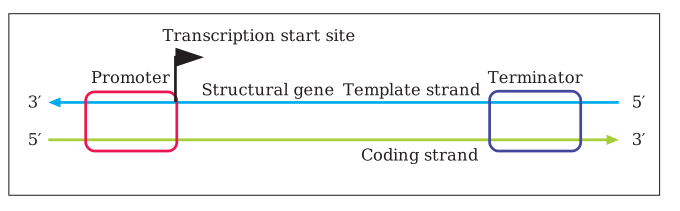
Transcription Unit: Each transcribed segment of DNA is a transcription unit. It consists of i. a promoter, ii. the structural gene and iii. a terminator:
i. The promoter is located towards the 5' end of the structural gene (upstream). It is the DNA sequence that provides the binding site for RNA polymerase; in prokaryotes the enzyme recognises the promoter by its sigma-factor subunit.
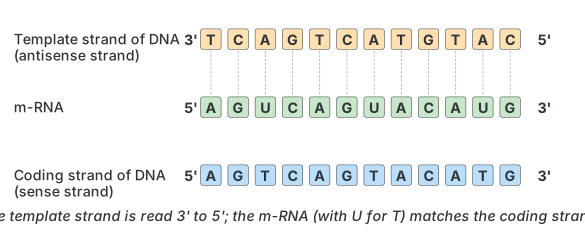
ii. Structural gene - the two DNA strands have opposite polarity. DNA-dependent RNA polymerase catalyses polymerisation only in the 5' to 3' direction, so the strand with 3' to 5' polarity acts as the template strand. The other strand, with 5' to 3' polarity, is complementary to the template; its base sequence is the same as that of the RNA (with thymine in place of uracil), so it is the actual coding strand (sense strand), whose information is copied onto the mRNA.
iii. The terminator is located at the 3' end of the coding strand (downstream) and defines the end of transcription.
Drawn by us to help you understand the concept clearly, and verified to make sure it's accurate. For exams, practice from your textbook's own diagram.
What this figure shows. A linear map of a transcription unit on double-stranded DNA, showing the promoter region positioned upstream (toward the 5' end) of the structural gene, the structural gene itself with its template (antisense) strand and coding (sense) strand running in opposite polarities, and the terminator sequence positioned downstream (toward the 3' end) where RNA polymerase detac …
Drawn by us to help you understand the concept clearly, and verified to make sure it's accurate. For exams, practice from your textbook's own diagram.
What this figure shows. A base-by-base comparison diagram showing a short stretch of the DNA template (antisense) strand running 3' to 5', the mRNA transcript being synthesised from it by complementary base pairing (with uracil replacing thymine wherever an adenine is copied), and the DNA coding (sense) strand running 5' to 3', which is shown to carry the same base sequence as the mRNA transcript (again with T standing in place of U) -- illustrating why the coding strand, not the template strand, matc …
After RNA polymerase binds the promoter, it moves along the DNA, locally unwinding the duplex over the gene so that the exposed template-strand bases can pair with incoming ribonucleoside triphosphates; as transcription proceeds, the transient DNA-RNA hybrid dissociates, releasing the growing mRNA strand while the DNA behind the enzyme re-forms its double helix. When RNA polymerase reaches the terminator, it detaches from the DNA and releases the completed primary transcript.
Do you know?
- Many viruses contain RNA as genetic material and replicate by first synthesising DNA and then forming RNA. This process is called reverse transcription; such viruses are known as retroviruses.
- Human immunodeficiency virus (HIV) is responsible for causing AIDS.
- In some cases, as in E. coli, a chain-terminating protein, the 'rho' factor, stops the synthesis of mRNA.
- Transcription as well as translation involves three stages: initiation, elongation and termination.
In bacteria the mRNA needs no processing because it has no introns, and prokaryotes possess only one type of RNA polymerase. In eukaryotes there are three RNA polymerases: RNA polymerase-I transcribes rRNA, RNA polymerase-II transcribes mRNA (the primary transcript, or heterogeneous nuclear RNA, hnRNA) and RNA polymerase-III transcribes tRNA and small nuclear RNA (snRNA).
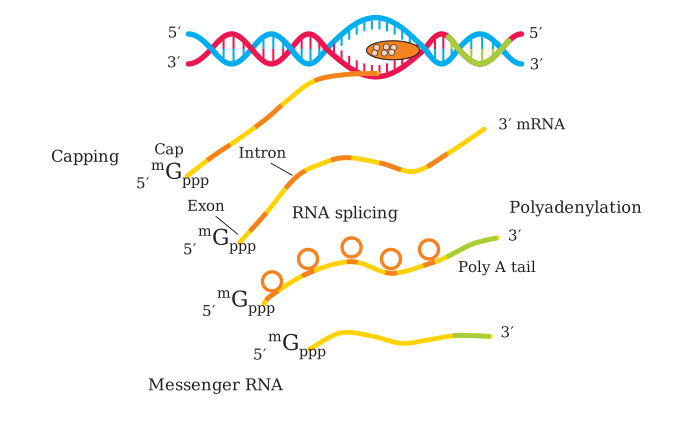
Transcription unit and the gene: The DNA sequence coding for mRNA, tRNA or rRNA is defined as a gene, and a cistron is a segment of DNA coding for one polypeptide. A transcription unit with a single structural gene is monocistronic, whereas a long DNA segment carrying a set of structural genes in one transcription unit is polycistronic. Structural genes in eukaryotes have interrupted non-coding sequences (introns); the coding or expressed sequences are exons, and only exons appear in the processed mRNA. …
Drawn by us to help you understand the concept clearly, and verified to make sure it's accurate. For exams, practice from your textbook's own diagram.
What this figure shows. A stepwise diagram of eukaryotic mRNA maturation: a primary transcript (hnRNA) containing alternating exons (coding) and introns (non-coding) is first capped at its 5' end with a methylated guanosine triphosphate cap, then has its introns removed and exons joined together by RNA splicing, and finally receives a poly-A tail added to its 3' end by polyadenylation, yielding the mature, processed mRNA that is exported from th …