Biology · Ch 7 — Plant Growth and Mineral Nutrition
Development
Development
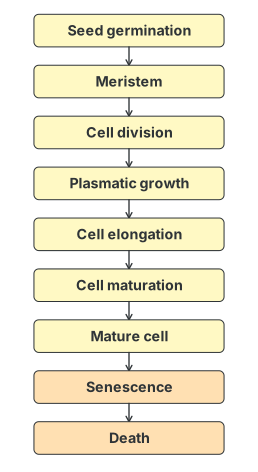
Development refers to all the ordered, progressive changes in the shape, form and complexity of a plant across its life cycle -- from the germination of the seed to eventual senescence and death. It is a broader term than growth alone: development encompasses growth, morphogenesis, maturation and senescence together, as one continuous sequence of change. A seed germinates and its meristems begin cell division; the resulting cells pass through plasmatic growth and elongation before undergoing cell maturation; the mature cells eventually enter senescence and the plant (or the organ) dies. Growth, in this scheme, is only the quantitative part of a much larger developmental programme that also includes the qualitative reorganisa …
Drawn by us to help you understand the concept clearly, and verified to make sure it's accurate. For exams, practice from your textbook's own diagram.
What this figure shows. A flow chart tracing the developmental sequence of a plant from seed to death: seed germination leads to activation of the meristem, which undergoes cell division; the resulting cells pass through plasmatic growth and then cell elongation; the elongated cells undergo cell maturation to become mature cells; mature cells eventually enter senescence, ending in death. The chart visually reinforces that development is a single continuous sequence in which growth (division, elongation) is only the …