Biology · Ch 7 — Plant Growth and Mineral Nutrition
Phases of Growth
Phases of Growth
The dividing, enlarging and differentiating cells of a meristem pass through three overlapping phases of growth.
A. Phase of cell division/ formation : Meristematic cells -- especially cambial cells -- are thin-walled, non-vacuolated, with a prominent nucleus and dense granular cytoplasm. A meristematic cell divides mitotically to give two daughter cells; one stays meristematic while the other begins to enlarge and differentiate. Growth in this phase is slow, corresponding to the lag phase of the growth curve.
B. Phase of cell enlargement/ elongation : The newly formed cell becomes vacuolated, osmotically active and turgid as it absorbs water. This turgor drives enlargement in both length and breadth, and the cell synthesises new wall material to keep pace. Growth here is rapid -- the exponential or log phase.
C. Phase of Cell maturation/ differentiation : The enlarged cell becomes structurally and physiologically specialised to carry out a particular function. Growth rate slows and levels off -- the stationary phase. …
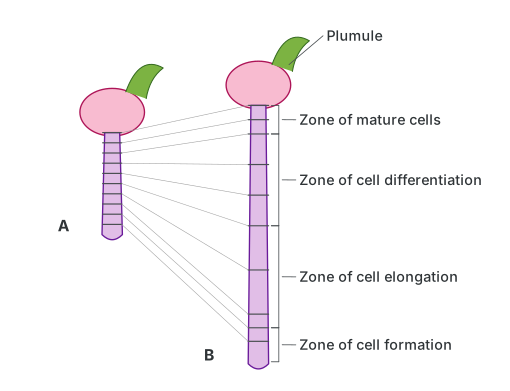
Drawn by us to help you understand the concept clearly, and verified to make sure it's accurate. For exams, practice from your textbook's own diagram.
What this figure shows. A two-part diagram of a growing root tip, showing the radicle at the start of growth (panel A) and after further growth (panel B). From the root cap upward, the diagram marks four zones in sequence: the zone of cell formation nearest the tip (where the apical meristem is actively dividing), the zone of cell elongation just behind it (where newly formed cells absorb water and lengthen), the zone of cell differentiation further up (where elongated cells begin to specialise into mature tissue types), and the zone of mature cells closest to the base, leading up towards the plumule. The diagram illustrates how the three phases of growth described in the text -- division, elongation and maturation -- are laid out as physic …