Biology · Ch 7 — Plant Growth and Mineral Nutrition
Growth Rate and Types of Growth
Growth Rate and Types of Growth
Growth rate : The growth rate is the amount of growth occurring per unit time; it is also called the efficiency index, and can be measured as an increase in the size or area of a leaf, flower or fruit.
The ratio of the change in cell number (dn) over the time interval (dt) is called the Absolute growth rate (AGR); alternatively, it is the measurement and comparison of total growth per unit time.
AGR = dn / dt
The AGR divided by the total number of cells (n) present in the medium gives the Relative growth rate (RGR) - the growth of a particular system per unit time expressed on a common basis, or the ratio of the growth in the given time to the initial growth.
RGR = AGR / n
AGR and RGR are useful in describing the dynamics of cell growth in culture.
Types of growth : There are two types of growth, arithmetic growth and geometric growth.
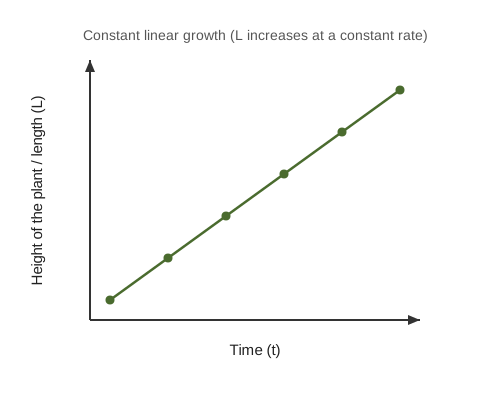
a. Arithmetic growth : Here the rate of growth is constant and the increase occurs in arithmetic progression, i.e. 2, 4, 6, 8 cm and so on. After mitosis one of the daughter cells continues to divide while the other takes part in differentiation and maturation; the elongation of a root at a constant rate best explains arithmetic growth. A linear curve is obtained when growth is plotted against time. Arithmetic growth is expressed mathematically as
Lt = Lo + rt
where Lt = length at time 't', Lo = length at time 'zero', r = growth rate and t = time of growth. When the length (L) is plotted against time (t) a linear curve is obtained, as in Graph 7.2.
Drawn by us to help you understand the concept clearly, and verified to make sure it's accurate. For exams, practice from your textbook's own diagram.
What this figure shows. Height of the plant (L) on the vertical axis against time (t) on the horizontal axis; the points lie on a straight line because an arithmetically growing organ adds the same length in every unit of time, so the slope of the line …
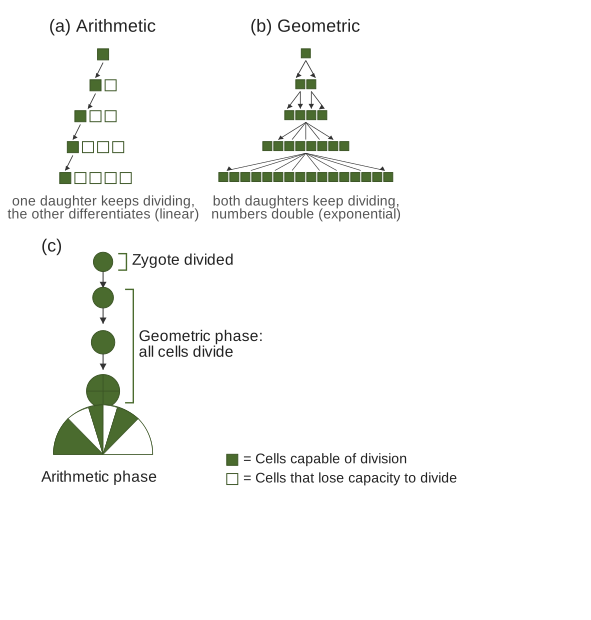
b. Geometric growth : A cell divides mitotically into two, and here both the daughter cells continue to divide and redivide repeatedly. Growth is slow initially but later becomes rapid, at an exponential rate. Geometric growth is expressed mathematically as
W1 = Wo e^rt
where W1 = final size, Wo = initial size, r = growth rate, t = time of growth and e = the base of the natural logarithm (Fig. 7.3).
Drawn by us to help you understand the concept clearly, and verified to make sure it's accurate. For exams, practice from your textbook's own diagram.
What this figure shows. (a) In arithmetic growth only one product of each division keeps dividing, so the row of cells lengthens by one cell at a time; (b) in geometric growth both products keep dividing, so the numbers go 1, 2, 4, 8, 16; (c) an embryo begins with a geometric phase in which every cell divides and passes into an arithmeti …
…
Drawn by us to help you understand the concept clearly, and verified to make sure it's accurate. For exams, practice from your textbook's own diagram.
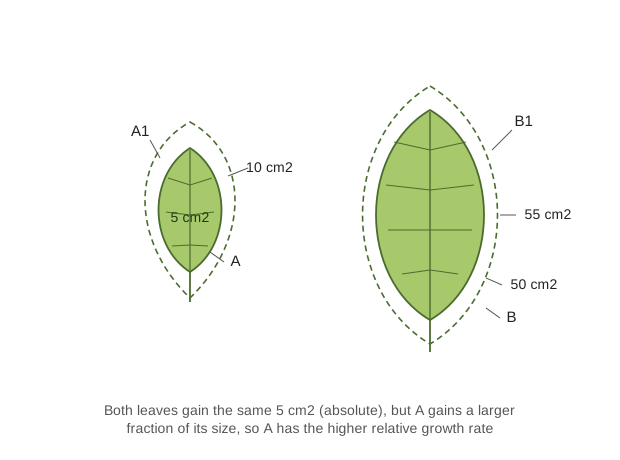
What this figure shows. Leaf A (5 sq cm) and leaf B (50 sq cm) each gain 5 sq cm in the same time to become A1 (10 sq cm) and B1 (55 sq cm). Their absolute growth rates are identical, but relative to its starting size …