Q.Explain sigmoid growth curve with the help of diagram.
Growth plotted against time gives an S-shaped (sigmoid) curve - slow lag phase, steep exponential phase, flat stationary phase - and the time it spans is the grand period of growth.
Step 1. Why the rate changes. The growth of an organ runs through three phases that correspond to the three phases of cell growth. In the lag phase (cell division/formation) the rate of growth is slow; in the exponential or log phase (cell enlargement) the rate is faster and reaches its maximum; in the stationary phase (cell maturation) the rate gradually slows down as cells stop enlarging and differentiate.
Step 2. The curve. Because the rate first rises and then falls, a graph of the total growth - the size or weight of the organ on the vertical axis - against time on the horizontal axis starts almost flat, curves steeply upward through the middle and then bends over to a plateau. The result is an elongated 'S', hence the name sigmoid curve.
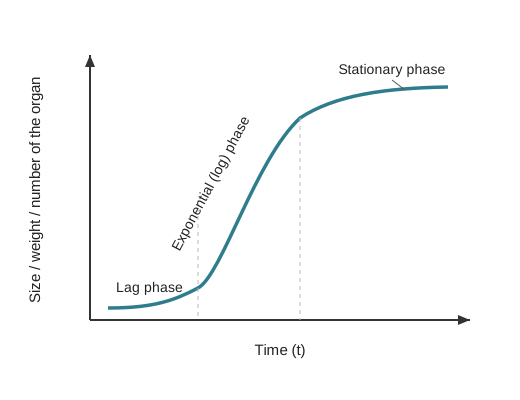
Step 3. Diagram. Draw the horizontal axis as Time and the vertical axis as Size/weight of the organ. Mark the gently rising foot of the curve as the lag phase, the steep middle as the exponential phase and the flat top as the stationary phase, as in the graph above.
Step 4. Grand period of growth. The total time required for all the phases to occur - from the start of the lag phase to the plateau of the stationary phase - is called the grand period of growth. The sigmoid curve is typical of the growth of cells in culture and of most plant organs, and the same idealised curve is used in the NCERT/CBSE Class 11 treatment of plant growth.
The sigmoid growth curve is the S-shaped curve obtained when the growth (size or weight) of an organ is plotted against time; its three parts are the lag, exponential and stationary phases, and the time it covers is the grand period of growth.
Unlock everything free for 14 days
- Full step-by-step solutions
- Concept-first explanations
- Methods, shortcuts & mistakes
- PYQ mapping + timed mock tests
Full access for 14 days. No credit card required.