Biology · Ch 7 — Plant Growth and Mineral Nutrition
Nitrogen Cycle
Nitrogen Cycle
The nitrogen cycle is the series of natural processes by which nitrogen moves from the atmosphere into living organisms, through the soil, and back again to the environment. Plants use the sugars made in photosynthesis to build proteins, and proteins require nitrogen -- but atmospheric nitrogen (N2) is very inert (unreactive) because its two atoms are joined by a strong triple covalent bond (N≡N), so plants cannot use it directly. To be usable, nitrogen must first be converted into a reactive form, generally as nitrate ions, before plants can take it up; nitrogen is, for this reason, often a limiting nutrient in agricultural ecosystems. A regular supply of usable nitrogen to plants is maintai …
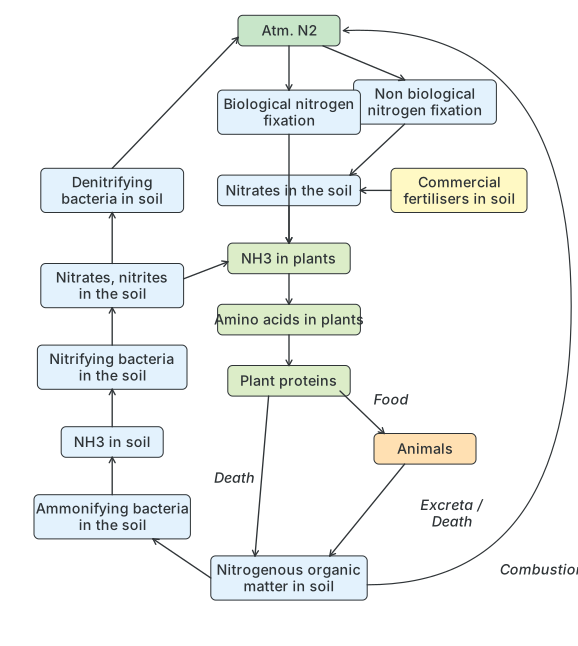
Drawn by us to help you understand the concept clearly, and verified to make sure it's accurate. For exams, practice from your textbook's own diagram.
What this figure shows. A cyclic diagram tracing nitrogen through the ecosystem: atmospheric N2 is converted into ammonia in soil either through non-biological (physical/industrial) nitrogen fixation or biological nitrogen fixation; ammonia in the soil is converted by nitrifying bacteria into nitrates and nitrites in the soil (with denitrifying bacteria able to return nitrates back toward the atmosphere); plants take up nitrates from the soil (supplemented by commercial fertilisers) and, together with nitrogen fixed directly, build amino acids and then plant proteins; these proteins pass through the food chain to animals as food; nitrogenous waste (excreta) and the death of both plants and animals return nitrogenous organic matter to the soil, which ammonifying bacteria convert back into NH3 in the soil; combustion is shown as a further pathway returning nitrogen compounds to the soil/atmosphere system. The diagram represents t …