Biology · Ch 2 — Reproduction in Lower and Higher Animals
Gastrulation
Gastrulation
Gastrulation : It is the process by which the 'gastrula' is formed from the blastocyst. In the gastrula stage the rate of cleavage slows, but two important events take place actively:
a. Differentiation of blastomeres : This results in the formation of the three germinal layers, ectoderm, mesoderm and endoderm, from the cells of the embryoblast.
b. Morphogenetic movements : Different types of movements by which cells reach their definite place in the embryo.
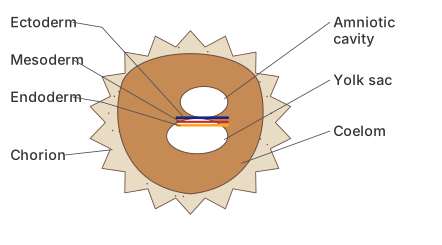
Drawn by us to help you understand the concept clearly, and verified to make sure it's accurate. For exams, practice from your textbook's own diagram.
What this figure shows. A vertical section through the late-gastrula-stage embryo, showing the three differentiated germ layers — an outer ectoderm, a middle mesoderm and an inner endoderm — positioned between the fluid-filled amniotic cavity above and the yolk sac below, with the surrounding chorion and the coelomic cavity visible …
Gastrulation begins in the embryoblast cells around the 8th day after fertilization. Cells at the free end of the inner cell mass, called hypoblasts (primitive endoderm), flatten, begin dividing, and grow downward towards the blastocoel (the cavity of the blastocyst); this layer, the first to differentiate, is the endoderm, and as it grows within the blastocoel it forms a sac, the yolk sac. The remaining cells of the inner cell mass, still in contact with the cells of Rauber, are called epiblasts (primary ectoderm); together, the hypoblast and epiblast layers form a flat, bilaminar (two-layered) embryonic disc.
After the endoderm forms, the second layer to differentiate is the ectoderm: cells of the epiblast divide and redivide, moving in a way that encloses a new cavity, the amniotic cavity. The floor of this cavity is formed by the embryonic disc itself; the pyramidal cells of the disc facing the amniotic cavity form the embryonic ectoderm, while the roof of the amniotic cavity is lined by amniogenic cells, which divide and redivide to form the amnion — an extra-embryonic membrane that surrounds and protects the embryo. As a result of these changes, the bilaminar embryonic disc comes to lie sandwiched between the amniotic cavity and the yolk sac. …