Biology · Ch 2 — Reproduction in Lower and Higher Animals
Gemmule Formation
Gemmule Formation
A gemmule is a special kind of internal bud formed only in sponges (Phylum Porifera), such as Spongilla, the common freshwater sponge. It consists of a mass of asexually produced dormant cells called archaeocytes, aggregated together and capable, under the right conditions, of developing into an entirely new sponge. To protect this mass through unfavourable periods, the archaeocytes become coated by a thick, resistant layer of secretion produced by another type of sponge cell, the amoebocytes. Gemmules are thus a survival strategy: they let the sponge tide over conditions such as drought, cold or scarcity of food that would kill the adult body. When favourable conditions of water and temperature return, the gemmule 'hatch …
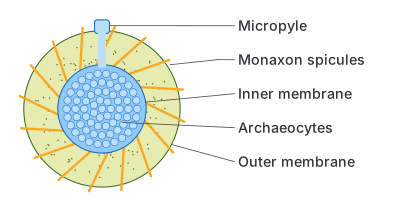
Drawn by us to help you understand the concept clearly, and verified to make sure it's accurate. For exams, practice from your textbook's own diagram.
What this figure shows. A cross-sectional diagram of a sponge gemmule showing its protective double-layered covering — an outer membrane and an inner membrane — enclosing the dormant mass of archaeocyte cells at the centre. Embedded in the covering are needle-like monaxon spicules that reinforce the resistant coat, and a small opening called the micropyle through which the archaeocytes eventually emerge when the gem …