Biology · Ch 1 — Reproduction in Lower and Higher Plants
Pollination
Pollination
Because both the male gametes (locked inside non-motile pollen grains) and the female gamete (locked inside an embedded embryo sac) are themselves non-motile, and because they are produced at two physically separate sites, the anther and the ovule, angiosperms cannot rely on the gametes moving towards each other unaided. Instead they have evolved the strategy of using abiotic agents (wind, water) and biotic agents (insects, birds, bats, snails), feeding the visitors and exploiting their mobility for pollination and, later, for seed dispersal. Pollination is the transfer of pollen grains from the anther to the stigma of a flower, and it is the essential pre-requisite for fertilization.
Self pollination is pollination that occurs within a single flower or between two flowers of a single plant; it results in inbreeding or selfing. Cross pollination, in contrast, is the transfer of pollen grains from the anther of one flower to the stigma of another flower on a different plant of the same species. On the basis of the source of the pollen, pollination is divided into three types:
a. Autogamy (self pollination) : A bisexual flower is pollinated by its own pollen grains, without any external pollinating agent. The offspring are genetically identical to the parent, e.g. pea, Clitoria.
Always Remember
- Flowers that use autogamy carry several adaptations in their structure to make it happen; it occurs without external pollinating agents.
- A flower that opens to expose its sex organs is called chasmogamous.
- The contrivances (conditions) that favour self pollination are bisexuality, homogamy and cleistogamy.
- Homogamy: the anther and the stigma of a flower mature at the same time.
- Some flowers are self pollinated even before the flower opens; this condition is cleistogamy. The underground flowers of some plants that show cleistogamy never open at all, e.g. Commelina benghalensis.
- Plants like Viola and Commelina produce both chasmogamous and cleistogamous flowers on the same plant.
b. Geitonogamy : Pollen is transferred to the stigma of a different flower borne on the same plant. Because it needs a pollinating agent it is functionally similar to cross pollination, but it cannot bring about genetic variation, since the pollen still comes from the same plant, and so it is only of ecological significance, e.g. Cucurbita maxima. Genetically it is like autogamy.
c. Xenogamy (cross pollination / out breeding) : Pollen grains of one flower are deposited, with the help of a pollinating agency, on the stigma of a flower of a different plant of the same species. This is the only type that generates genetically varied offspring.
The majority of flowering plants depend on the transfer of pollen grains; virtually all seed plants need to be pollinated, and most of the food and fibre crops grown across the world depend on pollinators to reproduce. The agents responsible for pollination fall into two main categories: A. Abiotic agents and B. Biotic agents.
A. Abiotic Agents : These are non-living agents, wind and water.
1. Pollination by wind (Anemophily) : Most of the important crop plants are wind pollinated, among them wheat, rice, corn (maize), rye, barley and oats; palms are wind pollinated too.
Adaptations in anemophilous flowers :
- The flowers are small, inconspicuous and colourless, without nectar or fragrance (there is no visitor to attract).
- The pollen grains are light, dry and produced in very large numbers, to raise the chance of pollination despite the enormous wastage of wind-carried pollen.
- The stigma is feathery, to trap the pollen carried on air currents.
- The stamens are exserted on long filaments and carry versatile (freely swinging) anthers.
- Both stamens and stigmas are exposed to the air currents.
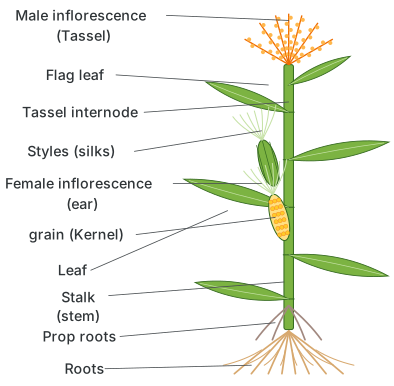
Drawn by us to help you understand the concept clearly, and verified to make sure it's accurate. For exams, practice from your textbook's own diagram.
What this figure shows. This diagram illustrates wind pollination using maize as the example plant, showing a single maize plant with its parts labelled: the male inflorescence, the tassel, at the top of the stalk, releasing pollen into the air; the female inflorescence, the ear, lower down on the stem, bearing long silk-like styles that catch airborne pollen; along with the flag leaf, stalk, prop roots, and the developing grain (kernel), illustrating how …
Always Remember
The pollen of wind-pollinated plants is what most often triggers the symptoms of hay fever in people who are sensitive to pollen: it is a hypersensitivity reaction to the airborne grains.
2. Pollination by water (Hydrophily) : Found only in some 30 genera of aquatic monocots, e.g. Vallisneria, Zostera, Ceratophyllum.
Adaptations in hydrophilous flowers :
- The flowers are small and inconspicuous.
- The perianth and the other floral parts are unwettable.
- The pollen grains are long and unwettable because of a mucilage covering.
- Nectar and fragrance are lacking.
Hydrophily is of two types. Hypohydrophily : pollination occurs below the surface of the water; the pollen grains are heavier than water, sink and are caught by the stigmas of the female flowers, e.g. in Zostera (sea grass) the pollen grains are long, ribbon-like and without an exine. Epihydrophily : the pollen grains float on the water surface and reach the stigma of the female flower, e.g. Vallisneria, a submerged, dioecious, fresh-water plant whose female flowers reach the surface for a short time to ensure pollination while the male flowers float free on the surface. The specific gravity of these pollen grains equals that of water, which is why they float. Not every aquatic plant is hydrophilous: some are anemophilous, e.g. Potamogeton and Halogaris (the genus name as the textbook prints it), and some are entomophilous, e.g. lotus, water hyacinth and water lily.
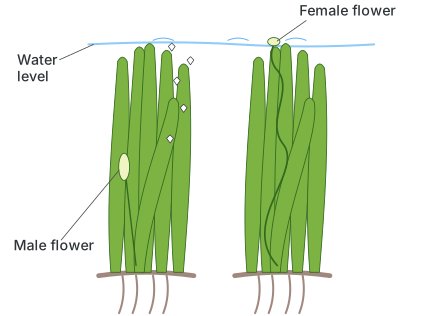
Drawn by us to help you understand the concept clearly, and verified to make sure it's accurate. For exams, practice from your textbook's own diagram.
What this figure shows. This figure shows the separate male and female plants of Vallisneria, a dioecious, submerged, freshwater aquatic plant. It depicts the male flower detaching from the male plant and floating freely on the water surface, while the female flower of the female plant is shown reaching the water surface temporarily on an elongated stalk, positioned at the wat …
B. Biotic Agents : These are living agents. About 80% of plants need the help of other living, moving creatures, insects, birds, bats and snails, to carry their pollen from one flower to another; these pollinators also sustain our ecosystems and produce natural resources by helping plants to reproduce.
1. Pollination by insects (Entomophily) : It occurs in rose, jasmine, Cestrum and many others.
Adaptations in entomophilous flowers :
- The flowers are large, showy and often brightly coloured.
- They produce a sweet odour (smell) and have nectar glands.
- The stigma is rough because of hairs, or sticky because of a mucilaginous secretion.
- The pollen grains are spiny and surrounded by a yellow sticky substance called pollen-kit.
- Some plants have special adaptations for the insect visitor that help cross pollination, e.g. the lever mechanism or turn-pipe mechanism in Salvia.
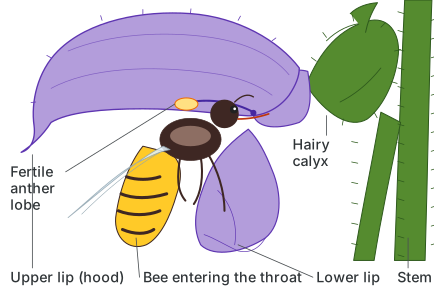
Drawn by us to help you understand the concept clearly, and verified to make sure it's accurate. For exams, practice from your textbook's own diagram.
What this figure shows. Drawn to the composition of the textbook's photograph: a bee has landed on the lower lip of a purple Salvia flower and is pushing its head into the throat of the corolla tube, under the large hooded upper lip; the hairy calyx and stem are on the right. The stamen of Salvia is a lever: its connective is a long arm pivoted on a short filament, with a sterile plate at the lower end and the fertile anther lobe at the upper end, hidden inside the hood. When the bee's head pushes the sterile plate the lever tips, the fertile lobe swings down and dusts pollen on the bee's back, to be carried to the stigma of the next flower; this 'lever mec …
2. Pollination by birds (Ornithophily) : Only a few types of birds are specialised for pollination; they are usually small with long beaks, e.g. sun birds and humming birds. Some ornithophilous plants are Bombax, Callistemon (bottle brush) and Butea.
Adaptations in ornithophilous flowers :
- The flowers are usually brightly coloured, large and showy.
- They secrete profuse, dilute nectar.
- The pollen grains are sticky and spiny.
- The flowers are generally without fragrance, because birds have a poor sense of smell.
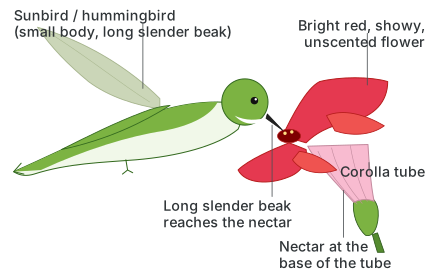
Drawn by us to help you understand the concept clearly, and verified to make sure it's accurate. For exams, practice from your textbook's own diagram.
What this figure shows. Drawn to the composition of the textbook's photograph: a small hovering hummingbird, wings blurred with beating, pushes its long slender beak into the mouth of a bright red tubular flower to reach the dilute nectar at the base of the tube. As it feeds, its head and beak brush the anthers and the stigma at the flower's mouth, so the sticky, spiny pollen is carried from flower to flower. The large, showy, brightly coloured, scentless flower with profuse dilute nectar shows the adaptations of ornithophilous flowers listed …
3. Pollination by Bats (Chiropterophily) : Bats can transport pollen over long distances, sometimes several kilometres.
Adaptations in Chiropterophilous flowers : …