Biology · Ch 1 — Reproduction in Lower and Higher Plants
Asexual Reproduction
Asexual Reproduction
Asexual reproduction does not involve the union of two compatible sex cells (gametes). A single parent organism gives rise to offspring that are genetically identical to itself and to one another; such genetically and morphologically identical individuals are called clones. Because no genetic recombination occurs, asexually produced offspring carry exactly the genetic makeup of the parent.
Organisms reproduce asexually by different modes or ways:
i. Fragmentation : A multicellular body may break into two or more pieces, whether by mechanical damage, growth pressure, or natural weak points. Each fragment, if it retains enough tissue, regenerates into a complete new individual. The filamentous alga Spirogyra is a classic example -- a broken filament segment simply continues growing as an independent thallus.
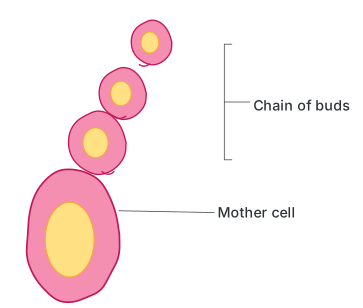
ii. Budding : A small outgrowth (bud) forms on the parent body, enlarges while still attached, and eventually detaches to live independently. This is the most common means of asexual multiplication in unicellular organisms such as Protosiphon and yeast, and it usually takes place when conditions (warmth, nutrients) are favourable; one or more buds may form at a time, and in yeast the buds themselves often bud again before separating, giving a short chain of cells. The Activity below lets you watch active yeast at work.
Drawn by us to help you understand the concept clearly, and verified to make sure it's accurate. For exams, practice from your textbook's own diagram.
What this figure shows. This figure shows the process of budding in yeast, a single-celled fungus. It depicts a mother cell putting out one or more small rounded outgrowths (buds) on its surface; several buds are shown still attached in a short chain, illustrating how repeated budding under favourable conditions can produce a connected chain of daughter cells be …
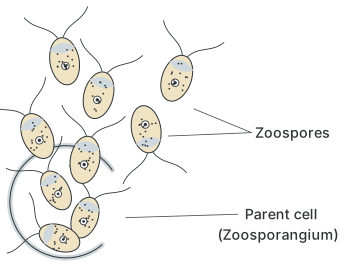
iii. Spore formation : Certain algae, such as Chlamydomonas, produce flagellated, motile zoospores inside the parent cell. Once released, each zoospore swims away and develops independently into a new individual without any fusion of gametes.
Drawn by us to help you understand the concept clearly, and verified to make sure it's accurate. For exams, practice from your textbook's own diagram.
What this figure shows. This figure illustrates zoospore formation in the green alga Chlamydomonas. A single parent cell, acting as a zoosporangium, is shown internally producing several flagellated, motile zoospores; the diagram depicts these zoospores being released from the parent cell wall, after which each swims away independently and develops into a new Chlamydomona …
Other asexual routes recorded in simple organisms include binary fission (an equal splitting of the parent cell into two, seen in Chlorella, diatoms, and Chlamydomonas), conidia formation (chains of asexual spores pinched off the tip of specialised hyphae, as in the mould Penicillium), and gemma formation (small multicellular buds produced in cup-like structures on the thallus, as in the liverwort Marchantia, which detach and grow into new plants when dispersed by rain-splash).
In higher plants the equivalent of asexual reproduction is vegetative propagation, in which a vegetative organ of the parent plant (a root, a leaf or a stem), not a seed or a spore, gives rise to a complete new plant. The textbook's 'Can you recall?' box at the end of this section lists the familiar examples of each organ; the artificial methods that agriculture builds on this capacity are taken up under Vegetative Reproduction next. …