Biology · Ch 1 — Reproduction in Lower and Higher Plants
Seed and Fruit Development
Seed and Fruit Development
The ultimate goal of reproduction in any organism, plants included, is the production of offspring for the next generation, and seed formation is the principal route by which flowering plants achieve this. Because pollination is the essential trigger for seed and fruit production, flowers must first be successfully pollinated for either process to proceed; seed development itself is specifically initiated by fertilization.
As the fertilized ovule matures into a seed, the two integuments persist and are transformed into the outer protective seed coat: sometimes this differentiates into two distinct layers, an outer, typically tough testa and an inner, thin, membranous tegmen. In a few genera, such as black pepper and beet, the nucellus itself also persists as a thin, papery layer called the perisperm, in addition to (or occasionally instead of) the endosperm.
Depending on how completely the developing embryo consumes the food reserves stored in the endosperm, mature seeds fall into two categories:
- Endospermic (albuminous) seeds: The embryo uses up only part of the endosperm's reserves during development, so the endosperm remains conspicuous and fills a substantial part of the mature seed, as in castor, coconut, and maize.
- Non-endospermic (ex-albuminous) seeds: The embryo absorbs and consumes the entire endosperm reserve during its own development, so that by maturity the endosperm has disappeared/disorganised entirely, as in pea and bean. In many such seeds the cotyledons themselves take over the role of food storage (or, in some cases, become the first photosynthetic organs after germination).
The micropyle typically persists in the mature seed coat as a small pore, through which water and oxygen can later enter during the soaking/imbibition stage of germination.
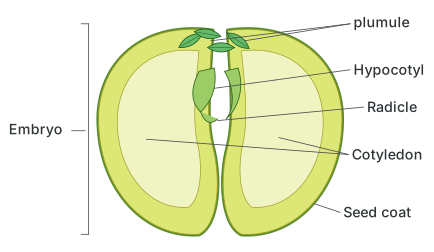
Drawn by us to help you understand the concept clearly, and verified to make sure it's accurate. For exams, practice from your textbook's own diagram.
What this figure shows. This is a labelled diagram of a bean seed as an example of a dicot seed, cut open to show its internal structure: the outer seed coat, and within it the embryo consisting of the plumule, the hypocotyl, the radicle, and the two fleshy cotyledons that fill almost the entire seed, since the bean is a non-endospermic (ex-albuminous) …
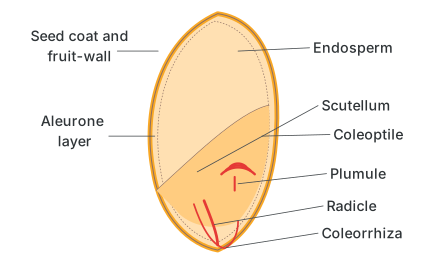
Drawn by us to help you understand the concept clearly, and verified to make sure it's accurate. For exams, practice from your textbook's own diagram.
What this figure shows. This is a labelled vertical-section diagram of a maize grain, representing a monocot seed. It shows the fused seed coat and fruit wall on the outside, the aleurone layer and the bulk of the starchy endosperm beneath it, since maize is an endospermic seed, and, to one side, the embryo consisting of the scutellum, coleoptile, plumule, radicle, and coleorrhiza, illustrating ho …
In parallel with seed development, hormonal signals produced by the developing seeds trigger the ovary to differentiate into a fruit: the ovary wall develops into the pericarp, which in fleshy fruits such as mango and coconut becomes clearly differentiated into three distinct layers.
Significance of seed and fruit formation :
- Fruits provide nourishment to the developing seeds.
- Fruits protect the seeds while they are immature.
- Seeds serve as important propagating organs (units) of the plant.
- Seeds and fruits develop special devices for their dispersal and so help in the distribution of the species. …