Chemistry · Ch 12 — Aldehydes, Ketones and Carboxylic Acids
Chemical reactions of aldehydes and ketones with nucleophile
Chemical reactions of aldehydes and ketones with nucleophile
In every reaction catalogued in this section, a nucleophilic reagent attacks the positively-polarised, electrophilic carbonyl carbon set up in section 12.7 -- the section works systematically through eight such reactions, labelled (a) to (h). (a) ADDITION OF HYDROGEN CYANIDE: HCN (itself only a weak acid) adds directly across the C=O bond of an aldehyde or ketone to give a CYANOHYDRIN, R'-C(OH)(CN)-R (R'=H gives an aldehyde-derived cyanohydrin, R'=alkyl/aryl gives a ketone-derived one); the reaction needs either an acid or a base catalyst to proceed at a useful rate. Cyanohydrin formation is described as a 'step-up' reaction, because it genuinely forms a brand-new carbon-carbon single bond in the process; and since the resulting -C#N group can later be converted on to -COOH, or to -CH2-NH2, and so on, cyanohydrins serve as useful intermediates in 'step-up' synthetic sequences that need one extra carbon added to a chain. (b) ADDITION OF NaHSO3 (sodium bisulfite, itself the sodium salt of sulfurous acid): aldehydes and ketones react with a saturated aqueous solution of sodium bisulfite to give a crystalline precipitate, the bisulfite-addition adduct. Usefully, this adduct is easily split back apart into the original aldehyde or ketone again, simply by treating it with dilute acid or dilute base -- which makes this reaction genuinely useful as a way to SEPARATE and PURIFY aldehydes and ketones away from other, non-carbonyl organic compounds in a mixture. (c) ADDITION OF ALCOHOLS: an aldehyde reacts with ONE molecule of an anhydrous monohydric alcohol, in the presence of dry hydrogen chloride gas as catalyst, to give an unstable intermediate called a HEMIACETAL (an alkoxy-alcohol); this hemiacetal then reacts further with a SECOND molecule of the same anhydrous alcohol (again dry HCl catalysed), losing a molecule of water, to give a stable, geminal-dialkoxy compound called an ACETAL. Ketones undergo the exact same two-step sequence with alcohols, giving first a HEMIKETAL and then a stable KETAL; and, specifically with a 1,2- or 1,3-diol (again dry HCl catalysed), a ketone instead gives a five- or six-membered CYCLIC ketal directly. A cyclic ketal is genuinely useful as a temporary PROTECTING GROUP, shielding a ketone elsewhere in a multifunctional molecule from unwanted reactions, since the cyclic-ketal reaction is fully reversible: treating the cyclic ketal with aqueous HCl regenerates the original ketone. A 'Remember' box notes one further related case: an organic molecule that already carries BOTH an -OH group and a carbonyl group, within the same molecule, can undergo this exact same reaction INTRAMOLECULARLY with dry HCl, forming a cyclic hemiacetal or hemiketal without needing any external alcohol at all. In every case, acetals and ketals are readily hydrolysed straight back to their parent aldehyde or ketone simply by treatment with aqueous mineral acid. (d) ADDITION OF GRIGNARD REAGENT: aldehydes and ketones react with an alkylmagnesium halide (a Grignard reagent), and then with acid on workup/hydrolysis, to give alcohols (this specific reaction, and the different alcohol classes it produces from aldehydes versus ketones versus formaldehyde, was already covered in Chapter 11, section 11.4.1d). (e) NUCLEOPHILIC ADDITION-ELIMINATION WITH AMMONIA DERIVATIVES: aldehydes and ketones react with a range of ammonia-derivative reagents (general formula NH2-Z) via an addition-then-elimination sequence, losing a molecule of water and forming a product containing a new C=N bond -- an IMINE. This reaction is reversible, and proceeds specifically in weakly acidic reaction medium; a substituted imine product made this way is given the special name SCHIFF'S BASE. A 'Remember' box explains why the medium has to be only WEAKLY acidic: in a STRONGLY acidic medium, the nitrogen atom of the ammonia-derivative reagent itself gets protonated, to (H3N(+)-Z), and a protonated nitrogen is no longer nucleophilic at all, so the reaction simply cannot proceed under strongly acidic conditions. All aldehydes and ketones give broadly similar reactions with this whole family of reagents; Table 12.7 catalogues five specific named reagents/products (oxime, hydrazone, phenylhydrazone, semicarbazone, and 2,4-dinitrophenylhydrazone). Because the resulting products are high-molecular-mass CRYSTALLINE solids, these reactions are genuinely useful in the laboratory for CHARACTERISING (identifying) an unknown original aldehyde or ketone, via its crystalline derivative's sharp melting point. (f) HALOFORM REACTION: this particular reaction is given specifically by acetaldehyde, by ALL methyl ketones (general formula CH3-CO-R), and by all alcohols that contain a CH3-CHOH- grouping. Warming any of these substrates with sodium hydroxide and iodine together (which generates sodium hypoiodite, NaOI, in situ as the true active reagent) gives a distinctive YELLOW precipitate. During the reaction, the substrate's methyl group is itself oxidatively converted into a haloform (here, iodoform, CHI3), while the REST of the molecule ends up as the sodium salt of a carboxylic acid carrying exactly ONE carbon atom fewer than the original substrate. Worked example: acetone, warmed with NaOH and I2, is oxidised by the in-situ-generated sodium hypoiodite to give sodium acetate plus a yellow precipitate of iodoform: H3C-CO-CH3 + 3 NaOI, with NaOH and heat, gives CHI3(down-arrow) + H3C-CO-ONa + 2 NaOH. Three important 'Remember' caveats are given: if a C=C double bond is present anywhere in the given aldehyde, ketone or methyl ketone, that C=C is NOT itself attacked by the hypohalite reagent; NON-methyl ketones (i.e. ketones without a methyl group directly on the carbonyl carbon) do NOT give a positive iodoform test at all; and secondary alcohols that happen to contain a CH3-CHOH- grouping DO still give a positive iodoform test, because the reagent first oxidises that alcohol group up to the corresponding CH3-CO- (methyl ketone) group in situ, which THEN goes on to form the iodoform as usual. (g) ALDOL CONDENSATION: an aldehyde or ketone that carries at least ONE alpha-hydrogen atom, treated with dilute alkali (dilute NaOH, KOH, or Na2CO3) as catalyst, undergoes an ADDITION reaction to form a beta-hydroxy aldehyde (called an 'aldol') or, for a ketone-derived product, a beta-hydroxy ketone (a 'ketol') -- this addition step ALONE is called the 'aldol reaction'. If the aldol product itself still has an alpha-hydrogen available (which it generally does, from the original substrate's own alpha-hydrogens), warming it further drives off a molecule of water by ELIMINATION, giving an alpha,beta-UNSATURATED aldehyde or ketone as the final product. The complete addition-then-elimination sequence, taken together, is called ALDOL CONDENSATION -- and, as an addition-elimination sequence acting at an electrophilic carbonyl carbon, it is itself a nucleophilic addition-elimination reaction (exactly the same broad reaction TYPE as (e) above, just with a carbanion nucleophile this time rather than an amine). Ketones that carry at least TWO alpha-hydrogens can undergo this same aldol condensation too, giving an alpha,beta-unsaturated KETONE as final product; worked example: two molecules of acetone, with barium hydroxide as base, first give the ketol 4-hydroxy-4-methylpentan-2-one, which on further warming loses water to give 4-methylpent-3-en-2-one. CROSS ALDOL CONDENSATION is the name given specifically to an aldol condensation carried out between TWO DIFFERENT aldehydes or ketones together. If BOTH partner carbonyl compounds happen to carry two alpha-hydrogens each, the reaction gives a genuine MIXTURE of FOUR distinct products (worked out fully in Fig. 12.5, for a mixed sample of ethanal and propanal) -- two 'self'-condensation products (each carbonyl reacting only with another molecule of its own kind) and two genuinely 'cross' products (the two different carbonyls reacting with each other, in either possible role). Ketones, just as much as aldehydes, can serve as one of the two components in a cross aldol …
Table 12.7 lists five ammonia-derivative reagents (R'=H for aldehyde, R'#H for ketone; all reactions lose H2O and give a crystalline imine derivative): (1) + NH2-OH (Hydroxylamine) -> oxime, R'-C(R)=N-OH. (2) + NH2-NH2 (Hydrazine) -> hydrazone, R'-C(R)=N-NH2. (3) + NH2-NH-C6H5 (Phenyl hydrazine) -> phenylhydrazone, R'-C(R)=N-NH-C6H5. (4) + NH2-NH-CONH2 (Semicarbazide) -> semicarbazone, R'-C(R)=N-NH-CONH2. (5) + 2,4-dinitrophenylhydrazine (a hydrazine bearing a 2,4-(NO2)2-C6H3- group on its terminal N) -> 2,4-dinitrophenylhydrazone, R'-C(R)=N …
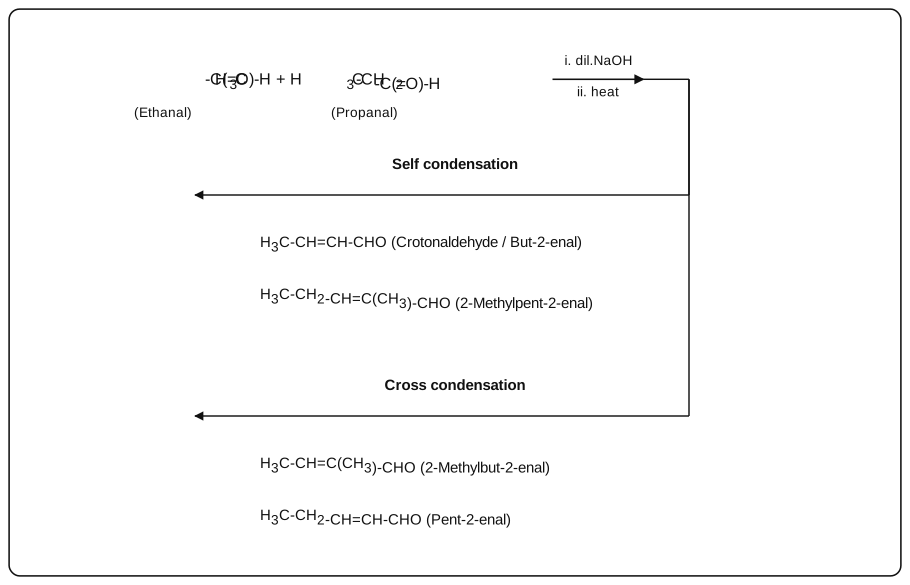
Drawn by us to help you understand the concept clearly, and verified to make sure it's accurate. For exams, practice from your textbook's own diagram.
What this figure shows. A mixture of ethanal (CH3-CHO) and propanal (CH3-CH2-CHO), treated with dilute base then heat, giving all FOUR possible aldol-condensation products: the two SELF-condensation products -- crotonaldehyde/but-2-enal (from two ethanal) and 2-methylpent-2-enal (from two propanal) -- and the two CROSS-condensation products -- 2-methylbut-2-enal and pent-2-enal (each built from one ethanal-derived and one propanal-derived fragment). The figure is the chapter's worked illustration of why cross aldol condensation between two different alpha-hydrogen-bearing carbonyls g …