Chemistry · Ch 12 — Aldehydes, Ketones and Carboxylic Acids
Laboratory tests for aldehydes and ketones
Laboratory tests for aldehydes and ketones
Aldehydes are easily oxidised on to carboxylic acids, and so themselves act as REDUCING agents toward mild oxidants; ketones, lacking any hydrogen directly on their carbonyl carbon, cannot be oxidised the same way and so resist these same mild oxidants. This one reactivity difference is exploited by three separate tests that are positive for ALDEHYDES ONLY, plus one further test specific to the KETONIC group. Aldehyde-only tests: the SCHIFF TEST -- an alcoholic solution of the aldehyde, treated with a few drops of Schiff's reagent (itself a colourless solution, made by passing SO2 gas through magenta-coloured p-rosaniline hydrochloride solution), turns pink, red or magenta, confirming the presence of an aldehydic -CHO group. The TOLLENS'/SILVER-MIRROR TEST -- an aldehyde boiled with Tollens' reagent (ammoniacal silver nitrate, itself made by mixing AgNO3 solution with a little dilute NaOH to precipitate a brown solid, then redissolving that solid with dilute ammonium hydroxide) deposits a bright silver mirror on the vessel wall, as the aldehyde is oxidised to a carboxylate ion while Ag(+) is simultaneously reduced to metallic Ag. The FEHLING TEST -- a mixture of the aldehyde with Fehling's solution (itself two separately-prepared solutions mixed together: Fehling A, copper sulfate crystals dissolved in concentrated sulfuric acid, and Fehling B, sodium potassium tartrate dissolved in sodium hydroxide solution), boiled in hot water, deposits a RED precipitate of cuprous oxide, as the aldehyde is oxidised to carboxylate while Cu2(+) is reduced to Cu(+); it is worth noting that an alpha-hydroxy ketone ALSO gives this particular test a false positive, so Fehling's alone cannot always distinguish an aldehyde from every possible ketone. Ketonic-group test: the SODIUM NITROPRUSSIDE TEST -- a freshly-prepared sodium nitroprusside solution is added to the ketone, shaken well, then basified drop by drop with sodium hydroxide solution; a RED colour appears, indicating the pre …
Worked out. Tollens' test: R-CHO + 2 Ag(NH3)2(+) + 3 OH(-) --heat--> R-COO(-) + 2 Ag (silver mirror) + 4 NH3 + 2 H2O. Fehling test: R-CHO + 2 Cu2(+) + 5 OH(-) --boil--> R-COO(-) + Cu2O (red precipitate) + 3 H2O. Sodium nitroprusside test on acetone: CH3-CO-CH3 + OH(-) -> CH3-CO-CH2 + H2O (enolate formation), then [Fe(CN)5NO]2(-) + CH3-CO-CH2 -> [Fe(CN)5NO(CH3-CO-CH2)]3(-) (re …
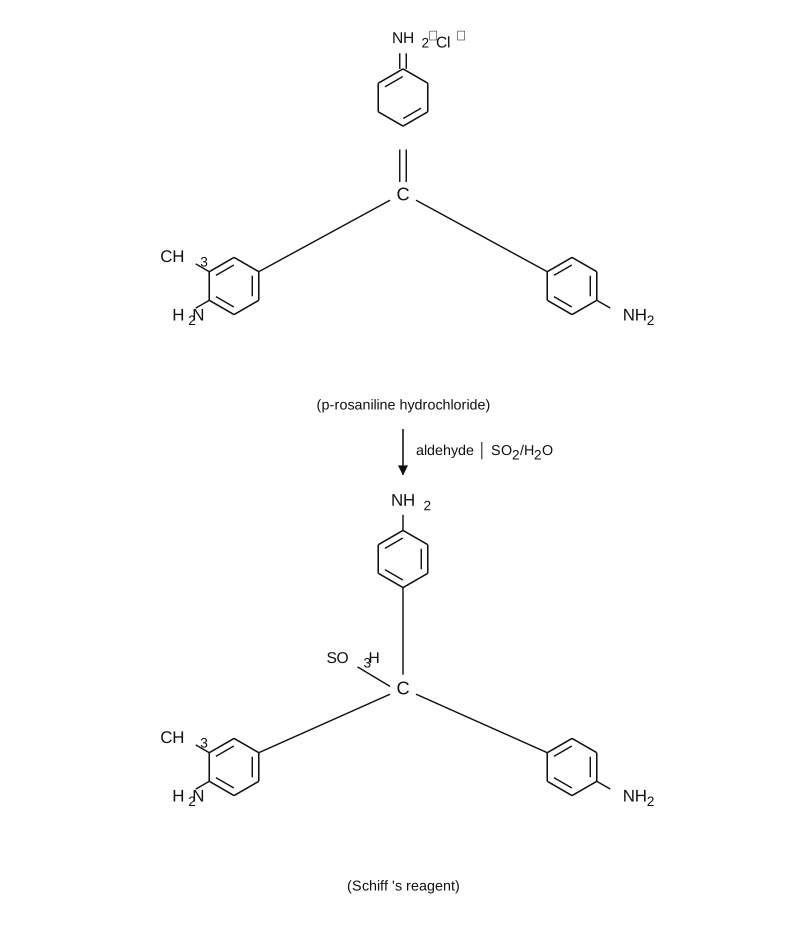
Drawn by us to help you understand the concept clearly, and verified to make sure it's accurate. For exams, practice from your textbook's own diagram.
Behind the Schiff test. Magenta p-rosaniline hydrochloride is decolourised by SO2/water: the central carbon picks up -SO3H, breaking the extended conjugation — that colourless solution is Schiff's reagent. An aldehyde removes the SO2, restoring the quinoid chromophore, which is why aldehydes tur …