Chemistry · Ch 12 — Aldehydes, Ketones and Carboxylic Acids
Nature of intermolecular forces
Nature of intermolecular forces
The carbonyl bond, C=O, present in both aldehydes and ketones, is a POLAR covalent bond (oxygen being considerably more electronegative than carbon). As a direct result, aldehyde and ketone molecules experience DIPOLE-DIPOLE forces of attraction between one another: neighbouring carbonyl-containing molecules orient themselves so that their oppositely-polarised atoms face each other -- the partially-positive carbonyl carbon of one molecule lining up opposite the partially-negative carbonyl oxygen of its neighbour (Fig. 12.1). This dipole-dipole attraction is the starting point for understanding the boiling-point trends worked out in the next two sections, and it is later explicitly ranked (in 12.6.4) as intermediate in strength -- weaker than hydrog …
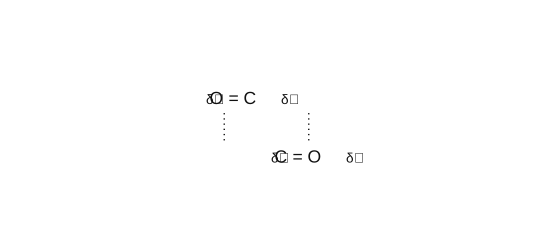
Drawn by us to help you understand the concept clearly, and verified to make sure it's accurate. For exams, practice from your textbook's own diagram.
What this figure shows. Two carbonyl (C=O) groups drawn facing each other, each carbon marked delta-plus and each oxygen marked delta-minus, oriented so the delta-plus carbon of one molecule faces the delta-minus oxygen of the neighbouring molecule -- illustrating how oppositely-polarised ends of neighbouring polar carbonyl groups line up to attract one another (dipole-dipole intermolecular attraction), the weakest of the three intermolecular forces discu …