Chemistry · Ch 12 — Aldehydes, Ketones and Carboxylic Acids
Solubility of aldehydes and ketones
Solubility of aldehydes and ketones
The oxygen atom of a carbonyl group, C=O, is able to take part in hydrogen bonding directly with a water molecule (Fig. 12.2), acting as the hydrogen-bond ACCEPTOR (its lone-pair electrons accepting a hydrogen bond from one of water's O-H hydrogens). Because of this, the LOWER aldehydes and ketones in each homologous series -- e.g. acetaldehyde, acetone -- are genuinely water-soluble. As molecular mass climbs further up either series, though, the proportion of the molecule taken up by its plain hydrocarbon portion (which, having no polar/hydrogen-bonding groups of its own, cannot itself hydrogen-bond to w …
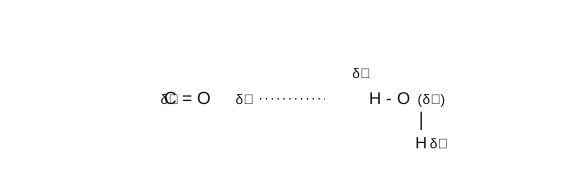
Drawn by us to help you understand the concept clearly, and verified to make sure it's accurate. For exams, practice from your textbook's own diagram.
What this figure shows. A carbonyl group's C=O drawn hydrogen-bonded to an H-O-H water molecule, with delta-plus marked on the carbonyl carbon and on the water's hydrogens, and delta-minus marked on the carbonyl oxygen and on the water oxygen -- showing the carbonyl oxygen's lone pair accepting a hydrogen bond from a water hydrogen, the interaction responsible for the water-solubility of lower aldehydes …