Chemistry · Ch 14 — Biomolecules
Optical isomerism in glucose
Optical isomerism in glucose
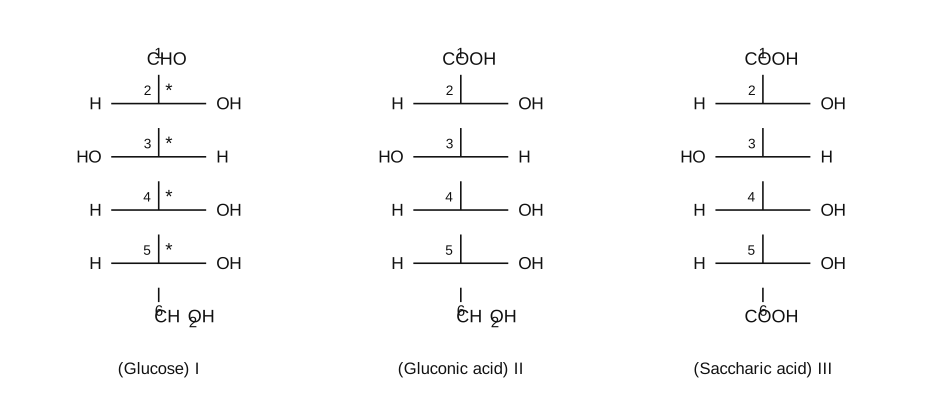
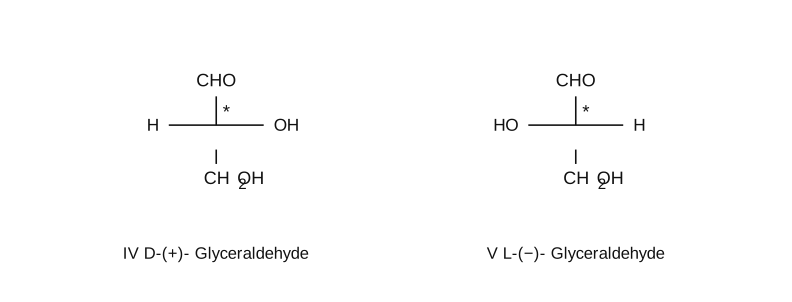
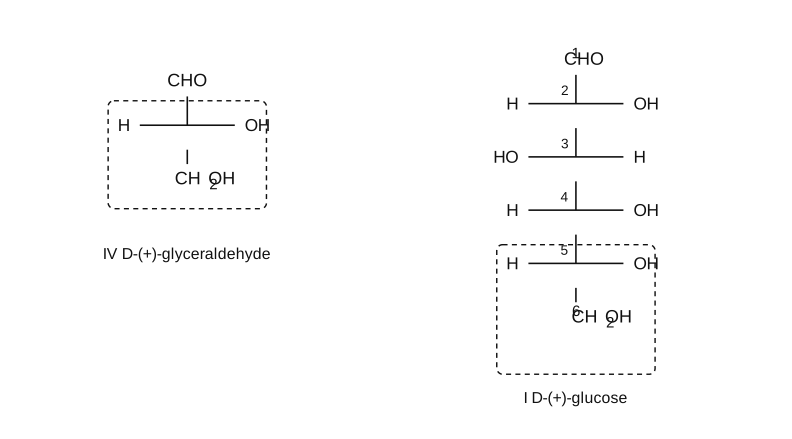
Glucose's structural formula, CHO-(CHOH)4-CH2OH, contains four chiral (stereogenic) carbons -- C-2, C-3, C-4 and C-5, each bonded to four different groups (C-1 and C-6 are not chiral). Since a molecule with n chiral centres can in principle exist as up to 2^n distinct stereoisomers, an aldohexose can exist as up to 2^4 = 16 different optical isomers, of which D-(+)-glucose is just one specific member. Working out exactly WHICH configuration real glucose has, at each of its four chiral centres, required elaborate chemical correlation and optical-rotation measurements; this was accomplished by the German chemist Emil Fischer (awarded the Nobel Prize in 1902), using the flat, vertically-drawn Fischer projection formula to represent each 3-D configuration on paper. Natural glucose is optically active and dextrorotatory, with specific rotation [alpha]D20 = +52.7 degrees -- this dextrorotation is why glucose is also commonly called dextrose, and the prefix (+)- or 'd-' in its name specifically records the SIGN of optical rotation. Separately, the prefix D- (capital, upright) records glucose's CONFIGURATION rather than its rotation sign, and is assigned by a relative system built on the reference compound glyceraldehyde: glyceraldehyde has just one chiral carbon and so exists as exactly two enantiomers, arbitrarily designated D-(+)-glyceraldehyde (its Fischer projection drawn with the C-2 -OH on the right) and L-(-)-glyceraldehyde (C-2 -OH on the left). Any compound that can be chemically correlated, through a series of reactions, back to D-(+)-glyceraldehyde is assigned the D-configuration; one correlated back to L-(-)-glyceraldehyde is assigned the L-configuration. For a monosaccharide with several chiral centres, this D/L label is specifically read off the configuration at its LOWEST (i.e. highest-numbered, furthest from the carbonyl) chiral carbon in the Fischer projection -- for glucose that is C-5, and since glucose's C-5 -OH points to the right (the same side as glyceraldehyde's reference -OH), glucose is assigned the D-configuration, giving its full name D-(+)-glucose. (Note that optical rotation, +52.7 degrees for glucose, is a directly measurable …
Drawn by us to help you understand the concept clearly, and verified to make sure it's accurate. For exams, practice from your textbook's own diagram.
What this figure shows. Three vertical Fischer projections drawn side by side and numbered C-1 to C-6 from top to bottom. (I) Glucose: C-1 = CHO, C-2 = H-C-OH, C-3 = HO-C-H, C-4 = H-C-OH, C-5 = H-C-OH, C-6 = CH2OH. (II) Saccharic acid: identical middle four carbons to glucose, but C-1 = COOH (oxidised from CHO) and C-6 = COOH (oxidised from CH2OH) -- i.e. both ends are carboxylic acid groups. (III) Gluconic acid: same middle four carbons again, C-1 = COOH (oxidised from CHO) but C-6 remains CH2OH (unoxidised) -- i.e. only the aldehydic end is oxidised. Comparing all three confirms the middle four stereocentres (C-2 to C-5) are untouched by the oxidations, isolating exactly which end i …
Worked out. Notes that optical rotation is easy to measure experimentally, but the actual spatial configuration at a chiral centre is not directly observable by a simple experiment -- it had to be inferred by chemical correlation for decades. In 1951, X-ray crystallographic studies of (+)-sodium rubidium tartrate directly established its absolute configuration for the first time (with -OH and H positions on the two chiral centres of the tartrate ion fixed by the crystal structure), finally anchoring the whole relative D/L configurational system (built on glyceraldehyde) to an experimentall …
Worked out. Worked problem: D/L configuration of a monosaccharide is read off the LOWEST (highest-numbered) chiral carbon in its Fischer projection. (i) Threose has two chiral carbons, C-2 and C-3; in the given Fischer projection the -OH at the lower chiral centre, C-3, points to the right, so it is D-threose. (ii) Ribose has three chiral carbons, C-2, C-3 and C-4; in the given Fischer projection the -OH at the lowest chiral centre, C-4, points to the left, so it is L-ribose. (Natural ribose, as found in RNA, is actually the D-form; this problem's numbering is a hypothetical illustration …
Drawn by us to help you understand the concept clearly, and verified to make sure it's accurate. For exams, practice from your textbook's own diagram.
What this figure shows. Two Fischer projections of the three-carbon sugar glyceraldehyde (CHO-CHOH-CH2OH), which has a single chiral carbon, C-2, and so exists as exactly one pair of enantiomers. Structure IV, D-(+)-glyceraldehyde: C-1 = CHO, C-2 = H-C-OH (the -OH points right), C-3 = CH2OH. Structure V, L-(-)-glyceraldehyde: C-1 = CHO, C-2 = HO-C-H (the -OH points left), C-3 = CH2OH -- the exact mirror image of IV. By convention the -OH pointing right at C-2 defines the D-label and left defines the L-label; every other monosaccharide's D/L designation is ultimately d …
Drawn by us to help you understand the concept clearly, and verified to make sure it's accurate. For exams, practice from your textbook's own diagram.
What this figure shows. Places D-(+)-glyceraldehyde (structure IV, its single chiral centre C-2 with -OH on the right) directly beside D-(+)-glucose (structure I, its lowest chiral centre C-5 also with -OH on the right, C-1 to C-6 numbered top to bottom: CHO, H-C-OH, HO-C-H, H-C-OH, H-C-OH, CH2OH). Because the -OH at glucose's lowest/highest-numbered chiral carbon (C-5) points the same way (right) as the -OH at glyceraldehyde's own chiral carbon, glucose is chemically correlated to D-(+)-glyceraldehyde and is therefore assigned the D-configuration -- illustrating …