Chemistry · Ch 14 — Biomolecules
Ring structure of glucose
Ring structure of glucose
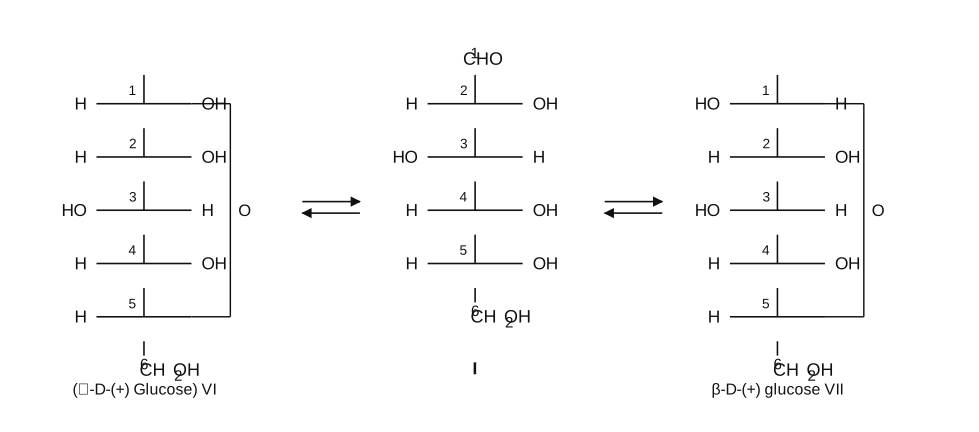
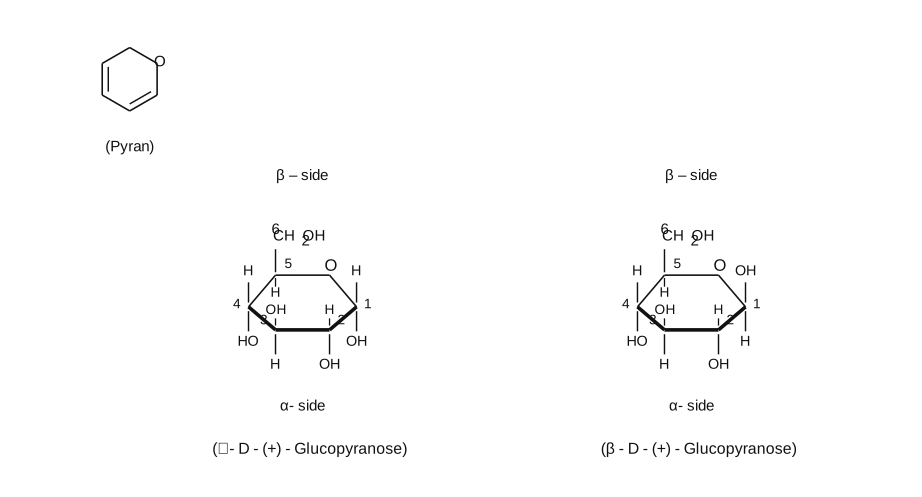
The open-chain Fischer structure of glucose, though it correctly explains many of glucose's properties, cannot account for every chemical property glucose is observed to show -- most notably, glucose does not react with all the reagents a genuinely free aldehyde would be expected to react with, and it also shows an unusual property called mutarotation (a slow change in optical rotation when freshly dissolved). The resolution is that in aqueous solution, glucose exists mainly as one of two CYCLIC (ring) structures, in dynamic equilibrium with a small amount of the open-chain form. The ring closes when the -OH group at C-5 reacts internally with the aldehydic carbon at C-1, forming a cyclic hemiacetal -- exactly the same hemiacetal-forming reaction an aldehyde undergoes with any external alcohol, except here the alcohol (the C-5 -OH) is part of the SAME molecule. This creates a six-membered ring: five carbons (C-1 through C-5) plus the one oxygen that bridged across from C-5, so the ring is called a pyranose ring, by analogy with the simple six-membered oxygen heterocycle pyran -- glucose in this cyclic form is accordingly called glucopyranose. Because C-1 was not previously a stereocentre in the open-chain form (it was a flat, sp2 aldehydic carbon) but becomes one upon ring closure (bonded to four different groups once the ring's own oxygen and the new -OH are both attached), ring closure creates a brand-new chiral centre at C-1, called the anomeric carbon. The two possible configurations at this new centre give two distinct ring structures called anomers: the alpha-anomer and the beta-anomer, which differ ONLY in the spatial arrangement at C-1 (every other stereocentre, C-2 through C-5, is identical between them). The clearer way to draw these ring structures is the Haworth formula, in which the pyranose ring is drawn as if viewed edge-on, perpendicular to the plane of the paper: the lower face of the ring is conventionally called the alpha-side and the upper face the beta-side. The alpha-anomer has its anomeric -OH (at C-1) drawn pointing down, on the alpha-side; …
Drawn by us to help you understand the concept clearly, and verified to make sure it's accurate. For exams, practice from your textbook's own diagram.
What this figure shows. Shows the equilibrium among three Fischer-style formulas of glucose: the open-chain form (I, CHO at C-1 through CH2OH at C-6) sits between two cyclic hemiacetal forms formed by an internal oxygen bridge from the C-5 -OH to C-1 -- alpha-D-(+)-glucose (VI) and beta-D-(+)-glucose (VII) -- which differ only in whether the new -OH created at the anomeric carbon C-1 points to the same side as (alpha) or the opposite side from (beta) the reference -OH at C-5 that closed the ring. All three forms interconvert freely in …
Drawn by us to help you understand the concept clearly, and verified to make sure it's accurate. For exams, practice from your textbook's own diagram.
What this figure shows. Two hexagonal Haworth-formula rings, each drawn as a six-membered ring with one ring oxygen (between C-1 and C-5) viewed edge-on/perpendicular to the plane of the paper, carbons numbered C-1 (right) round to C-6 (the exocyclic -CH2OH substituent above C-5). alpha-D-(+)-glucopyranose has its anomeric -OH at C-1 drawn pointing down (the alpha-side, below the ring plane); beta-D-(+)-glucopyranose has it drawn pointing up (the beta-side, above the ring plane). A small reference structure of pyran, the parent six-membered O-heterocycle (five CH2 groups plus one ring O), is shown alongside to explain why this ring …