Chemistry · Ch 14 — Biomolecules
Sucrose
Sucrose
Sucrose, C12H22O11, is the most common disaccharide of everyday life (ordinary table sugar) and is strongly dextrorotatory, with specific rotation +66.5 degrees. On hydrolysis -- brought about by dilute acid or by the specific enzyme invertase -- sucrose splits into an exactly equimolar mixture of D-(+)-glucose and D-(-)-fructose (C12H22O11 + H2O, catalysed by H+ or invertase, gives C6H12O6 glucose + C6H12O6 fructose). Because fructose's laevorotation (-92.4 degrees) is LARGER in magnitude than glucose's dextrorotation (+52.7 degrees), the resulting 1:1 product mixture has a net NEGATIVE (laevorotatory) optical rotation overall -- the sign of rotation literally flips, from the strongly positive sucrose to the net-negative product mixture. Because of this sign-reversal, the hydrolysis of sucrose is specifically called the INVERSION of sucrose, and the resulting equimolar glucose+fructose mixture is called invert sugar (used commercially as invert syrup -- see the Do you know box in section 14.2.8's sibling content). Structurally, the single glycosidic linkage in sucrose runs between C-1 of alpha-D-glucose and C-2 of beta-D-fructose. Crucially, BOTH of these carbons are the respective units' own ANOMERIC carbons (C-1 is glucose's anomeric carbon; C-2 is fructose's anomeric carbon) -- so unlike maltose or lactose, sucrose's glycosidic bond consumes the anomeric hydroxyl of BOTH monosaccharide units simultaneously, leaving NEITHER unit with a free, reactive hemiacetal/hemiketal group. Because neither the potential aldehyd …
Worked out. Reaction scheme: C12H22O11 (sucrose) + H2O, catalysed by H+ or the enzyme invertase, gives C6H12O6 (D-(+)-glucose) + C6H12O6 (D-(-)-fructose). This is exactly the sucrose-hydrolysis reaction used industrially to prepare glucose (section 14.2.3a); here the emphasis is on the accompanying reversal of optical rotation sign (dextrorotatory sucrose to net laevorotatory product mixture), which is why the reaction is specifically called inversion and the 1:1 produ …
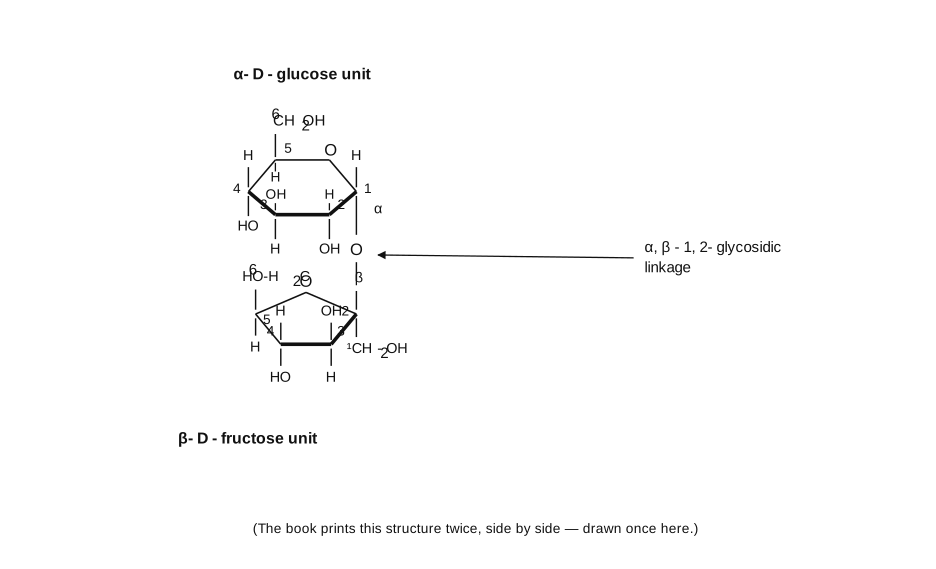
Drawn by us to help you understand the concept clearly, and verified to make sure it's accurate. For exams, practice from your textbook's own diagram.
What this figure shows. Shows the six-membered pyranose ring of alpha-D-glucose (carbons numbered C-1 through C-6, anomeric -OH at C-1 on the alpha-face) joined through an oxygen bridge directly to C-2 of the five-membered furanose ring of beta-D-fructose (with its own exocyclic CH2OH groups from C-1 and C-6). The glycosidic linkage is specifically described as an alpha,beta-1,2-glycosidic linkage because it uses the anomeric carbon of BOTH monosaccharide units (glucose's C-1 and fructose's C-2), which is why sucrose has no free anomeric h …
Worked out. Asks students to build physical models corresponding to the two alternative Haworth-formula drawings of sucrose shown in Fig. 14.8 and verify by hand that, despite looking different on paper (the glucose and fructose rings can be drawn oriented either way relative to each other), both drawings represent the identical molecule -- reinforcing that a Haworth formula's ring orientation on the page is a drawing convention, not a structural differe …