Answer the following · Q9
Q.ix. Write the electrode reactions when lead storage cell generates electricity. What are the anode and cathode and the electrode reactions during its recharging?
Maharashtra MsbshseTextbookSubjectiveImportance★★★★★
57% · 63/111 Questions
You're viewing a preview — the full solution, concept, methods & PYQ mapping are locked.
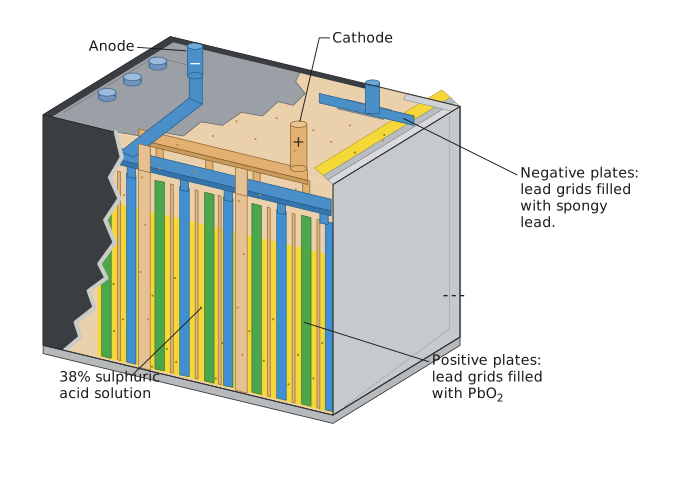
Start your 14-day free trial to unlock the full solution →Step 1. During DISCHARGE, the lead accumulator functions as a galvanic cell: at the anode, spongy Pb is oxidised and precipitates as PbSO4, ; at the cathode, PbO2 is reduced (in presence of H+) and also precipitates as PbSO4, .
Step 2. During RECHARGING, an external potential slightly above 2V is applied, and the cell functions as an electrolytic cell: the anode and cathode are INTERCHANGED, with the PbO2 electrode now the anode (+) and the Pb electrode now the cathode (–).
Step 3. The recharging anode reaction is the reverse of the discharge cathode reaction: . …
Unlock everything free for 14 days
- Full step-by-step solutions
- Concept-first explanations
- Methods, shortcuts & mistakes
- PYQ mapping + timed mock tests
Full access for 14 days. No credit card required.