Q.(i) Calculate effective atomic number of Fe in [Fe(CN)] [Given: (Z = 26)].
You're viewing a preview — the full solution, concept, methods & PYQ mapping are locked.
Start your 14-day free trial to unlock the full solution →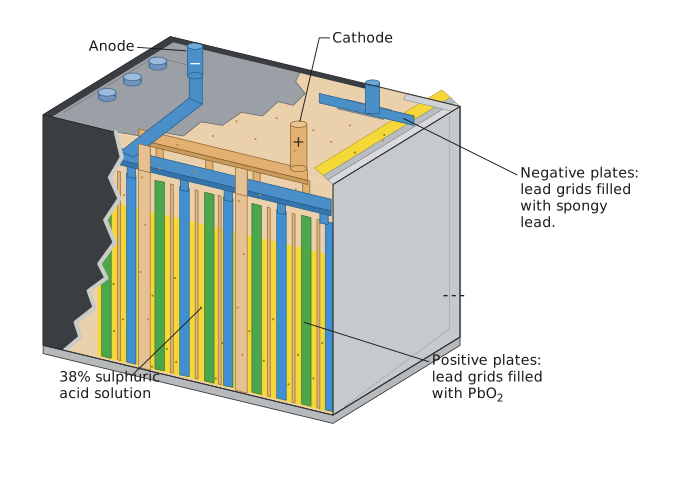
Fe attains an EAN of 36 (krypton configuration) in the hexacyanoferrate(II) ion; the lead accumulator is a Pb/PbO/HSO cell; H–O fuel cells are clean and continuous power sources.
(i) EAN of Fe in : Fe has , so has electrons. Each of the 6 ligands is a 2-electron donor, contributing electrons via coordinate bonds.
(This equals the atomic number of krypton, the next noble gas — consistent with the effective atomic number rule.)
(ii) Lead accumulator (lead–acid battery): It consists of a lead (Pb) plate as the anode (negative electrode) and a lead dioxide () plate as the cathode (positive electrode), with alternating sets of plates immersed in aqueous sulfuric acid (38% ) as electrolyte, held in a container/case; the plates are connected externally to deliver current. During discharge, both electrodes convert to lead sulfate (), and the process is reversed on recharging.
(iii) Two advantages of the fuel cell:
…
Unlock everything free for 14 days
- Full step-by-step solutions
- Concept-first explanations
- Methods, shortcuts & mistakes
- PYQ mapping + timed mock tests
Full access for 14 days. No credit card required.