Chemistry · Ch 10 — Halogen Derivatives
Classification of halogen derivatives
Classification of halogen derivatives
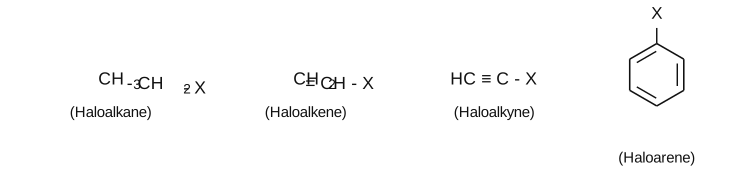
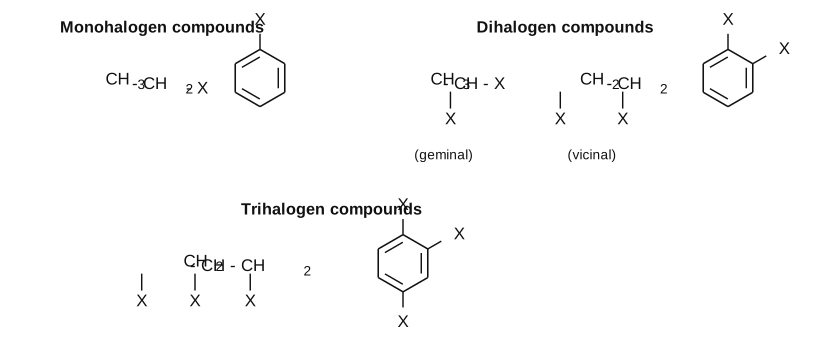
Halogen derivatives of hydrocarbons are formed when one or more hydrogen atoms of an aliphatic or aromatic hydrocarbon are replaced by halogen atoms (F, Cl, Br or I). Since the parent family of all organic compounds is the hydrocarbon, every halogen derivative can be traced back to the hydrocarbon it was substituted from. This chapter studies halogen derivatives systematically along two independent classification axes: (a) by the hydrocarbon skeleton to which the halogen is bonded -- giving haloalkanes (halogen on a saturated sp3 chain), haloalkenes (halogen on a carbon of a C=C double bond), haloalkynes (halogen on a carbon of a C-triple bond-C), and haloarenes (halogen directly on an aromatic ring carbon); and (b) by the number of halogen atoms present -- giving mono-, di-, tri- or polyhalogen compounds. The rest of the chapter looks in detail at the monohalogen compounds, because t …
Drawn by us to help you understand the concept clearly, and verified to make sure it's accurate. For exams, practice from your textbook's own diagram.
Classification by skeleton. The halogen may sit on a saturated sp3 carbon (haloalkane), on a doubly bonded sp2 carbon (haloalkene), on a triply bonded sp carbon (haloalkyne), or directly on an aromatic ring (haloarene) — the four parent skeletons every later react …
Drawn by us to help you understand the concept clearly, and verified to make sure it's accurate. For exams, practice from your textbook's own diagram.
Classification by halogen count. One halogen gives a monohalogen compound; two give a dihalogen compound — on the same carbon (geminal) or on adjacent carbons (vicinal); three give a trihalogen compound. The same count classification applies on rings, where t …