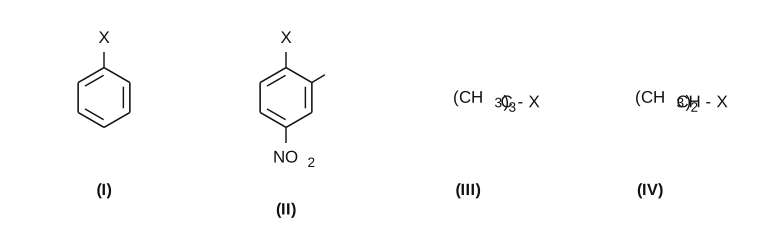
Q.The correct order of increasing reactivity of C-X bond towards nucleophile in the following compounds is
b. II < I < III < IV
c. III < IV < II < I
d. IV < III < I < II
Step 1. Sort the aryl halides first. Structure I is a plain aryl halide (X directly on an unactivated benzene ring); its C-X bond has partial double-bond character from resonance with the ring (section 10.6.7), which makes it very hard to break, so it is the least reactive of the four. Structure II is the same kind of aryl halide but with an electron-withdrawing -NO2 group on the ring; an EWG at an activating position markedly increases reactivity towards nucleophilic substitution by stabilising the reaction's anionic intermediate (section 10.6.7), so II is more reactive than I but still an aryl halide.
Step 2. Compare the two alkyl halides using the SN2 yardstick. Structure III, (CH3)3C-X, is a tertiary alkyl halide; structure IV, (CH3)2CH-X, is a secondary alkyl halide. For nucleophilic substitution reactivity assessed on the SN2 scale used throughout this chapter (Problem 10.5), reactivity runs primary > secondary > tertiary, because the SN2 transition state gets more crowded as substitution increases. So between III and IV, the secondary halide IV is more reactive than the tertiary halide III.
Step 3. Combine. Putting all four in increasing order of reactivity towards a nucleophile: I (unactivated aryl, least reactive) < II (activated aryl) < III (tertiary alkyl) < IV (secondary alkyl, most reactive).
(a) I < II < III < IV.
Unlock everything free for 14 days
- Full step-by-step solutions
- Concept-first explanations
- Methods, shortcuts & mistakes
- PYQ mapping + timed mock tests
Full access for 14 days. No credit card required.