Chemistry · Ch 10 — Halogen Derivatives
Classification of monohalogen compounds
Classification of monohalogen compounds
Monohalogen compounds are classified further by the position of the halogen atom and the hybridisation state of the carbon it is bonded to. (a) Alkyl halides (haloalkanes): the halogen is on an sp3-hybridised carbon that is part of a saturated skeleton; depending on how many other carbons that carbon is attached to, the halide is primary (R-CH2-X), secondary (R2CH-X) or tertiary (R3C-X) -- see Table 10.1 for named examples such as bromoethane and 2-chloropropane. (b) Allylic halides: the halogen sits on an sp3 carbon that is next to (allylic to) a carbon-carbon double bond, e.g. CH2=CH-CH2-X (allyl halide). (c) Benzylic halides: the halogen sits on an sp3 carbon that is itself bonded to an aromatic ring, e.g. C6H5-CH2-X (benzyl halide). (d) Vinylic halides: the halogen is bonded directly to an sp2 carbon of a C=C double bond, e.g. CH2=CH-X; a vinylic halide is a type of haloalkene. (e) Haloalkynes: the halogen is bonded to an sp carbon of a C-triple bond-C, e.g. CH(triple bond)C-X. (f) Aryl halides (haloarenes): the halogen is bonded directly to an sp2 carbon of an aromatic ring itself, e.g. chlorobenzene. This six-way split by hybridisation and position (rather than simply 'which halogen') is what actually controls each compound's chemistry later in the chapter -- for example, only alkyl, allylic and benzylic halides …
Formula -- Common name -- IUPAC name. CH2Cl2 -- Methylene chloride -- Dichloromethane. CH3CH2Br -- Ethyl bromide -- Bromoethane. CH3CH(Cl)CH3 -- Isopropyl chloride -- 2-Chloropropane. (CH3)2CH-CH2Br -- Isobutyl bromide -- 1-Bromo-2-methylpropane. (CH3)3CBr -- Tert-butyl bromide -- 2-Bromo-2-methylpropane. (CH3)3C-CH2Cl -- Neopentyl chloride -- 1-Chloro-2,2-dimethylpropane. CH2=CH-Cl -- Vinyl chloride -- 1-Chloroethene. CH2=CH-CH2Br -- Allyl bromide -- 3-Bromopropene. CH(triple bond)C-Cl -- Chloroacetylene -- Chloroethyne. C6H5-CH2I -- Benzyl iodide -- Iodophenylmethane. p-I-C6H4-CH3 -- p-Iod …
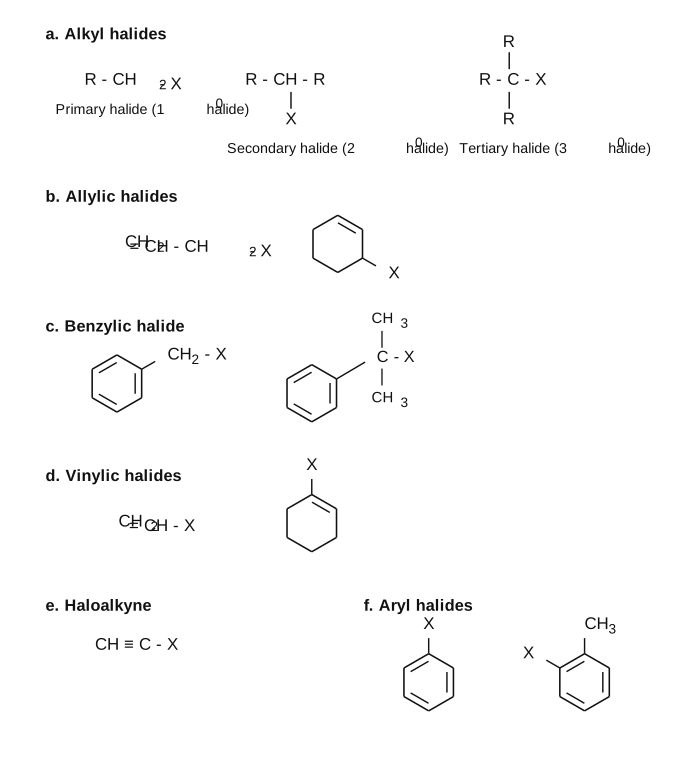
Drawn by us to help you understand the concept clearly, and verified to make sure it's accurate. For exams, practice from your textbook's own diagram.
Worked out. The substitution state of the sp3 carbon bearing the halogen defines three classes of alkyl halide: a primary (1 degree) halide has the halogen on a carbon attached to only one other carbon, written R-CH2-X; a secondary (2 degree) halide has the halogen on a carbon attached to two other carbons, written R2CH-X; and a tertiary (3 degree) halide has the halogen on a carbon attached to three other carbons, written R3C-X. This is the same substitution classification used for alcohols in the Class 11 textbook (section 14.3), just applied here to the carbon-haloge …
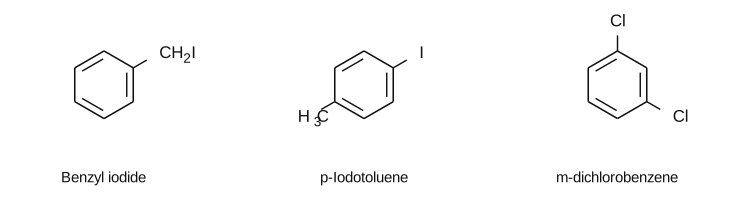
Drawn by us to help you understand the concept clearly, and verified to make sure it's accurate. For exams, practice from your textbook's own diagram.
Table 10.1's drawn rows. Three entries of the naming table are printed as ring structures rather than condensed formulas: benzyl iodide (iodophenylmethane), p-iodotoluene (1-iodo-4-methyl benzene) and m-d …