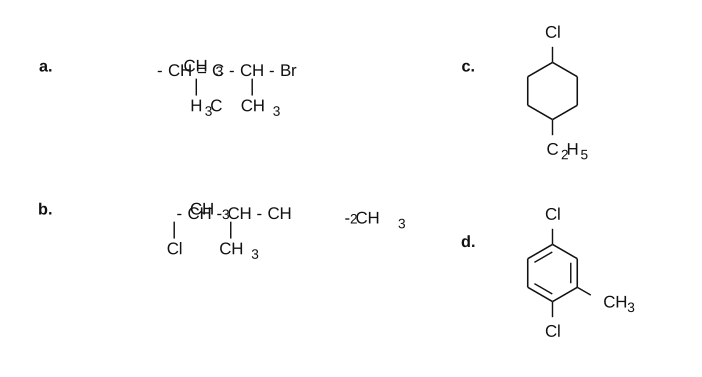
Q.Write IUPAC name of the following compounds
Concept understanding — Nomenclature of Haloalkanes
Haloalkanes carry two naming systems side by side. The common system names the alkyl group first, then adds 'halide' -- methyl iodide, ethyl bromide, tert-butyl chloride, neo-pentyl bromide -- and is still widely used for simple, well-known compounds. The IUPAC system treats the halogen exactly like any other substituent: find the longest chain containing the halogen-bearing carbon, number it to give the lowest locant set overall, and cite the halogen as a fluoro-/chloro-/bromo-/iodo- prefix in alphabetical order alongside any other substituents, e.g. CH3-CH(Cl)-CH2-CH3 is 2-chlorobutane, and (CH3)3C-CH2-Br is 1-bromo-2,2-dimethylpropane (common name neopentyl bromide). Two refinements matter for exam questions: (1) when the halogen sits on an unsaturated chain, the double/triple bond gets priority for the lowest locant over the halogen, e.g. CH2=C(CH3)-CH2-Cl is numbered from the alkene end to give 3-chloro-2-methylprop-1-ene, not the other way round; (2) for a polyhalogenated ring or chain, every halogen present gets the lowest possible LOCANT SET taken together, and the halogens themselves are then cited alphabetically (bromo before chloro before fluoro before iodo), e.g. 1-bromo-2-chloro-4-iodobenzene. A compound described only by its two alkyl substituents plus a halogen (e.g. 'diethyl chloromethane') must first be redrawn as a full structure -- CH3-CH2-CHCl-CH2-CH3 -- before the true IUPAC name (3-chloropentane) becomes obvious.
a. 4-Bromo-3-methylpent-2-ene · b. 2-Chloro-3-methylpentane · c. 1-Chloro-4-ethylcyclohexane · d. 2,5-Dichlorotoluene (1,4-dichloro-2-methylbenzene)
Name each structure by the lowest-locant rule:
- a. CH₃-CH=C(CH₃)-CH(Br)-CH₃ — a pent-2-ene chain with CH₃ at C-3 and Br at C-4: 4-Bromo-3-methylpent-2-ene
- b. CH₃-CHCl-CH(CH₃)-CH₂-CH₃ — pentane chain, Cl at C-2, CH₃ at C-3: 2-Chloro-3-methylpentane
- c. the cyclohexane ring with Cl and C₂H₅ on opposite (1,4) carbons: 1-Chloro-4-ethylcyclohexane
- d. the benzene ring with Cl, CH₃ and Cl as drawn (Cl at C-1, CH₃ at C-2 side, Cl para): 2,5-dichlorotoluene, systematically 1,4-dichloro-2-methylbenzene
4-Bromo-3-methylpent-2-ene; 2-Chloro-3-methylpentane; 1-Chloro-4-ethylcyclohexane; 1,4-dichloro-2-methylbenzene
- Pick the longest chain (or the ring), number for lowest locants to the principal characteristic, then list substituents alphabetically.
- Numbering the pentene chain from the wrong end — the double bond gets the lower locant.
- CBSE 2026Set ANNUAL1 markQ.Give the structure of 2-chloro-3-methylpentane.
›Reveal solutionSolution
2-chloro-3-methylpentane is a 5-carbon chain (pentane) with Cl on C2 and a methyl branch on C3.
Numbering the parent pentane chain C1 to C5:
- C1: CH₃
- C2: CHCl (chloro substituent here)
- C3: CH(CH₃) (methyl branch here)
- C4: CH₂
- C5: CH₃
So the structure is CH₃–CHCl–CH(CH₃)–CH₂–CH₃, where the second carbon carries the chlorine and the third carbon carries the methyl branch.
✓Final answerCH₃–CHCl–CH(CH₃)–CH₂–CH₃ (2-chloro-3-methylpentane).
- CBSE 2024Set ANNUAL1 markQ.Write the structure of the following organic halogen compound. 1, 4-Dibromobut-2-ene
›Reveal solutionSolution
But-2-ene is numbered C1-C4 with the double bond at C2=C3; substituting Br at C1 and C4 gives the structure.
Step 1: Draw the parent chain but-2-ene (4 carbons, double bond between C2 and C3):
CH3-CH=CH-CH3, numbered C1-C2=C3-C4.
Step 2: '1,4-dibromo' means a bromine substituent replaces one H each at C1 and C4.
Step 3: Combine — the structure is:
BrCH2−CH=CH−CH2Br
This is a symmetric allylic dihalide: 1,4-dibromobut-2-ene.
✓Final answerStructure: BrCH2-CH=CH-CH2Br (1,4-dibromobut-2-ene).
- CBSE 2023Set ANNUAL1 markQ.Write structural formula and IUPAC name of chloroform.
›Reveal solutionSolution
Chloroform's structural formula is CHCl₃ and its IUPAC name is trichloromethane.
Chloroform is a haloalkane in which three of the four hydrogen atoms of methane (CH₄) are replaced by chlorine atoms.
Structural formula: three Cl atoms and one H atom attached to a single central carbon — written linearly as CHCl₃.
IUPAC naming: The parent chain is methane (one carbon). Three chlorine substituents are named with the prefix 'trichloro-'; locants are unnecessary since there is only one carbon. This gives the IUPAC name trichloromethane.
Chloroform is a colourless, sweet-smelling liquid once used as an anaesthetic; it is also a common laboratory solvent.
✓Final answerStructural formula: CHCl₃; IUPAC name: trichloromethane.
- CBSE 2021Set OC1 markQ.Write the IUPAC name of CH3−CH(Cl)−CH(CH3)−CH2−CH3 (drawn with the Cl below the second carbon and the CH3 branch above the third carbon of the chain).
›Reveal solutionSolution
The parent chain is pentane, bearing a chlorine and a methyl group on adjacent carbons; numbering from the end that gives the lower locant set names it 2-chloro-3-methylpentane.
Working out the IUPAC name
The given compound CH3−CH(Cl)−CH(CH3)−CH2−CH3 has a continuous 5-carbon chain, so the parent hydrocarbon is pentane.
Numbering from the left: C1 (CH3), C2 (bears Cl), C3 (bears CH3), C4 (CH2), C5 (CH3) → substituent locants {2 (chloro), 3 (methyl)}.
Numbering from the right instead would give locants {3 (methyl), 4 (chloro)}.
Comparing the two locant sets at the first point of difference, {2,3} is lower than {3,4}, so numbering from the left (chloro at C2, methyl at C3) is correct, per IUPAC's lowest-locant rule.
Substituents are cited in alphabetical order in the name: chloro before methyl.
This gives the name: 2-chloro-3-methylpentane.
✓Final answer2-Chloro-3-methylpentane.
- CBSE 2018Set ANNUAL1 markQ.Write IUPAC name of CH3.C(C2H5)2.CH2Br.
›Reveal solutionSolution
IUPAC naming always starts by finding the LONGEST continuous carbon chain in the structure; here that chain runs through both ethyl branches (5 carbons, a pentane), leaving -CH3 and -CH2Br as two substituents on its middle carbon.
STRUCTURE: CH3-C(C2H5)2-CH2Br is a central carbon bonded to four groups: a -CH3, two -C2H5 (ethyl) groups, and a -CH2Br group. Total: 7 carbon atoms, 1 bromine.
STEP 1 - Find the longest chain: Tracing a path through the two ethyl branches AND the central carbon gives a continuous run of 5 carbons: CH3-CH2-C(...)-CH2-CH3. This is longer than the alternative path through the central carbon plus the -CH2Br arm (only 4 carbons). By the rule 'always select the longest possible continuous chain first,' the parent chain is this 5-carbon PENTANE, with the original central carbon becoming C-3 (the middle carbon, by symmetry).
STEP 2 - Identify substituents on C-3: What remains attached to C-3 (not part of the parent chain) are the original -CH3 group (a methyl substituent) and the original -CH2Br group (a bromomethyl substituent, i.e. -CH2Br treated as a compound substituent).
STEP 3 - Number and name: Since C-3 is the middle carbon of a 5-carbon chain, both substituents get locant 3 regardless of numbering direction. Citing substituents alphabetically (bromomethyl before methyl):
3-(bromomethyl)-3-methylpentane.
✓Final answer3-(Bromomethyl)-3-methylpentane.
🎓Unlock everything free for 14 days
- ✓Full step-by-step solutions
- ✓Concept-first explanations
- ✓Methods, shortcuts & mistakes
- ✓PYQ mapping + timed mock tests
Full access for 14 days. No credit card required.