Chemistry · Ch 10 — Halogen Derivatives
From hydrocarbon
From hydrocarbon
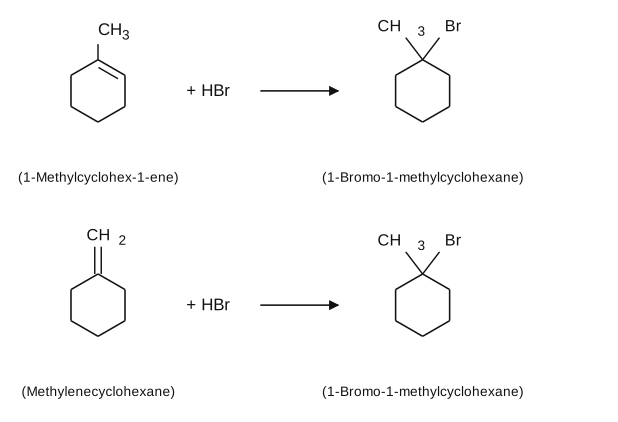
Alkyl halides can be built up from hydrocarbons instead of from alcohols. Direct free-radical halogenation of an alkane is not a practical way to make a specific alkyl halide, because it is unselective and gives a mixture of mono- and polyhalogen compounds rather than one clean product. The practical hydrocarbon-based route is addition of a hydrogen halide (HX) to an alkene: alkenes add HX according to Markovnikov's rule (H to the carbon that already carries more hydrogens, X to the more substituted carbon) under normal conditions, but add HBr specifically with the opposite, anti-Markovnikov regiochemistry when peroxides are present (the peroxide/free-radical mechanism), giving the primary bromide instead of the Markovnikov product; the full treatment of reactivity order of HX, Markovnikov's rule and the peroxide effect is in the Class 11 textbook, Chapter 15, section 15.2.4. Worked Problem 10.1 applies Markovnikov addition of HBr to 1-methylcyclohexene to build 1-bromo-1-methylcyclohexane. Alkenes can also react with chlorine or bromine themselves: at room temperature in an inert solvent like CCl4 the halogen adds across the double bond to give a vicinal dihalide, but on heating to a high temperature the same reagents instead substitute a hydrogen on the …
Drawn by us to help you understand the concept clearly, and verified to make sure it's accurate. For exams, practice from your textbook's own diagram.
Worked out. Problem: how would you obtain 1-bromo-1-methylcyclohexane starting from an alkene, and what is the alkene? Solution: Markovnikov addition of HBr places the incoming Br on the more substituted (more stable-carbocation) carbon. Starting from 1-methylcyclohexene (a cyclohexane ring with a methyl group on one double-bond carbon and the double bond between that carbon and its neighbour), addition of HBr puts Br on the ring carbon that already carries the methyl group (the more substituted carbon), giving 1-bromo-1-methylcyclohexane directly, with H adding to the other …
Worked out. When an alkene is treated with chlorine or bromine, usually in an inert solvent such as CCl4 at room temperature, the halogen adds straight across the C=C double bond to give a vicinal dihalide -- a compound with one halogen atom on each of the two carbons that were doubly bonded: C=C + X2 -> X-C-C-X (X = Cl or Br). This is a simple electrophilic addition, distinct from the substitution reactions covered later in the chapter, and it is the standard laboratory way to conve …
Worked out. If an alkene is instead heated with Br2 or Cl2 at high temperature (rather than reacted at room temperature in an inert solvent), the halogen does not add across the double bond; instead a hydrogen atom on the allylic carbon (the sp3 carbon next to the C=C) is substituted by a halogen atom, and an allyl halide is formed with the original double bond intact: for example CH2=CH-CH3 + Cl2 (heat) -> CH2=CH-CH2Cl + HCl. Temperature is therefore the deciding factor between getting an addition product (vicinal dihalide, low temperature/inert solvent) and a substitution product (allyl halide, high temp …