Chemistry · Ch 10 — Halogen Derivatives
Solubility
Solubility
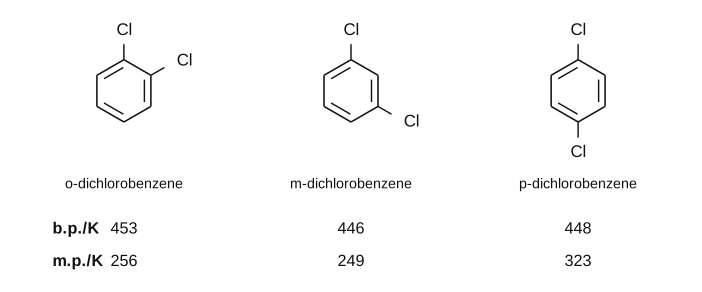
Although alkyl halides are moderately polar compounds (section 10.4.1), they are insoluble in water. This is because alkyl halides cannot form hydrogen bonds with water molecules, so the attraction between alkyl halide molecules themselves (and between water molecules themselves) is stronger than any attraction that could form between an alkyl halide molecule and a water molecule; alkyl halides are, however, readily soluble in non-polar organic solvents, where similar (van der Waals) forces operate on both sides. Aryl halides show the same basic pattern -- insoluble in water, soluble in organic solvents -- and, when not further modified by another functional group, behave much like the corresponding alkyl halides overall. One place aryl halides differ interestingly from alkyl halides is among the isomeric dihalobenzenes: the ortho, meta and para isomers of a dihalobenzene have nearly identical boiling points, but their melting points vary considerably, with the para isomer's melting point running quite a bit higher than the ortho or meta isomer's (for dichlorobenzene: b.p. 453/446/448 K but m.p. 256/249/323 K for ortho/meta/para respectively). This is because the para isomer's symmetrical structure lets it pack much more closely and regularly into a crystal lattice than the …
Drawn by us to help you understand the concept clearly, and verified to make sure it's accurate. For exams, practice from your textbook's own diagram.
Isomer data. The three dichlorobenzenes boil within a few kelvin of each other (453/446/448 K) but the para isomer melts at 323 K against 256/249 K for ortho/meta — its symmetrical structure packs the crystal lattice better, so melting nee …