Skip to content
Exercise 1.5 · Q132

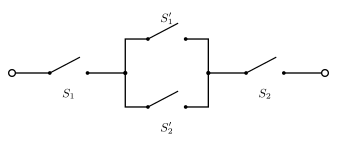
Q.Obtain the simplest logical expression of the following and draw the corresponding switching circuit: (p∧q∧∼p)∨(∼p∧q∧r)∨(p∧∼q∧r)∨(p∧q∧r)(p \wedge q \wedge \sim p) \vee (\sim p \wedge q \wedge r) \vee (p \wedge \sim q \wedge r) \vee (p \wedge q \wedge r)

Maharashtra MsbshseTextbookSubjectiveImportance★★★★★
58% · 132/227 Questions
🔒 Locked · start free trial →

You're viewing a preview — the full solution, concept, methods & PYQ mapping are locked.

Start your 14-day free trial to unlock the full solution →

Start with (p∧q∧∼p)∨(∼p∧q∧r)∨(p∧∼q∧r)∨(p∧q∧r)(p \wedge q \wedge \sim p) \vee (\sim p \wedge q \wedge r) \vee (p \wedge \sim q \wedge r) \vee (p \wedge q \wedge r).

Step 1 — the first term p∧q∧∼p=(p∧∼p)∧q≡F∧q≡Fp \wedge q \wedge \sim p = (p \wedge \sim p) \wedge q \equiv F \wedge q \equiv F by the complement law, so it drops out.

Remaining: (∼p∧q∧r)∨(p∧∼q∧r)∨(p∧q∧r)(\sim p \wedge q \wedge r) \vee (p \wedge \sim q \wedge r) \vee (p \wedge q \wedge r).

Step 2 — every remaining term contains rr, so factor it out: r∧[(∼p∧q)∨(p∧∼q)∨(p∧q)]r \wedge [(\sim p \wedge q) \vee (p \wedge \sim q) \vee (p \wedge q)].

Step 3 — inside the bracket, combine the last two terms: (p∧∼q)∨(p∧q)≡p∧(∼q∨q)≡p∧T≡p(p \wedge \sim q) \vee (p \wedge q) \equiv p \wedge (\sim q \vee q) \equiv p \wedge T \equiv p (distributive, complement, identity laws).

So the bracket becomes (∼p∧q)∨p(\sim p \wedge q) \vee p. By absorption (A∨(∼A∧X)≡A∨XA \vee (\sim A \wedge X) \equiv A \vee X with A=pA=p, X=qX=q): (∼p∧q)∨p≡p∨q(\sim p \wedge q) \vee p \equiv p \vee q. …

Unlock everything free for 14 days

  • Full step-by-step solutions
  • Concept-first explanations
  • Methods, shortcuts & mistakes
  • PYQ mapping + timed mock tests

Full access for 14 days. No credit card required.