Mathematics · Ch 5 — Vectors
Addition of Two Vectors
Addition of Two Vectors
If and are two vectors, their sum (resultant) can be constructed by either
of two equivalent laws.
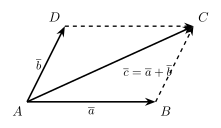
Parallelogram Law. Draw and as two adjacent
sides of a parallelogram starting from the common point . Then is the diagonal
through .
Drawn by us to help you understand the concept clearly, and verified to make sure it's accurate. For exams, practice from your textbook's own diagram.
What this figure shows. Draws a parallelogram ABCD with AB and AD as two adjacent sides representing vectors a and b starting from the same point A; the diagonal AC of the parallelogram, also starting at A, is then the sum a+b. The picture makes visible why the rule is named for a parallelogram: completing the shape from the two given sides produces the resultant automatically as the diagonal through the commo …
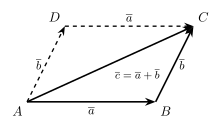
Triangle Law. Draw and then, starting exactly where the first arrow ended,
; then is the third side of the triangle, closing it back to the start. Applying the triangle law twice inside the
same parallelogram ( and ) re-derives the parallelogram law, confirming the two
are the same rule seen two ways.
Subtraction. is defined as : reverse the arrow for and add by
the triangle law. Concretely, if , and is the
point with , then
.
Rules to remember. Use the parallelogram law when two vectors act simultaneously from the same point
(e.g. two velocities/forces acting together); use the triangle law when they act one after another (e.g.
consecutive displacements). Adding a vector to its own negative always gives ; in any triangle ,
because the path returns to its start.
Addition of vectors is commutative () and associative
(), is the additive identity (),
is the additive inverse (), and for scalars : , , . Finally, the Triangle Inequality follows because one side of a triangle is never longer than
the sum of the other two; and any two vectors span a plane in which and
both lie.
Polygon (extended) law. For vectors placed tip-to-tail around a polygon, repeated use of
the triangle law collapses the whole sum to the single vector spanning start to end:
.
Worked examples.
- In a polygon with , the polygon law gives, e.g., , and similarly (found from the triangle law in ), while is built by chaining several triangle-law steps together.
- Midpoint theorem by vectors. If are midpoints of sides of , then and , so …
Drawn by us to help you understand the concept clearly, and verified to make sure it's accurate. For exams, practice from your textbook's own diagram.
What this figure shows. Draws a triangle ABC where side AB represents vector a and the next side BC (starting exactly where AB ended) represents vector b; the third side AC, closing the triangle back to the start, represents the sum a+b. This tip-to-tail construction is the most common way students are taught to add two vectors, and the text also uses the same triangle (relabelled through vertex D) to re-derive the parallelogram result, tying the two laws together as one …