Mathematics · Ch 5 — Vectors
Coplanar Vectors
Coplanar Vectors
Two or more vectors are coplanar if they can be drawn lying in a single plane, or in mutually parallel
planes.
Theorem (a vector coplanar with two non-collinear vectors). If are non-collinear, a vector
is coplanar with and if and only if there exist unique scalars with
. Sketch of proof: place along and along
; for , draw a line through parallel to meeting line
at , and a line through parallel to meeting line at ; then
for some scalars , and the
parallelogram/triangle law gives .
Uniqueness follows because if also equalled , subtracting gives
, and since are non-collinear this forces
.
A combination (with the scalars, at least one non-zero) is
called a linear combination of ; in particular, for ,
the three vectors are automatically coplanar.
Theorem (three coplanar vectors). are coplanar if and only if there is a non-zero
combination (i.e. ). If instead are
not coplanar, the only solution of is -- such vectors are
called linearly independent (and non-coplanar); when a non-zero solution exists, they are linearly dependent (and coplanar).
Worked examples.
- To show are coplanar, write the first as times the second plus times the third, match coefficients to get three equations, solve any two for and check the third is automatically satisfied -- here …
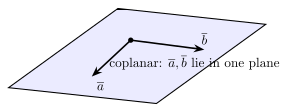
Drawn by us to help you understand the concept clearly, and verified to make sure it's accurate. For exams, practice from your textbook's own diagram.
What this figure shows. Draws several arrows lying flat within one shaded plane (or within two parallel sheets) to make the idea of coplanarity visually concrete: any two of the arrows drawn in that same flat sheet are automatically coplanar with each other, while an arrow poking out of the sheet at an angle is not coplanar with the ones lying in it. This is the geometric picture behind the later algebraic test that a third vector lying in the plane of two others must be some …